 ARCORA FAUCETS
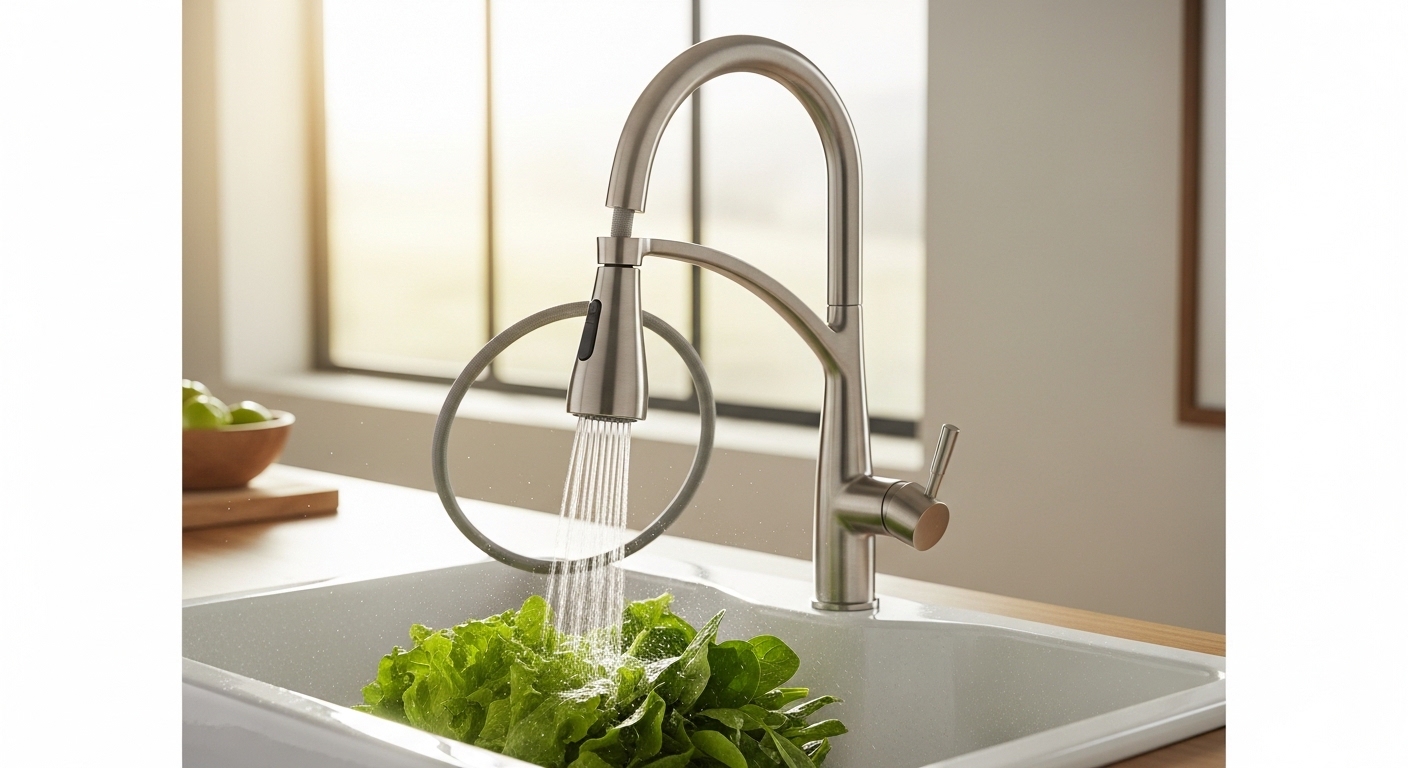
If you’ve been Googling “best pull down kitchen faucet” at 11 p.m. while scrubbing tomato sauce off a cast-iron pan, this guide is for you. A pull down kitchen faucet is the workhorse most American households actually need — the spray head pulls straight down into the sink, gives you reach across a double basin, and (with the right model) makes rinsing a sheet pan a 10-second job instead of a wrist-cramping ordeal. Below, we break down what genuinely matters in 2026, what’s marketing fluff, and which configurations make sense for which kitchens and budgets.
What actually makes a pull-down faucet “the best” — and not just expensive?
The best pull-down faucet is the one that nails five things: a solid-brass body (not zinc), a ceramic disc cartridge, a magnetic or counter-weighted dock that actually retracts the hose, a dual-function sprayer (stream + rinse) with at least 1.5 GPM flow, and a finish backed by PVD coating or equivalent. Everything else — touchless sensors, voice control, LED lights — is a nice-to-have, not a deal-breaker.
Here’s why those five matter in practice. Zinc-bodied faucets crack at the threads within 3–5 years under hard water. Rubber-disc cartridges (the kind in $40 big-box specials) start dripping within 18 months. A weak dock means the spray head sags an inch below the spout after six months, which looks terrible and signals the inevitable hose replacement. And a single-function aerator-only sprayer is useless for rinsing rice off plates — you need that punchy rinse jet.
What “solid brass” really means (and how to spot fakes)
“Solid brass” should mean the spout, body, and waterway are all forged brass — not a brass-plated zinc shell. Pick up the faucet box at the store: a true solid-brass pull-down weighs 6–9 pounds. A zinc one weighs 3–4 pounds. If a manufacturer brags about being “lead-free brass” and provides an NSF/ANSI 372 certification number, that’s a good sign. Reputable brands like Arcora list the exact certification on the product page; we hold NSF/ANSI 61 and 372 for waterway safety across our pull-down line.
Pull-down vs. pull-out vs. commercial-style: which one fits your sink?
A pull-down faucet has a high-arc spout with the spray head that pulls vertically downward — best for deep, wide sinks. A pull-out is a lower-profile spout where the head pulls horizontally toward you — better for shallow sinks under low windows. A commercial/spring-coil faucet is a pull-down on steroids with a visible spring — dramatic look, but it needs 28+ inches of clearance and a strong sink base. Most American kitchens (60%+ of installs we ship) are best served by a standard pull-down.
| Type | Best for | Clearance needed | Typical price range | Downside |
|---|---|---|---|---|
| Pull-Down | Deep single or double basins, standard kitchens | 18–22 inches above counter | $150–$400 | Hose can sag if dock is weak |
| Pull-Out | Shallow sinks, low window sills, small kitchens | 10–14 inches | $120–$300 | Less reach, less rinse power |
| Commercial Spring-Coil | Large farmhouse sinks, statement kitchens | 28+ inches | $250–$700 | Dramatic; can hit upper cabinets |
| Articulating / Industrial | Pro-style kitchens, heavy washing | 24+ inches | $350–$900 | Overkill for most homes |
If you’ve ever wondered whether this style still fits modern aesthetics, the short answer is yes — and we cover it more fully in our take on whether pull-down kitchen faucets are out of style in 2026. Spoiler: they’re not. They’ve just gotten sleeker.
How much should I actually spend on a pull-down kitchen faucet?
For a daily-use family kitchen, spend $180–$320. Under $100, you’re getting zinc bodies, plastic waterways, and cartridges that fail in two years. Over $500, you’re mostly paying for brand prestige (Kohler, Brizo, Waterstone) — not better function. The $180–$320 band is where you get full brass, ceramic disc, magnetic dock, and a lifetime warranty without paying a designer markup.
That said, there are situations where splurging makes sense — a rental property is the opposite of where you’d splurge, while a forever-home renovation might be. We dig into the calculus of when to splurge vs. save on faucets in detail, and the gap between budget faucets and high-end faucets is narrower than most people assume — if you know what to look for.
What you’re paying for at each price tier
- Under $100: Zinc body or thin brass-plate, rubber cartridge, plastic waterway, weak gravity-only dock. Expect 2–4 years of life. Fine for a rental unit you’ll flip.
- $100–$180: Mixed brass/zinc, ceramic cartridge, basic magnetic dock, decent PVD finish on chrome or stainless. Good 5–7 year faucet for a starter home.
- $180–$320 (sweet spot): Full solid brass, German or Sedal ceramic cartridge rated 500,000 cycles, strong magnetic dock, dual-spray, lifetime limited warranty. 10–15 year lifespan. This is where Arcora’s flagship pull-downs sit.
- $320–$500: Premium finishes (matte black, brushed gold, champagne bronze), occasional smart features (motion sensor, voice control), brand recognition. Real-world durability is similar to the sweet-spot tier.
- $500+: Luxury brands, made-in-USA brass, hand-finished. You’re buying jewelry that washes dishes.
Which finish holds up best over 10 years of daily use?
Stainless steel and PVD-coated brushed nickel hold up best — they hide water spots, resist fingerprints, and don’t show wear on the handle pivot. Polished chrome shows every droplet but is the most scratch-resistant. Matte black looks stunning at install but shows hard-water buildup within months if you live anywhere with calcium in your water. Brushed gold and champagne bronze are durable in PVD but limited in resale-friendliness if you ever sell the house.
If you’re agonizing over whether to go shiny or matte, our breakdown of shiny vs. matte faucet looks walks through the maintenance differences honestly. Quick rule of thumb: matte finishes look incredible in design photos but require gentler cleaning — no abrasive pads, no vinegar soaks, just mild soap and a soft cloth. If you have well water or live in cities like Phoenix, Las Vegas, or Indianapolis with notoriously hard water, stainless steel or brushed nickel will be more forgiving day-to-day.
Is matte black still a smart choice in 2026?
Yes, but with caveats. Matte black peaked around 2021–2023 and remains popular, but designers in 2026 are mixing finishes more — black faucet with brass cabinet pulls, for example. If you want a matte black pull-down, look for one with a PVD (Physical Vapor Deposition) coating, not paint. PVD is essentially a vacuum-bonded metallic layer; paint chips within a year. We covered this finish question in our look at matte black finish in 2025 and beyond.
What features actually matter in a pull-down — and which are gimmicks?
Worth-it features: magnetic dock, dual-spray (stream/rinse), 360° swivel, ceramic disc cartridge, braided stainless hose, single-handle temperature control. Skip-it features (for most people): touchless motion sensors (unreliable in sunny kitchens), voice-controlled water dispensing, LED temperature lights, “smart” app integration. Those gimmicks add $100+ and are the first things to fail.
The exception: if you cook with raw chicken or are immunocompromised, a touch-on or touchless faucet is genuinely useful. Just expect to replace the sensor module within 5–7 years.
Single-handle vs. double-handle pull-downs
For a pull-down, go single-handle. 99% of pull-downs are single-handle for a reason — you usually have one hand free, and you’re often holding a dish. A double-handle pull-down forces a weird reach and adds an extra hole in your countertop that limits future fixture swaps.
How do I know if it’ll fit my sink (and what about installation)?
Before buying, measure three things: the number of mounting holes in your sink/counter (1, 2, 3, or 4-hole), the depth of cabinet clearance below the sink (you need at least 14 inches of vertical space), and the distance from the wall behind the faucet to any window or backsplash. Most pull-downs are single-hole, but they include an optional escutcheon (deck plate) to cover 3-hole sinks.
Installation is usually a 45–90 minute DIY job if you’re handy. The trickiest part isn’t the faucet itself — it’s removing the old one. Decades of mineral buildup can fuse the old mounting nut to the threads. Our guide on removing an old faucet covers the technique with a basin wrench and penetrating oil; the same approach works for kitchen models. And if you’ve been hearing odd noises, don’t assume it’s the new faucet — a whistling kitchen faucet is usually an aerator or supply-line issue, not a defect.
Universal fit — true or marketing?
Mostly true, with one caveat. Standard US sinks use 1-3/8″ mounting holes and 1/2″ NPT supply connections, which most pull-down faucets match. But European and some commercial sinks use different standards. We unpack this fully in are all faucets universal fit? — short version: 95% of US homes are plug-and-play; verify before ordering if you have a European import sink.
What about water flow, GPM, and hard-water performance?
Federal max flow is 2.2 GPM (gallons per minute), but most modern pull-downs ship at 1.5–1.8 GPM to meet WaterSense standards while still feeling powerful. California, Colorado, Washington, Georgia, and a handful of other states require 1.8 GPM or lower. Don’t fall for “high-flow” claims promising 2.5+ GPM — those are illegal to sell in the US for new installs.
For hard water, look for a faucet with a removable, rubberized aerator face — you can wipe limescale off the spray nozzles with your thumb. Avoid faucets with deeply recessed metal aerators that require disassembly to clean. Even with a good faucet, mineral buildup is inevitable in hard-water zones; our walkthrough on removing limescale naturally uses white vinegar and a plastic bag — takes about an hour and adds years to the spray performance.
How long should a good pull-down kitchen faucet last?
A quality pull-down should last 10–20 years with basic maintenance. The cartridge (the part that controls water flow) is the first to wear, usually around year 7–10, and is a $25–$50 replacement part. The pull-down hose is the second wear point, typically year 8–12. Both should be covered under a lifetime limited warranty from any reputable manufacturer, including Arcora — we ship cartridge and hose replacements free for the original owner.
Signs your current pull-down is on its last legs: persistent drip after the handle is fully closed, mineral crust around the base that won’t scrub off, sprayer that won’t retract fully, or a wobbly handle. The full diagnostic checklist is in how to tell if your faucet needs replacement.
Our top 5 pull-down kitchen faucet picks for 2026 (and who they’re for)
- Best overall family pick ($220–$280): A solid-brass pull-down with magnetic dock, dual-spray, brushed nickel PVD, single-handle. This is the no-regrets choice for 80% of households. Arcora’s flagship pull-down lives in this bracket.
- Best budget ($120–$160): A mid-tier brass/zinc hybrid with ceramic cartridge and basic magnetic dock. Stainless or chrome only — skip premium finishes at this tier.
- Best for hard water ($200–$260): Look for a wipe-clean rubber aerator face, brushed nickel finish, and replaceable spray nozzles.
- Best touchless ($300–$420): Worth it only if you cook a lot of raw meat. Look for a 5-year sensor warranty minimum.
- Best statement piece ($350–$600): Spring-coil commercial style in matte black or champagne bronze. Verify ceiling/cabinet clearance before ordering.
FAQ
What’s the difference between a pull-down and a pull-out faucet?
A pull-down has a high arc and the spray head pulls vertically down into the sink — best for deep basins. A pull-out has a lower profile and the head pulls horizontally toward you — best for shallow sinks or low window sills. Pull-downs generally have better rinse power; pull-outs are more compact.
Are pull-down kitchen faucets reliable, or do the hoses break?
Quality pull-downs with braided stainless-steel hoses (not plastic-coated) are very reliable — typical hose life is 8–12 years. The failure mode is usually the dock weakening (sagging spray head) before the hose actually leaks. Avoid models with thin nylon hoses, and check that the warranty explicitly covers the hose.
Do I need a plumber to install a pull-down kitchen faucet?
Not usually. If you can use a basin wrench, shut off your supply valves, and follow a 4-step instruction sheet, you can install one in under 90 minutes. The exception: if your shut-off valves are corroded or you have galvanized supply lines, call a plumber to avoid flooding your kitchen.
What GPM is best for a pull-down kitchen faucet?
1.8 GPM is the sweet spot — strong enough to rinse a pot quickly, low enough to comply with WaterSense and California Title 20. 1.5 GPM is fine for light cooking; 2.2 GPM (the federal max) is overkill and wastes water.
Is a magnetic dock really better than a gravity dock?
Yes, significantly. Gravity docks rely on the weight of the spray head to seat back into the spout — they sag noticeably within 12 months as the silicone seal compresses. Magnetic docks use a neodymium magnet to snap the head into place crisply, even after years of use. It’s a $20 cost difference at manufacturing and worth every cent.
Can a pull-down kitchen faucet be used with a reverse-osmosis or filtered water system?
Yes, but you’ll typically run a separate dedicated faucet for RO water. Some pull-downs have a 3-way option (hot, cold, filtered) but they’re rare and pricey. For most homes, install your pull-down in the main hole and add a small filtered-water faucet in the soap-dispenser hole.
How do I keep a pull-down kitchen faucet looking new?
Wipe it down with a damp microfiber cloth daily, and once a month do a vinegar-water soak on the aerator. Skip abrasive sponges, bleach, and ammonia-based cleaners — they pit PVD finishes. For stubborn spots on matte black, use a drop of dish soap on a soft cloth.
About Arcora
Arcora is a faucet and bathroom-fixtures brand serving North American homeowners since 2014. Every Arcora kitchen and bath faucet is third-party tested to NSF/ANSI 61 (drinking water system components) and NSF/ANSI 372 (lead-free compliance), and ships with a limited lifetime warranty on the body and finish. Our pull-down kitchen faucets are pressure-tested to 500,000 open-close cycles — roughly 60 years of typical household use — before they leave the factory.
Author note: This guide was written by the Arcora editorial team in consultation with our product engineering and customer-service teams, who collectively handle more than 40,000 kitchen-faucet installations and warranty interactions per year. We update this article quarterly based on real customer feedback and field-failure data.