 ARCORA FAUCETS
If you’ve been comparing spec sheets and wondering what is considered a low flow kitchen faucet, here’s the honest, no-fluff version: it comes down to one number on the box — the GPM rating. Anything rated at 1.5 GPM or lower is generally marketed and certified as low flow. That single number determines how much water leaves the spout every minute, how fast your pot fills, how much you spend heating water, and whether the faucet qualifies for water-efficiency labels and rebates. Below, we’ll break down exactly where the line sits, what the different numbers actually feel like at the sink, and how to pick one that doesn’t leave you frustrated.
What GPM Counts as “Low Flow” — and Where’s the Cutoff?
Low flow starts at 1.5 GPM or below, measured at 60 pounds per square inch (psi) of water pressure. That’s the practical industry cutoff. To understand why 1.5 is the magic number, you need to know the three benchmarks that faucets are measured against.
The U.S. federal maximum for a kitchen faucet is 2.2 GPM at 60 psi — no new faucet sold in the country is allowed to exceed that. Older faucets from before the tightened rules often ran 2.5 GPM or higher. And the water-efficiency sweet spot that earns the WaterSense-style “high efficiency” reputation lands at 1.5 GPM or less. So the landscape looks like this:
| Flow Rate (GPM) | Category | What It Means |
|---|---|---|
| 2.5+ GPM | Legacy / pre-regulation | Old faucets; wastes water and energy |
| 2.2 GPM | Federal maximum (standard) | The legal ceiling for new kitchen faucets |
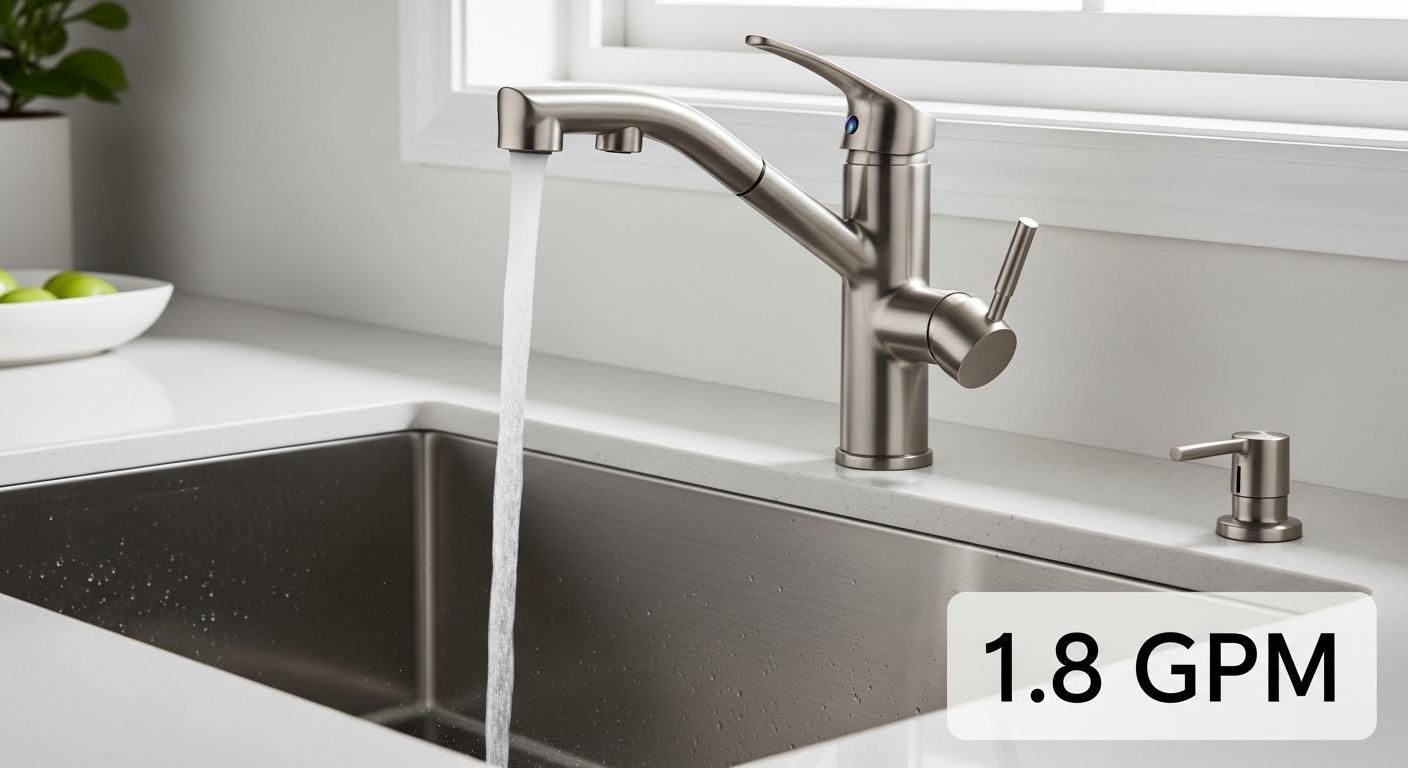
| 1.8 GPM | Efficient | A common “eco” middle ground |
| 1.5 GPM | Low flow | The widely accepted low-flow threshold |
| 1.0–1.2 GPM | Ultra low flow | Maximum savings; can feel weak for filling pots |
One important note for the kitchen specifically: bathroom faucets are held to a stricter federal cap of 2.2 GPM as well, but many efficiency programs push bathroom faucets down to 1.5 or even 1.2 GPM. Kitchen faucets are treated a little more generously because you actually need volume to fill pots, wash produce, and rinse dishes. That’s why a lot of manufacturers land on 1.8 GPM for the kitchen as a compromise — noticeably more efficient than 2.2, but not as stingy as a 1.5 GPM bathroom-style flow.
How Much Water Does a Low Flow Kitchen Faucet Actually Save?
Switching from a 2.2 GPM faucet to a 1.5 GPM model cuts your flow by about 30% — and since roughly two-thirds of what comes out of a kitchen tap is heated water, you’re also trimming your water-heating bill, not just the water bill. That’s the part people forget: the biggest savings from a low flow faucet often show up on your gas or electric bill, because you’re heating less water.
Let’s put real numbers on it. Say your household runs the kitchen faucet a total of 30 minutes a day between dishes, rinsing, and cooking:
- At 2.2 GPM: 30 min × 2.2 = 66 gallons per day → about 24,000 gallons a year.
- At 1.5 GPM: 30 min × 1.5 = 45 gallons per day → about 16,400 gallons a year.
- The difference: roughly 7,600 gallons saved per year — plus the energy to heat a good chunk of it.
For most households, the water and energy savings pay back the modest cost of a new aerator or faucet within the first year. And you don’t necessarily need a whole new faucet to get there — more on that in a second.
Does a Low Flow Faucet Mean Weak, Annoying Water Pressure?
No — and this is the biggest myth about low flow. A well-designed low flow faucet doesn’t lower your pressure; it lowers the volume while keeping the stream feeling strong. The trick is the aerator, the little screened cap on the end of the spout.
An aerator mixes air into the water, so a 1.5 GPM stream feels almost as forceful as a 2.2 GPM one — you get the same “push” against a dirty pan with less actual water. If you’ve ever wondered how that screen does its job or whether yours is clogging up and choking your flow, we break it down in our guide to what faucet aerator mesh is and whether to clean or replace it. A clogged aerator, ironically, is the number-one reason a perfectly good faucet feels weak.
There is a real distinction worth knowing about, though:
- Aerated flow: air mixed in, softer, splash-resistant stream. Great for everyday washing. This is what most low flow kitchen faucets use.
- Laminar flow: a clear, solid, non-aerated column of water. Fills pots faster and is preferred in some settings, but splashes more and doesn’t disguise low volume as well.
If your home already struggles with weak flow before you even install a restrictor, the problem may be your plumbing or supply pressure, not the faucet. It’s worth reading why tap low water pressure suddenly gets worse and how to fix it before you blame a low flow rating — sometimes the fix is a shut-off valve that isn’t fully open or mineral buildup, not the GPM spec.
How Do I Find Out My Current Faucet’s Flow Rate?
Check the aerator or the spec sheet first — the GPM is usually stamped right on the side of the aerator or printed in the manual. If you can’t find it, you can measure it yourself in under a minute with a measuring jug.
Here’s the quick DIY method:
- Grab a measuring container marked in cups or ounces (a large glass measuring cup works).
- Turn the faucet on full hot-and-cold to its maximum.
- Time how many seconds it takes to fill exactly one quart (32 oz).
- Divide 15 by that number of seconds. The result is your GPM. (Example: fills a quart in 10 seconds → 15 ÷ 10 = 1.5 GPM.)
If the number comes out at 2.2 or higher, you’re running a standard or legacy faucet and there’s real savings on the table. If it’s already 1.5 or under, congratulations — you’ve already got a low flow setup.
Can I Make My Existing Faucet Low Flow Without Buying a New One?
Yes — swap the aerator. In most cases you can convert a standard faucet to low flow for just a few dollars by replacing the existing aerator with a 1.5 GPM (or lower) one. Aerators unscrew from the spout tip and are sold in standard male and female threads at any hardware store.
This is the cheapest water-saving upgrade in the entire house. A low flow aerator costs a couple of dollars, screws on in 60 seconds with your hand (or a wrapped pliers if it’s stuck), and instantly drops your kitchen faucet to the low flow tier. The catches:
- You need the right thread size and gender — measure or bring your old aerator to the store to match it.
- Pull-down and pull-out spray heads sometimes have built-in, non-removable aerators, so you can’t always swap them; on those you’d need a new spray head or a new faucet.
- Very old faucets with worn valves may still drip regardless of the aerator — a flow fix won’t cure a leak.
If you’re already shopping for a new faucet rather than retrofitting, it’s worth choosing one that’s efficient and genuinely convenient. Our roundup of the best pull down kitchen faucet for a busy family kitchen covers models that balance a lower GPM with a strong, usable spray — which is exactly the combination that keeps low flow from feeling like a downgrade.
Is a Low Flow Kitchen Faucet Worth It, or Will I Regret It?
For the vast majority of kitchens, a 1.5 GPM low flow faucet is absolutely worth it — you save water and energy while barely noticing a difference at the sink. The one scenario where you might want to think twice is if you fill large stockpots constantly (canning, big-batch cooking) and hate waiting the extra few seconds. In that case, 1.8 GPM is a smart middle ground.
Here’s how to decide based on how you actually use your kitchen:
| Your Situation | Recommended Flow | Why |
|---|---|---|
| Standard household, dishes and rinsing | 1.5 GPM | Best savings, no real downside |
| Heavy cook, fills big pots often | 1.8 GPM | Fills faster, still efficient |
| Drought region / rebate available | 1.2–1.5 GPM | May qualify for water utility rebates |
| Very low home water pressure | 1.8–2.2 GPM | Keeps a usable stream when psi is low |
That last row matters. If your home already runs at low static pressure (under ~40 psi), pushing down to an ultra-low 1.0 GPM aerator can leave you with a genuinely disappointing trickle. Low flow works best when your incoming pressure is healthy, because the aerator relies on decent pressure to build that airy, forceful stream. Match the faucet to your plumbing, not just to the biggest number on the water-savings chart.
What About Rebates, Standards, and Certifications?
Look for the water-efficiency label and a solid warranty — those two things separate a real low flow faucet from a cheap one that just chokes the water. Reputable low flow kitchen faucets are independently tested to certification standards (like the ASME A112.18.1 / CSA B125.1 plumbing standards and NSF/ANSI 61 for drinking-water safety) so that the 1.5 GPM you’re promised is the flow you actually get, and the materials touching your water are lead-safe.
Many local water utilities also offer rebates for installing WaterSense-labeled or verified low flow fixtures, especially in drought-prone regions. It’s worth a two-minute check of your water provider’s website before you buy — a rebate can effectively make the upgrade free. Just keep the receipt and the model number, since rebate programs usually require proof that the fixture meets the 1.5 GPM (or lower) threshold.
A quick note from our team
Author note: This guide was written by the Arcora product team, who design, test, and sell kitchen and bathroom faucets full-time. We flow-test our own faucets on calibrated rigs at 60 psi to confirm real-world GPM, and every Arcora kitchen faucet is built to the ASME/CSA plumbing standards and backed by our warranty. We wrote this because the “low flow means weak water” myth costs people real money in wasted water and energy — and a properly built low flow faucet simply doesn’t have that problem. When in doubt, match your GPM to your pressure and how you cook, and you’ll be happy with the result.
FAQ
What GPM is considered low flow for a kitchen faucet?
1.5 GPM or lower at 60 psi is the widely accepted low flow threshold for kitchen faucets. The federal maximum is 2.2 GPM, so anything at or under 1.5 GPM is meaningfully more efficient. Ultra-low-flow models drop to around 1.0–1.2 GPM but can feel weak for filling large pots.
Is 1.8 GPM considered low flow?
1.8 GPM is best described as “efficient” rather than true low flow. It’s noticeably better than the 2.2 GPM standard cap, but it doesn’t hit the 1.5 GPM line that most water-efficiency programs use to define low flow. It’s a good middle ground if you fill big pots often and don’t want to wait extra seconds.
Will a low flow faucet make my water pressure weak?
No. A low flow faucet reduces water volume, not pressure. A quality aerator mixes air into the stream so a 1.5 GPM flow feels nearly as forceful as 2.2 GPM. If your faucet already feels weak, the usual culprit is a clogged aerator or genuinely low household water pressure, not the flow rating itself.
Can I convert my current kitchen faucet to low flow?
Usually yes — just replace the aerator with a 1.5 GPM (or lower) one for a couple of dollars. Aerators unscrew from the spout tip. The main exception is pull-down and pull-out spray heads with built-in, non-removable aerators, where you’d need a new spray head or a new faucet instead.
Do low flow kitchen faucets qualify for rebates?
Often, yes. Many local water utilities offer rebates for WaterSense-labeled or verified low flow fixtures, particularly in drought-prone areas. Check your water provider’s website before buying, and keep the receipt and model number as proof that the faucet meets the 1.5 GPM threshold.
What’s the difference between aerated and laminar flow?
Aerated flow mixes air in for a softer, splash-resistant stream that hides low volume well — ideal for a low flow faucet. Laminar flow is a clear, solid column of water that fills pots faster and splashes less at the bottom, but it doesn’t disguise reduced volume as effectively. Most low flow kitchen faucets use aerated flow.