 ARCORA FAUCETS
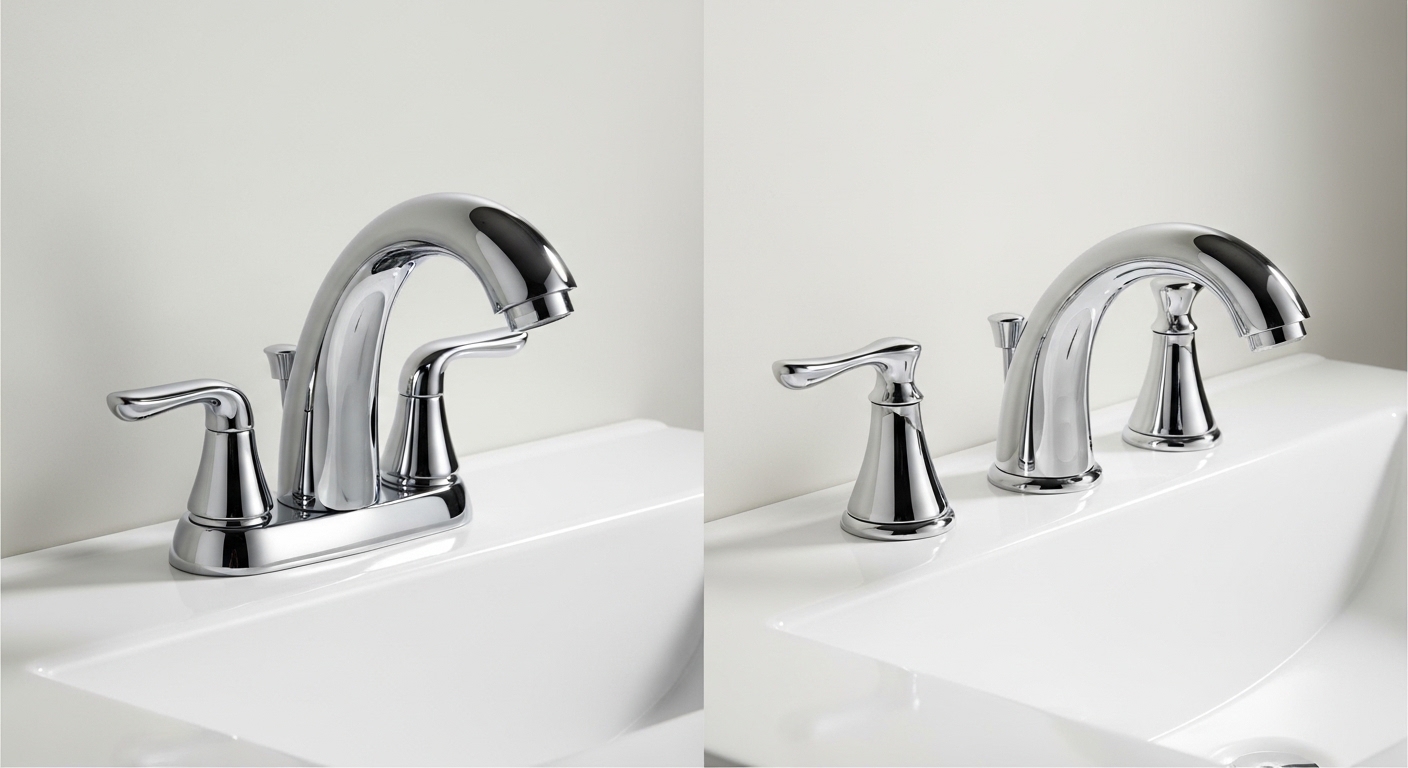
If you’re trying to replace centerset faucet with widespread hardware, the very first thing to check isn’t the faucet — it’s the sink. Centerset and widespread faucets are measured by the same number (hole spacing), but they usually mean two completely different distances. Get that number wrong and you’ll be standing at the return counter, or worse, holding a drill over your porcelain sink. This guide walks you through exactly what to measure, when the swap is easy, when it’s a real project, and how to do it right so you don’t spring a leak six months later.
Arcora has spent years engineering bathroom faucets for real American vanities, and we test every widespread valve body to industry flow and durability standards before it ships. So this isn’t generic advice — it’s what we tell customers who call in asking whether their sink can take the upgrade.
What’s the actual difference between a centerset and a widespread faucet?
A centerset faucet is one connected unit — spout and both handles sit on a single base plate, and the mounting holes are 4 inches apart (center of the outer holes). A widespread faucet is three separate pieces — the spout and each handle mount independently, with the outer holes typically 8 to 16 inches apart. That gap is the whole story: a centerset is “4-inch spread,” a widespread is “8-inch spread.”
Because the pieces are separate on a widespread, the spout and handles connect underneath the sink with flexible supply lines and a T-connector, not a rigid shared body. That’s what lets you spread the handles wide and gives that custom, upscale look. It also means installation involves a couple more connections down in the cabinet.
- Centerset (4″): One-piece or base-plate design, three holes 4 inches apart (or a single-hole faucet on a deck plate). Common on smaller vanities and builder-grade sinks.
- Widespread (8″): Three independent pieces, outer holes 8 inches apart. Common on mid- to high-end vanities and anywhere someone wanted a more tailored look.
- Mini-widespread (4″): Looks like a widespread — three separate-looking pieces — but the holes are only 4 inches apart. This is the secret weapon for centerset conversions, and we’ll come back to it.
Can I put a widespread faucet where my centerset faucet is now?
Only if your sink already has three holes drilled 8 inches apart. This is the make-or-break question, and most centerset installations fail it — standard centerset sinks have their outer holes just 4 inches apart, which is far too narrow for a true 8-inch widespread spout and handles to reach. You physically cannot bridge that gap with a standard widespread.
So before you buy anything, measure. Grab a tape measure and find the distance from the center of the left hole to the center of the right hole:
- 4 inches apart: You have a centerset deck. A true 8″ widespread will not fit. Your options are a mini-widespread (4″ spread) or re-drilling the sink.
- 8 inches apart: Great news — a widespread faucet drops right in. This is a clean swap.
- Single hole only: You’ll need a single-hole faucet, or a deck plate to cover the extra space.
If you’re not 100% sure how to read hole spacing or how many holes you’re working with, our guide on what hole size is needed for a faucet breaks down the measurements before you commit to a purchase. Measuring twice here saves you a return and a headache.
What if my sink only has holes 4 inches apart?
Buy a mini-widespread faucet — it gives you the separated three-piece look on a 4-inch hole layout, no drilling required. This is the answer for the vast majority of people converting from a centerset. A mini-widespread has an independent spout and two handles just like a full widespread, but the connecting hardware underneath is sized for 4-inch spacing. From the top, most guests can’t tell the difference.
The alternative — drilling new holes to create an 8-inch spread — is only realistic on certain materials. You can drill through a stainless steel or thin porcelain-on-steel sink with a diamond hole saw, but drilling cast iron, fireclay, or a vitreous china pedestal risks cracking the whole basin. If your sink is porcelain or the vanity top is stone, we strongly recommend the mini-widespread route or replacing the sink entirely rather than gambling on a drill. The cost of a cracked $300 sink dwarfs the price of the right faucet.
Widespread vs. mini-widespread vs. centerset: which should I actually buy?
Match the faucet to your existing hole spacing first, then to your style. Here’s the honest breakdown of what fits what, so you can buy once:
| Faucet type | Hole spacing needed | Look | Best for | Install difficulty |
|---|---|---|---|---|
| Centerset (4″) | 4 inches (3 holes) or 1 hole + plate | Compact, connected | Small vanities, budget builds, rentals | Easy |
| Mini-widespread (4″) | 4 inches (3 holes) | Separated, upscale | Upgrading a centerset without drilling | Easy–Moderate |
| Widespread (8″) | 8 inches (3 holes) | Separated, wide, custom | Larger vanities already drilled at 8″ | Moderate |
| Single-hole | 1 hole (plate covers extras) | Modern, minimal | Covering unwanted holes fast | Easy |
Notice the pattern: if your sink is drilled at 4 inches, your realistic upgrade path is a mini-widespread, not a true widespread. Everyone wants the wide 8-inch spread because it photographs beautifully, but the hole spacing on your sink decides for you. Don’t fall in love with a faucet until you’ve confirmed it fits your deck.
How do I actually replace a centerset faucet with a widespread — step by step?
Assuming your holes match your new faucet (8″ for widespread, 4″ for mini-widespread), the swap takes about 1 to 2 hours with basic tools. Here’s the sequence that avoids the two classic mistakes — flooding the cabinet and cross-threading a connection.
- Shut off the water. Turn the two shutoff valves under the sink clockwise until they stop. Open the old faucet to release pressure and confirm the water’s actually off. Put a bucket and towel underneath.
- Disconnect the supply lines. Use a basin wrench to loosen the hot and cold supply lines from the old faucet’s tailpieces. Expect a little residual water.
- Remove the old centerset faucet. Unscrew the mounting nuts underneath and lift the old faucet out from the top. Old faucets can be stubborn from corrosion — if it won’t budge, our walkthrough on how to remove an old bathroom faucet covers freeing seized nuts without damaging the sink.
- Clean the deck. Scrape off the old plumber’s putty or gasket residue and wipe the surface dry. A clean deck is what makes the new seal watertight.
- Set the new spout and handles. Drop the spout into the center hole and each handle valve into the outer holes. Secure them from below with the included mounting nuts. Hand-tighten, then snug with a wrench — don’t overtighten and crack the deck.
- Connect the T-fitting and supply lines. A widespread routes hot and cold from the handle valves into a central spout via a T-connector or flexible hoses. Connect these first, then attach the supply lines from the shutoff valves to the hot and cold inlets. Wrap threads with plumber’s tape.
- Turn the water back on and test. Open the shutoffs slowly. Run hot and cold, then check every connection underneath for drips. Tighten a quarter-turn more if you see moisture.
If you’ve never worked under a sink before, the general flow is similar to swapping any bathroom faucet — our guide on how to change a bathroom faucet yourself without a plumber shows the tool basics and the shutoff-valve routine in more detail.
What tools and materials do I need?
Keep it simple — you likely have most of this already. The one specialty tool worth owning is a basin wrench; it reaches the nuts a normal wrench can’t in the tight space behind the sink.
- Basin wrench and an adjustable wrench
- Bucket, towels, and a flashlight or headlamp
- Plumber’s tape (PTFE) for threaded connections
- Plumber’s putty or silicone (check whether your faucet includes a gasket — many widespreads do)
- New braided stainless supply lines (replace old ones while you’re in there — they’re cheap insurance)
- Your new widespread or mini-widespread faucet with all its hardware
Do I need a plumber, or is this a real DIY job?
If your hole spacing already matches the new faucet, this is a genuine DIY job for anyone comfortable working under a sink — no soldering, no pipe cutting, just threaded connections. The whole thing is mechanical: loosen, lift, set, connect, test. The most common way people get into trouble isn’t the plumbing — it’s buying a faucet that doesn’t match their hole spacing, then trying to force it.
You should call a plumber if any of these apply: your shutoff valves are corroded and won’t turn (or don’t exist), you need to drill new holes in a porcelain or stone surface, or the existing supply pipes are old galvanized steel that crumbles when touched. Those are the situations where a $150 service call is cheaper than a flooded bathroom cabinet.
Will a widespread faucet leak more than my old centerset?
No — a properly installed widespread is no more leak-prone than a centerset; it simply has two extra connection points underneath (the T-fitting and the second handle valve). Leaks come from bad connections, not from the faucet style. If you wrap threads with plumber’s tape, seat the gaskets correctly, and don’t overtighten, a quality widespread seals just as reliably.
The failure point people forget is the connecting hoses under a widespread. Cheap faucets use thin, kink-prone tubing between the valves and spout. This is where build quality genuinely matters — Arcora widespread faucets use ceramic disc cartridges rated for 500,000 open-close cycles and braided connecting lines, and they carry a limited lifetime warranty on the finish and function. When you’re adding connection points, you want them made from real brass and stainless, not pot metal. If you ever do notice a drip after install, catching it early keeps it a five-minute fix rather than a cabinet repair.
How much does it cost to switch from centerset to widespread?
Budget $80 to $400 for the faucet itself, plus about $10 to $30 in supplies if you DIY. A mini-widespread that fits your existing 4-inch holes keeps you at the low end with zero drilling. Here’s a realistic breakdown so you know where the money goes.
| Scenario | Faucet cost | Extra work | Total estimate (DIY) |
|---|---|---|---|
| 4″ holes → mini-widespread | $80–$250 | None (drop-in) | $90–$280 |
| 8″ holes → widespread | $120–$400 | None (drop-in) | $130–$430 |
| 4″ holes → true widespread (drill required) | $120–$400 | Drill or replace sink | $250–$700+ |
The takeaway: converting is cheap and easy when you buy the faucet that matches your holes, and expensive when you fight your sink to force an 8-inch spread onto a 4-inch deck. Nine times out of ten, the mini-widespread is the smart money.
FAQ
Can I replace a centerset faucet with a widespread faucet without drilling new holes?
Yes, but only by using a mini-widespread faucet, which is designed for the 4-inch hole spacing of a centerset sink while giving you the separated three-piece look. A true 8-inch widespread requires holes 8 inches apart, so you’d have to drill new holes — which we don’t recommend on porcelain, fireclay, or stone.
How do I know if my sink is 4-inch or 8-inch spread?
Measure from the center of the left mounting hole to the center of the right mounting hole. Four inches means centerset (use a centerset or mini-widespread faucet); eight inches means widespread. If there’s only one hole, you need a single-hole faucet or a deck plate to cover the extras.
Is a widespread faucet better than a centerset?
Neither is objectively “better” — a widespread looks more custom and upscale and suits larger vanities, while a centerset is compact, budget-friendly, and easier to clean around. The right choice mostly depends on your sink’s hole spacing and the style you want. Function and reliability are identical when both are well made.
Do widespread faucets come with everything I need to install them?
Most quality widespread faucets include the spout, both handle valves, mounting hardware, gaskets, and the connecting hoses or T-fitting. You’ll typically supply your own plumber’s tape, plumber’s putty (if no gasket is included), and ideally fresh braided supply lines. Always check the box contents and the spec sheet before starting.
How long does it take to replace a centerset with a widespread?
About 1 to 2 hours for a drop-in swap where the hole spacing already matches, including cleanup and leak-testing. First-timers should budget extra time for freeing a corroded old faucet. If you have to drill new holes, add significant time and skill — that pushes the job toward a professional.
Will an 8-inch widespread faucet cover the old centerset holes?
No. Because a widespread’s pieces mount into separate holes 8 inches apart, it can’t span or cover holes that are only 4 inches apart — the spout and handles won’t line up, and you’d be left with exposed holes. To reuse a 4-inch deck, choose a mini-widespread instead.
Author note: This guide was written by the Arcora fixtures team, drawing on hands-on installation testing and years of fielding real customer questions about faucet hole spacing and conversions. Arcora designs and tests bathroom and kitchen faucets to industry flow-rate and durability standards, and backs its widespread faucets with a limited lifetime warranty. When in doubt about your specific sink, measure your hole spacing and reach out before you buy — matching the faucet to the deck is the single most important decision in this whole project.