 ARCORA FAUCETS
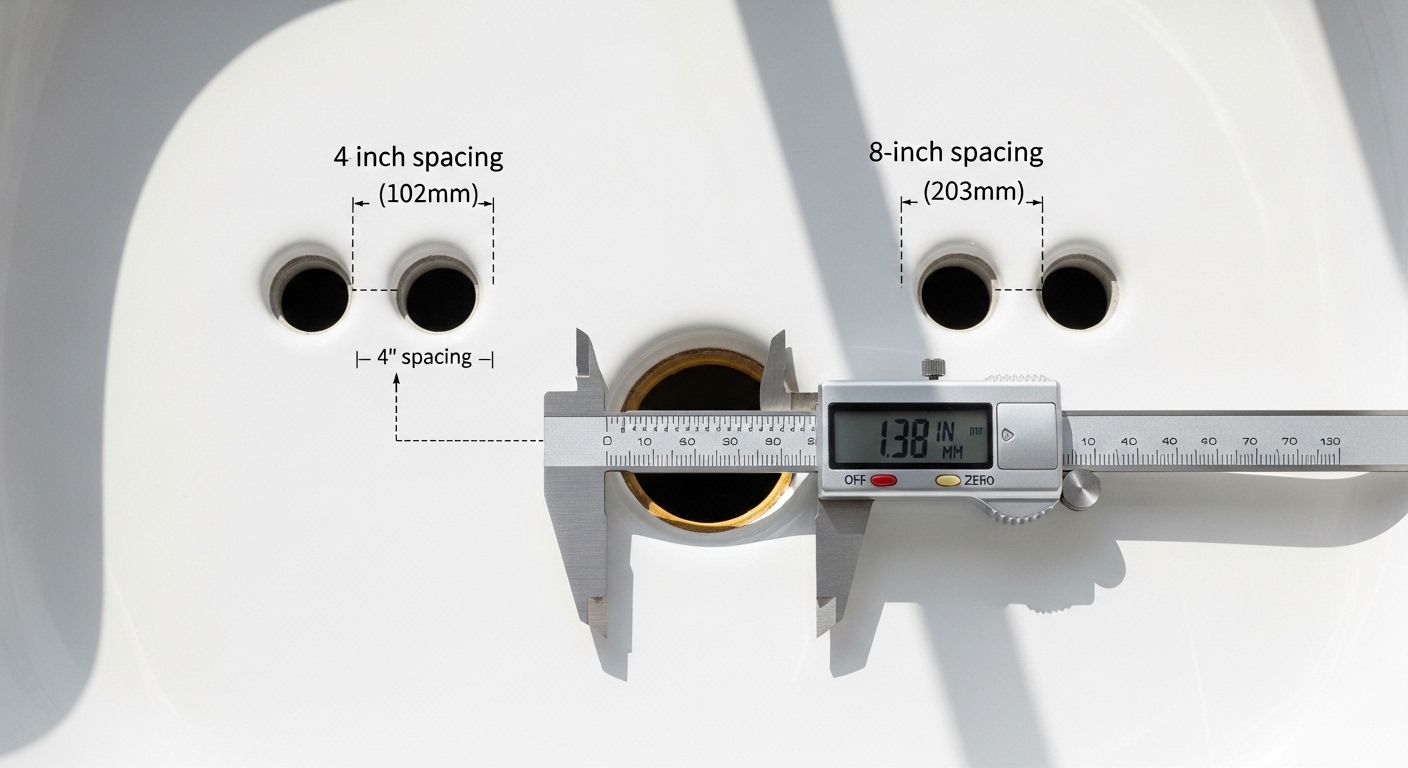
Figuring out the exact hole size needed for a faucet is the one measurement that trips up most first-time DIY installers, and it’s the difference between a 20-minute swap and a return trip to the store. The good news: faucet mounting holes are far more standardized than they look. In this guide we’ll give you the exact diameters, the spacing between holes (which matters just as much), how to measure a hole you already have, and what to do when your countertop hole is too big, too small, or you have the wrong number of them.
What Size Hole Do I Actually Need for a Standard Faucet?
For nearly all residential faucets, the mounting hole needs to be 1-3/8 inch (1.375″, or roughly 35 mm) in diameter. That’s the industry default for both bathroom and kitchen faucets. A smaller group of faucets — mostly heavier pull-down kitchen models, commercial-style bridge faucets, and some vessel-sink faucets — call for a 1-1/2 inch (1.5″, or ~38 mm) hole to fit their thicker mounting shank.
Here’s the key insight most people miss: faucet shanks are designed to fit up to a certain hole size, not exactly. A faucet spec’d for a 1-3/8″ hole will happily drop into a 1-1/2″ hole too — the base, gasket, or deck plate covers the extra gap. The problem only runs one direction: a faucet that needs 1-1/2″ will not fit through a 1-3/8″ hole without enlarging it. So when in doubt, a slightly larger hole is safer than a slightly smaller one.
Standard drilled sinks — porcelain, fireclay, and stainless — almost always come with 1-3/8″ holes from the factory precisely because that’s the accepted norm. If you’re buying a new sink and a new faucet together, you rarely need to think about diameter at all. It’s the mismatched replacements and stone-countertop drilling jobs where the number matters.
How Do I Measure the Faucet Hole I Already Have?
Measure the hole straight across its widest point (the inside diameter), not the visible cutout in the countertop surface. Pull the old faucet first so you can measure the bare hole in the sink deck or counter, then compare that number to the faucet’s spec sheet.
You’ve got three easy ways to do it, from most to least accurate:
- Digital or dial caliper: Open the jaws inside the hole and read the inside diameter. This is the gold standard — you’ll get an exact number like 1.38″ and know instantly whether you need a 1-3/8″ or 1-1/2″ faucet.
- Tape measure or steel ruler: Lay it flat across the hole and read edge-to-edge. Aim for the true center. It’s harder to be precise on a curved sink deck, but you’ll get within 1/16″.
- The coin trick: A U.S. quarter is about 0.955″ and a half-dollar is about 1.2″. Neither equals a faucet hole, but if a quarter drops through with obvious room to spare on all sides, you’re almost certainly looking at a standard 1-3/8″ hole.
Removing the old faucet cleanly is half the battle here — corroded nuts and stuck baseplates can make measuring impossible until the unit is out. If you’re pulling a stubborn older unit, our walkthrough on how to remove an old Moen bathroom faucet covers the exact tools and the order of operations that keep you from cracking the sink.
Hole Diameter vs. Hole Spacing — What’s the Difference and Which Matters More?
Both matter, but they answer different questions. Diameter (1-3/8″ or 1-1/2″) decides whether the faucet physically drops through the hole. Spacing — the center-to-center distance between multiple holes — decides whether a multi-hole faucet’s handles and spout line up with the holes you have. You can nail the diameter and still buy the wrong faucet if the spacing is off.
Bathroom sinks come in three standard configurations, and this is where most returns happen:
| Configuration | Number of Holes | Hole Spacing (center-to-center) | Individual Hole Diameter | Best For |
|---|---|---|---|---|
| Single-hole | 1 | N/A | 1-3/8″ (some 1-1/2″) | Modern, compact vanities; easiest install |
| Centerset | 3 | 4″ | 1-3/8″ each | Small to mid-size bathroom sinks |
| Widespread | 3 | 8″ (range 6″–16″) | 1-3/8″ each | Larger vanities, higher-end look |
| Mini-widespread | 3 | 4″ | 1-3/8″ each | Widespread style in a tight space |
| Wall-mount | 2 (in wall) | Varies by valve | N/A (rough-in based) | Vessel sinks, custom looks |
Kitchen faucets are simpler on spacing but split on hole count. A single-hole pull-down faucet needs one 1-3/8″ hole (occasionally 1-1/2″). Older three- and four-hole kitchen sinks used an 8″ spread for the two handles plus the spout, often with an extra hole for a sprayer or soap dispenser. Most modern single-hole kitchen faucets include a deck plate (escutcheon) that covers the unused 4th, 3rd, and 2nd holes on a standard 3- or 4-hole sink — so you don’t have to fill or re-drill anything.
My Countertop Hole Is Too Big or Too Small — Now What?
If the hole is too small, you enlarge it; if it’s too big, you cover it with a deck plate or use a mounting adapter. Neither problem should force you to buy a whole new sink, though the fix depends on your material.
When the hole is too small (needs enlarging):
- Stainless steel or thin metal sink: A step drill bit (Unibit) opens a 1-3/8″ hole to 1-1/2″ in a couple of minutes. Go slow, use cutting oil, and clamp a backing block.
- Porcelain, ceramic, or enameled cast iron: Use a diamond hole saw with water cooling. These materials chip if you rush — patience is everything.
- Granite, quartz, or other stone countertops: This is a job for a diamond core bit and constant water. If you’re not confident, hire a fabricator. A cracked stone top costs far more than the faucet.
When the hole is too big or you have extra holes: A deck plate (also called an escutcheon or base plate) is the standard fix — it’s a cover that sits under the faucet and spans a 4″ or 8″ spread, hiding unused holes. Many single-hole faucets ship with an optional deck plate in the box for exactly this reason. For a single oversized hole, a mounting ring or large rubber gasket can bridge the gap. And if you have a hole you’ll never use again (an old sprayer hole, say), a simple sink hole cover / button plug in a matching finish snaps in for a few dollars.
Does the Faucet Hole Size Change for a Vessel Sink or Bar Faucet?
Vessel-sink and bar/prep faucets still use the same 1-3/8″ standard hole in most cases — what changes is the height of the faucet and sometimes the shank length, not the hole diameter. A tall vessel faucet mounts through a single 1-3/8″ hole in the countertop behind the bowl, exactly like a single-hole bathroom faucet.
Bar and prep faucets are essentially compact kitchen faucets and follow kitchen norms: one 1-3/8″ hole for the body. The one thing to double-check on both is deck thickness — the faucet’s threaded shank has to be long enough to pass through your countertop plus the mounting hardware. Thick stone or a stacked butcher-block counter can exceed the shank length on budget faucets, so verify the maximum deck thickness in the spec sheet (most handle up to about 2″–2-1/2″).
What Tools and Parts Do I Need to Get the Hole Right?
You need a way to measure, a way to enlarge if necessary, and the right cover parts if your holes don’t match. Here’s the practical shopping list before you start any faucet swap:
- Measuring: Digital caliper (ideal) or a steel tape measure.
- Enlarging metal: Step drill bit, cutting oil, safety glasses.
- Enlarging ceramic/stone: Diamond hole saw or core bit, a steady water supply for cooling, painter’s tape to mark and prevent walking.
- Covering/adapting: Deck plate matching your faucet finish, extra gaskets, or sink hole button plugs.
- Sealing: Plumber’s putty or 100% silicone to seal the faucet base against the deck.
While you’re upgrading, it’s worth checking the connection under the sink too — a fresh faucet often pairs best with modern quick-connect supply fittings. If you want to speed up the whole job and skip fiddly threading, our guide to sink aerator quick connect fittings shows how the newer push-fit hardware saves time on a swap. And for tricky adapter situations where your supply lines or aerator threads don’t match the faucet, a compatibility read on what real users recommend for bathroom sink faucets can save you a second trip.
How Many Holes Should I Drill for a Brand-New Installation?
If you’re starting fresh on a new countertop, drill for the faucet you’ve already chosen — never guess. Buy the faucet first, read its installation template, and match the number of holes and the spacing to that exact model. This is the single most common ordering mistake: people drill a “standard 3-hole” counter, then fall in love with a sleek single-hole faucet and end up hiding two holes forever.
General rules for new installs:
- Single-hole faucet: one 1-3/8″ hole. Cleanest modern look.
- Widespread bathroom faucet: three 1-3/8″ holes at 8″ spread.
- Kitchen faucet with side sprayer or soap dispenser: add one accessory hole (usually 1-3/8″ or the accessory’s spec) beside the main hole.
- Undermount stone sink: holes are drilled in the countertop, not the sink — coordinate with your fabricator using the faucet template.
Precise measuring pays off across every fixture in the bathroom, not just the sink. The same “measure the real dimension, not the visible opening” discipline applies to tub and shower work — see our breakdown of how to get the right tub spout measurement before you buy a replacement if you’re tackling the whole bathroom at once.
Quick Reference: Faucet Hole Size Cheat Sheet
| Faucet Type | Standard Hole Diameter | Typical Hole Count | Notes |
|---|---|---|---|
| Single-hole bathroom faucet | 1-3/8″ (35 mm) | 1 | Deck plate optional to cover 3-hole sinks |
| Centerset bathroom faucet | 1-3/8″ | 3 @ 4″ spread | Handles + spout on one base |
| Widespread bathroom faucet | 1-3/8″ | 3 @ 8″ spread | Separate spout and handles |
| Single-hole kitchen / pull-down | 1-3/8″–1-1/2″ | 1 | Heavier models may need 1-1/2″ |
| Vessel / bar faucet | 1-3/8″ | 1 | Check deck-thickness limit |
FAQ
What is the standard hole size needed for a faucet in inches and millimeters?
The standard mounting hole is 1-3/8 inch, which equals about 35 mm. Some heavier kitchen and vessel faucets need 1-1/2 inch (about 38 mm). If your existing hole falls anywhere between 1-3/8″ and 1-1/2″, most residential faucets on the market will fit it.
Will a 1-3/8″ faucet fit in a 1-1/2″ hole?
Yes. A faucet designed for a 1-3/8″ hole fits fine in a slightly larger 1-1/2″ hole because the base plate, gasket, or deck plate covers the extra space. The reverse is not true — a faucet needing 1-1/2″ won’t pass through a 1-3/8″ hole without enlarging it.
Can I make a faucet hole bigger myself?
Yes, with the right bit for your material. Use a step drill bit for stainless steel, and a water-cooled diamond hole saw for porcelain, ceramic, or enameled cast iron. For granite or quartz countertops, use a diamond core bit with constant water — or hire a fabricator, since a cracked stone top is expensive to replace.
How do I cover an extra or oversized faucet hole?
Use a deck plate (escutcheon) to span and hide unused holes under a single-hole faucet, a mounting ring or large gasket to bridge one oversized hole, or a snap-in sink hole button plug in a matching finish for a hole you’ll never use again. Many single-hole faucets include an optional deck plate in the box.
Does hole spacing matter as much as hole diameter?
For multi-hole faucets, yes — equally. Diameter decides whether the faucet drops through; spacing (4″ for centerset, 8″ for widespread) decides whether the handles and spout line up with your existing holes. Always match both numbers to the faucet’s spec before buying.
What if I don’t know my faucet model or its required hole size?
Measure the hole you already have with a caliper or tape (inside diameter across the widest point), then shop for a faucet rated for that size. Nearly all standard sinks are drilled at 1-3/8″, so if a U.S. quarter drops through with clear room around it, you almost certainly have a standard hole and can buy any standard single-hole faucet.
A Note on Expertise and Standards
This guide was written and reviewed by the arcorafaucet product and installation team, drawing on the fitment specifications we publish for our own faucet lines and years of fielding installer questions. Arcora designs and tests kitchen and bathroom faucets to widely recognized North American plumbing standards, and every faucet ships with a model-specific installation template and a manufacturer’s warranty — so the hole size, spacing, and maximum deck thickness for your exact model are always printed in the box. When a spec sheet and a general rule of thumb disagree, follow the spec sheet: it reflects the actual tested tolerances for that faucet. If you’re ever unsure whether your countertop can be safely drilled, especially with stone, consult a licensed plumber or stone fabricator before cutting.