 ARCORA FAUCETS
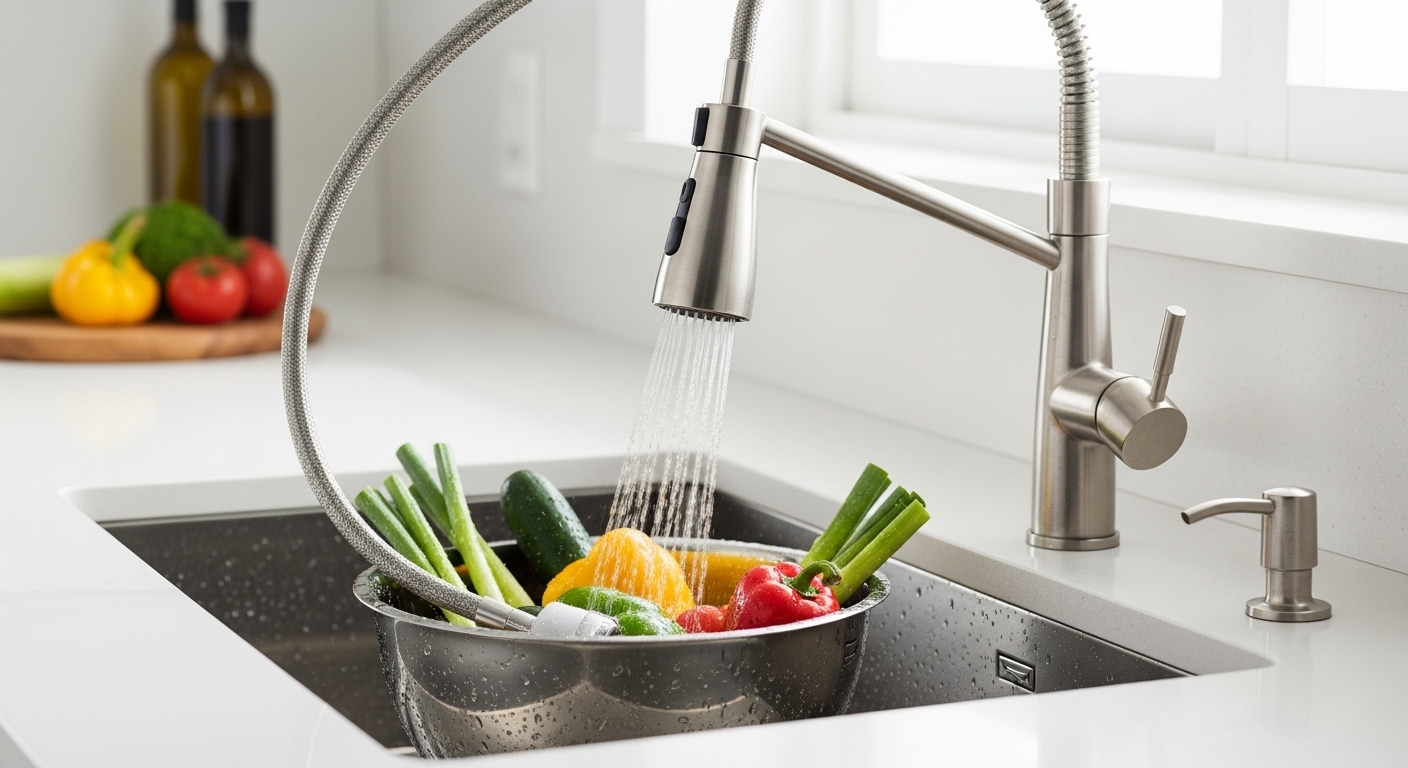
If you’ve been searching “faucet sprayer bunnings,” you’re almost certainly in one of two situations: your side spray or pull-out hose has stopped working, or you want to add a sprayer to a kitchen that never had one. Bunnings is a solid first stop for tapware, hoses, aerators and adapters, but the range moves between stores and seasons, and a lot of the cheaper spray heads are plastic parts that crack or clog within a couple of years. This guide walks you through exactly what a good faucet sprayer setup looks like, what to check before you buy, and when a full pull-out mixer beats a bolt-on sprayer.
We make and test kitchen mixers for a living, so the advice here is the same thing we’d tell a friend standing in the plumbing aisle with their phone out — not a sales pitch.
What exactly is a “faucet sprayer” — side spray, pull-out, or pull-down?
A faucet sprayer is any part of your kitchen tap that lets you direct a spray of water where you want it, and there are three common types. The one you need depends on how your sink is drilled and how your current tap is built.
- Side spray — a separate hand sprayer mounted in its own hole beside the tap, connected under the sink by a hose to a diverter. This is the classic “add-on” sprayer and the one people most often replace.
- Pull-out spray — the spout head itself pulls out toward you on a hose, usually with a short, low-arc spout. Great for smaller sinks.
- Pull-down spray — a tall gooseneck spout where the head pulls straight down into the sink. Better reach for filling big pots.
When people search for a “faucet sprayer bunnings,” they usually mean either a replacement side-spray head, a replacement pull-out hose-and-head, or a full mixer that has the sprayer built in. Knowing which of the three you have saves you buying the wrong thing twice. If you’re not sure, look under the sink: a separate hose feeding a button-operated wand in its own hole is a side spray; a single hose retracting up into the spout is a pull-out or pull-down.
Which faucet sprayer type should I buy for my sink?
Buy a pull-down mixer if you have a deep single-bowl sink and cook a lot; buy a pull-out mixer for a shallow or double bowl or a window behind the sink; only buy a standalone side spray if you’re keeping an existing tap that already has that fourth hole. The short version: a side spray is a repair, a pull-out or pull-down is an upgrade. If your side sprayer has failed and the tap itself is old, it’s often smarter (and barely more expensive) to switch to an all-in-one pull-out mixer and cap the spare hole.
Is a Bunnings faucet sprayer good quality, or should I look elsewhere?
Bunnings sprayers range from perfectly fine to disposable, and the deciding factor is almost always the spray head material and the cartridge. For an occasional-use laundry or garden-utility tap, an entry-level plastic sprayer is genuinely fine. For a main kitchen you use ten times a day, that same plastic head is a false economy — the trigger stiffens, the nozzle scales up with hard-water minerals, and the internal seals give out.
Here’s what separates a sprayer that lasts eight years from one that lasts eighteen months, regardless of where you buy it:
| Feature | Budget sprayer (~$20–45) | Mid / premium sprayer (~$80–250+) |
|---|---|---|
| Spray head | Plastic, chrome-plated | Metal or reinforced ABS with silicone anti-scale nozzles |
| Hose | Thin PVC | Nylon-braided, weighted for smooth retraction |
| Cartridge / valve | Rubber washer or basic ceramic | Ceramic disc, often brand-tested to 500,000+ cycles |
| Spray modes | Stream / spray | Stream / spray / pause, sometimes power-clean boost |
| Finish durability | Flakes on edges over time | PVD brushed nickel / matte black, scratch & tarnish resistant |
| Warranty | 1–2 years | 5 years to lifetime on cartridge/finish |
The single most useful upgrade is the ceramic-disc cartridge paired with silicone anti-scale nozzles — those little rubbery bumps you can rub with a thumb to knock off limescale. If you’re in a hard-water area, that one feature does more for long-term performance than the finish or the brand name. To go deeper on how mineral buildup wrecks flow and how to fight it, our guide on faucet aerator mesh and whether to clean or replace it explains the exact same physics that clogs a sprayer nozzle.
What size and connector do I need before I buy a faucet sprayer at Bunnings?
Before you buy any faucet sprayer at Bunnings, measure three things: the hose connector thread, the hole diameter in your sink or bench, and the number of tap holes you have. Getting these wrong is the number-one reason sprayers get returned, so it’s worth five minutes with a tape measure and a torch under the sink.
- Connector thread. Kitchen mixer hoses commonly use a 1/2″ BSP or a proprietary quick-connect. A replacement side-spray usually screws onto a diverter with a specific thread — take a photo of the fitting or unscrew the old one and bring it in.
- Tap hole size. Most Australian and NZ sinks are drilled around 32–36mm for the tap body. A standalone side spray needs its own smaller hole. If you’re changing hole counts, you’ll want to know the exact bore.
- Number of holes. A three-hole or four-hole sink gives you options; a single-hole sink limits you to a monobloc mixer with an integrated sprayer.
If any of that sounds fiddly, it is — but it’s the difference between a ten-minute swap and a wasted trip. We put together a full walkthrough on what hole size is needed for a faucet and how to know before you buy, and if you’re pairing a spray head to a non-standard tap or an imported fixture, our piece on the faucet adapter homeowners actually need covers the thread mismatches that trip people up most.
Can I just replace the sprayer head and keep my existing faucet?
Yes, if the failure is in the head or hose and the tap body and cartridge are still good — a like-for-like head or hose replacement is a 15-minute job with no plumber needed. Unscrew the old head from the hose, check the thread and washer, and screw on the matching replacement. Where this goes wrong is when people try to force a generic head onto a proprietary hose from a specific brand; the threads look close but won’t seal, and you get a slow drip inside the cabinet. If your tap is a well-known brand, buy that brand’s spare head, or buy a whole new mixer. If your whole tap is more than ten years old and the sprayer just died, replacing the lot is usually the better spend.
How do I install a replacement faucet sprayer myself?
You can install most replacement sprayer heads and hoses yourself in under 30 minutes with two hands and a torch — no specialist tools for a head swap, and just an adjustable spanner for a hose or diverter change. Here’s the reliable sequence for a pull-out head-and-hose replacement:
- Turn off the hot and cold isolation valves under the sink and open the tap to release pressure.
- Disconnect the spray hose from the supply/diverter connection under the bench. Have a towel ready for the cupful of water still in the line.
- Pull the old head and hose up and out through the spout.
- Feed the new hose down through the spout, attach the weight at the marked position so the head retracts smoothly, and reconnect to the supply.
- Turn the water back on slowly, then run and inspect every joint for drips for a full minute before you walk away.
For a standalone side spray, the extra step is the diverter — the little valve inside the tap body that redirects water to the side hose when you press the trigger. A weak or blocked diverter is a common reason a side spray “won’t spray hard enough,” and it’s a cheap part to replace. The install logic overlaps a lot with a full mixer swap; if you’re going the whole-tap route, the technique in our guide on how to replace a kitchen faucet step by step transfers directly to any brand.
One tip the boxes never mention: dry-fit the head into the spout dock before you connect the water, and make sure the magnetic or mechanical dock actually holds the head snug. A head that won’t sit properly in its dock is the most annoying long-term flaw of a cheap pull-down, and you can’t feel it until it’s installed.
Why is my faucet sprayer weak, leaking, or stuck?
A weak, leaking, or stuck sprayer almost always comes down to one of four things: mineral scale in the nozzles, a tired diverter, a kinked or worn hose, or low incoming water pressure. Diagnose in that order and you’ll fix most sprayers without replacing the tap.
- Weak or uneven spray: usually limescale on the nozzles. Rub the silicone tips, or soak the head in a 50/50 white-vinegar solution for an hour, then rinse.
- Won’t switch to spray / weak diverter: the diverter valve is blocked or worn. Clean or replace it.
- Leaks at the head or won’t retract: the hose weight has slipped, or the hose is cracked or kinked where it rubs the cabinet.
- Everything is weak, not just the spray: the problem is upstream water pressure, not the sprayer.
That last one catches a lot of people who buy a new sprayer and see no improvement. If the whole tap is gutless, the sprayer isn’t the culprit — walk through our guide on why your tap’s low water pressure suddenly gets worse and how to fix it before you spend a cent on a new head. And if the noise is what’s bothering you rather than the flow, our explainer on why your faucet makes noise covers the water-hammer and cartridge issues that a new sprayer won’t solve.
Is a full pull-out mixer worth it over a bolt-on sprayer?
For a main kitchen, a full pull-out or pull-down mixer is almost always worth the extra money over a bolt-on side spray, because you get one sealed system instead of two failure points. A side spray relies on a diverter and a second hole that can leak; an integrated pull-out has fewer connections and a cleaner look. Where the bolt-on still wins is cost and disruption: if your tap is fine and you only need spray function on a laundry or butler’s sink, a $30 side spray is the sensible call.
If you’re weighing finishes and styles for that upgrade, brushed nickel and matte black are the two most forgiving in a busy kitchen because they hide water spots and fingerprints better than polished chrome. Our breakdown of whether a brushed nickel pull-out tap is worth it for a busy kitchen and our roundup of the best pull-down kitchen faucet for a busy family both go deeper on which spec actually survives daily use.
How much should I spend on a faucet sprayer?
Spend around $20–45 for a laundry or secondary-sink side spray, $80–150 for a solid main-kitchen pull-out mixer, and $150–300+ if you want a premium PVD finish with a lifetime cartridge warranty. Above roughly $300 you’re paying for brand cachet and designer styling, not meaningfully better function. The sweet spot for most families is the $100–180 band: a metal spray head, braided hose, ceramic cartridge, and a real multi-year warranty. Under $50 is fine for light use but expect to replace it sooner.
Faucet sprayer buying checklist
Before you check out — whether at Bunnings, another retailer, or online — run down this quick list:
- Confirmed connector thread and tap-hole size against your existing setup
- Metal or reinforced spray head, not thin plastic, if it’s a main sink
- Nylon-braided hose with a retraction weight for pull-out/pull-down
- Ceramic-disc cartridge, not a rubber washer
- Silicone anti-scale nozzles if you have hard water
- A finish that hides spots (brushed nickel or matte black) for high-use kitchens
- A warranty of at least 5 years on the cartridge and finish
- Compliance marks appropriate to your region (e.g. WaterMark in Australia)
That WaterMark point matters more than people realise: in Australia, kitchen and bathroom tapware connected to the mains is required to be WaterMark-certified, and a bargain sprayer without it can cause you grief with plumbing compliance and insurance. Always check the certification before you buy, wherever you buy.
FAQ
Does Bunnings sell replacement faucet sprayer heads on their own?
Bunnings stocks some standalone spray heads, side sprays, hoses and diverter parts, but the range varies by store and over time. Because threads aren’t universal, take your old head or a clear photo of the fitting in with you, or match to the exact brand of your existing tap. If you can’t find a matching head, replacing the whole hose-and-head assembly — or the whole mixer — is often more reliable than forcing a generic part to seal.
Can I put a pull-out sprayer on a single-hole sink?
Yes. A single-hole sink is actually ideal for a monobloc pull-out or pull-down mixer, since the sprayer is built into the spout and needs no separate hole. If your sink currently has extra holes from an old side spray, you can cap them with a matching blanking plate for a clean look.
Why does my new sprayer still have weak pressure?
If a brand-new sprayer sprays weakly, the problem is usually upstream: partially closed isolation valves, a clogged inlet filter, low mains pressure, or a blocked diverter rather than the head itself. Open the isolation valves fully, clean the inlet screens, and check whether the standard stream is also weak — if the whole tap is gutless, the sprayer isn’t the cause.
Are metal spray heads really better than plastic?
For a main kitchen, yes. Metal (or heavy reinforced ABS) heads resist heat, cracking and finish flaking far better than thin chrome-plated plastic, and they usually pair with better cartridges and hoses. For a rarely-used laundry or utility tap, a plastic head is perfectly adequate and cheaper.
How long should a good faucet sprayer last?
A quality pull-out or pull-down mixer with a ceramic-disc cartridge should last 8–15 years with basic care, while a budget plastic side spray often needs replacing in 2–4 years. The biggest killers are limescale and finish wear, both of which you slow down by wiping the head dry and periodically de-scaling the nozzles.
Do I need a plumber to fit a faucet sprayer?
For a like-for-like head or hose swap, no — it’s a straightforward DIY job. For a full new mixer, check your local rules: some regions require a licensed plumber for any connection to the mains water supply, both for compliance and to keep your warranty and insurance valid. When in doubt, a quick call to a plumber for the final connection is cheap insurance.
Author note: This guide was written by the product team at Arcora, who design, pressure-test and cycle-test kitchen and bathroom mixers to international standards, including cartridge endurance testing to 500,000+ open-close cycles and finish testing for corrosion and abrasion resistance. Arcora has supplied faucets and bathroom fixtures to customers across North America, Australia and New Zealand, and every mixer ships with a multi-year warranty on the cartridge and finish. We wrote this to help you buy the right sprayer once — not to talk you into the most expensive one.