 ARCORA FAUCETS
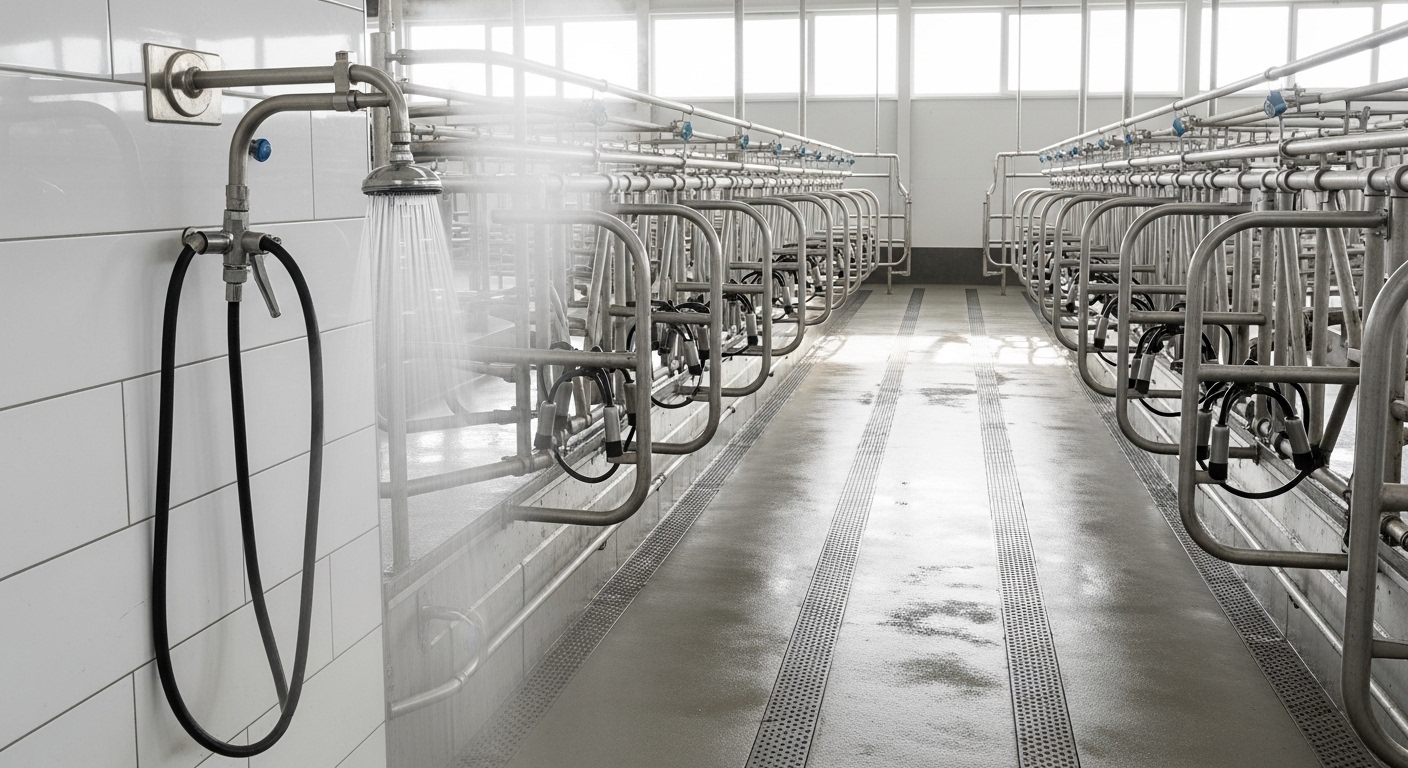
If you’ve ever managed or worked on a dairy operation, you already know a shower system in dairy farm environments isn’t a luxury — it’s part of the food-safety chain. Between manure, milking residues, iodine teat dips, hoof-trimming runoff, and the constant humidity of a parlor, a farm needs purpose-built showers that can survive being hosed with hot water and chlorinated cleaners every single day. Residential fixtures fail within months. This guide walks through exactly what to install, where, at what flow and temperature, and which spec sheets actually matter when the dairy inspector shows up.
Written for owner-operators, herd managers, and facility builders planning a new parlor or retrofitting an aging wash-up area, this is the practical, no-fluff breakdown — based on Grade-A PMO (Pasteurized Milk Ordinance) expectations, NSF/ANSI 372 lead-free standards, and what we see returned vs. what survives on real farms.
Why does a dairy farm need a dedicated shower system at all?
Because cross-contamination between people, animals, and milk is the single biggest cause of failed inspections and rejected tanker loads. A dedicated shower system in a dairy farm separates “barn dirty” from “parlor clean,” letting workers strip out of soiled coveralls, rinse off, and re-enter the milking area without dragging pathogens like E. coli, Listeria, or Staph aureus into the bulk tank room.
In Grade-A operations, the PMO requires accessible handwashing and, in many state interpretations, a dedicated worker hygiene area with hot and cold running water near the milking parlor. Many co-ops (DFA, Land O’Lakes, Organic Valley) now write shower facilities into their audit checklists, especially for farms milking 200+ cows where 24/7 shift work means employees often shower onsite between rotations.
There’s also a second category most first-time buyers forget: the equipment wash-down shower. That’s the high-flow hose station you use to rinse parlor decks, return lanes, the holding pen, and the bulk tank room floor. Different fixture, different spec — but both fall under the umbrella of “shower system” on a dairy.
What’s the difference between a personnel shower and a wash-down shower on a dairy?
A personnel shower is a fully enclosed hygiene station for workers — same hardware you’d see in a gym locker room, but commercial-grade. A wash-down shower (sometimes called a “wash bay” or “barn shower”) is a single high-pressure hose with a thermostatic mixing valve, mounted on an unfinished wall, used to clean equipment, cow legs, udders, or the parlor itself.
Most dairies need both, and the mistake is treating them as the same purchase. Here’s how the requirements diverge:
| Feature | Personnel Hygiene Shower | Wash-Down / Parlor Shower |
|---|---|---|
| Typical flow rate | 1.8–2.5 GPM (water-saving) | 4–8 GPM (rapid rinse) |
| Operating pressure | 45–60 PSI | 60–90 PSI (some up to 120) |
| Temperature range | 95–110°F (anti-scald limited) | 120–160°F (sanitizing) |
| Material requirement | Chrome or PVD-coated brass | 304 or 316 stainless steel |
| Valve type | Pressure-balanced or thermostatic | Thermostatic mixing valve (TMV) |
| Hose length | Fixed wall-mount or 5 ft slide bar | 15–50 ft retractable industrial hose |
| Spray pattern | Wide rain or massage | Adjustable jet/fan/cone |
| Compliance | NSF 372 lead-free, ASSE 1016 | USDA, 3-A Sanitary Standards |
If you only invest in one of the two, prioritize the wash-down shower in the parlor — that’s the one keeping your somatic cell count down and your bulk tank passing antibiotic and bacteria tests.
What water temperature and flow rate actually work for milking parlor cleaning?
For sanitizing milking equipment and parlor surfaces you need a minimum of 140°F at the point of use, with 160°F being the practical sweet spot for fat and protein residue from milk. Flow rate of 4–6 GPM at 70 PSI is enough for one operator with a hose; if two workers will be washing down simultaneously, plan for 8–10 GPM combined demand and a hot water heater sized accordingly (a 50-gallon commercial unit minimum, more commonly a 100-gallon tank with a recovery rate above 200 GPH).
Why these numbers matter: milk fat solidifies below 100°F, which means a “warm” shower is actually worse than no rinse at all — you smear the residue across stainless and create a biofilm that traps bacteria. That’s also why pressure-balanced valves (cheap, common in homes) are the wrong choice for parlor work. You want a thermostatic mixing valve that locks in a precise temperature regardless of upstream pressure swings when the bulk tank wash cycle kicks on.
For personnel showers, dial it back. ASSE 1016/ASSE 1017 compliant valves cap the worker shower at around 110°F to prevent scalding, and 2.0–2.5 GPM is plenty. Spending money on a 6 GPM rain head for the locker room when you have a 75-gallon water heater means cold showers at 5 a.m. milking. Match the fixture to the job.
What about water hardness and dairy water chemistry?
Most dairies pull from well water, and well water on grazing land tends to run hard — 15 to 30 grains per gallon is normal. Hard water destroys shower cartridges, clogs aerators, and leaves scale that harbors bacteria. Install a softener upstream of any sanitation showers (not on potable lines feeding the cows — they actually prefer mineralized water), and budget for descaling. Vinegar soaks work for routine maintenance; for heavier buildup, see our practical breakdown on how to remove limescale from faucets naturally. The same principles apply to shower wands and parlor sprayers.
Stainless steel, brass, or PVD-coated — which finish survives a dairy?
304 stainless steel is the baseline for any shower hardware that lives in or near a milking parlor; 316 stainless is the upgrade for operations that use heavy chlorine or peracetic acid sanitizers. Brass with PVD coatings (brushed nickel, matte black) belongs only in the office bathroom or worker locker room — never in the wet zone.
Here’s why finishes fail in dairy environments faster than anywhere else:
- Chloride attack: Sanitizers like sodium hypochlorite eat through chrome plating on brass within 12–18 months. Stainless 316 resists it almost indefinitely.
- Acid wash cycles: CIP (clean-in-place) cycles use phosphoric or nitric acid that gets aerosolized — anything within 10 feet of the milk line gets misted.
- Ammonia from manure: Slowly oxidizes copper and zinc alloys. Brass turns green, then porous.
- Constant humidity: 80–95% RH year-round. Galvanized fittings start weeping rust in 6 months.
- Iodine teat dip: Stains everything it touches — including matte black coatings.
For the personnel side, where the environment is gentler, PVD finishes like brushed gold or matte black hold up fine and look professional in employee facilities. If you’re outfitting a worker bathroom or locker room on a dairy that doubles as the family home (very common on smaller operations), the trends in residential finishes still apply — see our coverage on brushed gold finishes in 2026 for what’s holding up in real-world humidity. Just keep that hardware out of the parlor itself.
If you’re seeing the early warning signs on existing hardware — pitting, discoloration, weeping bases — read up on why faucets rust quickly before you replace anything. The fix is often upstream of the fixture itself (galvanic corrosion from mixed metals, or a sacrificial anode gone bad in the water heater).
How do you plumb a shower system for a dairy farm without code violations?
You need three things right from day one: a backflow preventer (RPZ or double-check, depending on your jurisdiction), lead-free certified fittings under NSF/ANSI 372 (≤0.25% lead content), and an air gap between any hose end and a non-potable surface. Skip any of these and your inspector will shut down the parlor.
The backflow issue is the big one. A hose-end wash-down shower sitting in a puddle of dirty parlor water is, by definition, a cross-connection hazard. If a city main pressure drop happens during a fire event, that contaminated water can siphon back into the potable supply. Most states require a reduced-pressure zone (RPZ) assembly on any commercial dairy with a hose station, tested annually by a certified tester.
For step-by-step on the valve side, our walkthrough on how to replace anti-siphon faucet valves covers the residential cousin of these devices — the engineering principle is identical, just scaled up for parlor flow rates.
The lead-free spec became federal law under the 2014 Safe Drinking Water Act amendment, but enforcement on farms has tightened in the last three years. Any new fixture installed on a dairy must be NSF/ANSI 372 certified and stamped or marked accordingly. If you’re not sure what that means for your sourcing, our explainer on what makes a faucet lead-free walks through the standards.
What pipe size and routing should you use?
3/4″ supply lines are the minimum for any shower delivering more than 4 GPM at the head — 1/2″ lines starve the fixture and you’ll feel it as soon as a second valve opens. For a parlor with two wash-down stations and a holding-pen hose, run 1″ trunk lines and branch down to 3/4″ at each station. Use Type L copper or schedule 40 PEX-A for hot lines; avoid CPVC near the parlor because the hot wash water + parlor chemicals embrittle it within a few years.
What does a complete dairy farm shower setup cost in 2026?
A bare-bones single wash-down station with a thermostatic valve, stainless wand, 30-foot hose, and proper backflow runs $850–$1,400 installed. A full hygiene shower for personnel — enclosure, fixture, drain, water heater capacity — comes in at $2,200–$4,000. For a 200-cow rotary parlor with two wash-down stations, two personnel showers, and a 100-gallon commercial water heater, budget $9,000–$14,000 turnkey.
That’s not where dairy operators usually overspend, though. The expensive mistake is buying residential-grade fixtures because they cost $200 instead of $600 — and replacing them every 14 months when cartridges seize from hard water and sanitizer exposure. A proper 316 stainless thermostatic shower assembly has a documented 10–15 year service life in a parlor environment. Amortized, the commercial unit costs less per year.
For a deeper take on when premium pricing pays for itself versus when you’re paying for branding, see our analysis of when to splurge vs. save on faucets. The dairy answer is almost always: splurge on anything in the wet zone, save on the office bathroom.
How do you maintain a dairy shower system so it actually lasts?
Weekly: rinse and inspect spray faces, check for leaks at hose connections, and verify the thermostatic valve is holding setpoint within ±2°F. Monthly: descale aerators and spray heads with a 5% citric acid soak, inspect the backflow assembly for weeping, and pull cartridges to check for sediment. Annually: certified backflow test, replace any wear seals, and inspect the water heater anode rod.
The connection points are where most leaks start, and a leak in a parlor isn’t just a water bill — it’s a wet floor that’s a slip hazard and a bacteria reservoir. Our quick checklist on how to check faucet connections for leaks works equally well for parlor hose stations; the difference is you should be doing it weekly rather than seasonally.
Keep a maintenance log. Co-op auditors and state milk inspectors love seeing one, and it’s the cheapest thing you can do to make compliance audits painless. Note the date, fixture ID, what you did, and any parts replaced.
What about retrofitting an older dairy that was never designed for showers?
Most older tie-stall and stanchion barns weren’t built with worker hygiene facilities — the assumption was that the farmer lived 50 feet away and would shower in the house. If you’re now running employees and need to comply with modern audit checklists, the cheapest retrofit is a prefab shower module installed in the milk house or a dedicated outbuilding with its own water heater, drained to the wash water lagoon (not the septic).
Skid-mounted shower modules are surprisingly affordable now — 6’×8′ insulated units with hot water, lighting, and a poly-coated steel floor pan run $6,500–$11,000, and you can have one craned into position in a day. For parlor wash-down retrofits, the lift is even smaller: tap into existing hot and cold lines, add the TMV and backflow, mount a wash-down station on the wall, and you’re done in an afternoon.
Who actually makes commercial-grade shower systems suitable for dairy use?
The serious commercial players are Chicago Faucets, T&S Brass, Symmons (Maxline series), Bradley, and Haws — all of whom publish 3-A Sanitary or NSF certifications on their dairy-suitable hardware. For the worker hygiene side, the cross-over is wider; any commercial-grade fixture rated for healthcare or food service will hold up. Arcora’s commercial line is built on the same 304/316 stainless backbone with NSF 372 certification and a 10-year warranty against finish failure in wet-zone applications.
When you’re shopping, look for these certifications stamped or printed on the fixture itself or in the spec sheet:
- NSF/ANSI 372 — lead-free compliance (mandatory federally)
- NSF/ANSI 61 — drinking water system components
- ASSE 1016 / 1017 / 1070 — anti-scald and mixing valve performance
- 3-A Sanitary Standard 02-12 — equipment for processing milk and milk products (for wash-down hardware near milk contact surfaces)
- cUPC — uniform plumbing code listing
FAQ
Can I use a regular home shower head for a dairy farm wash-down?
No. Residential shower heads are built for 1.8–2.5 GPM at low pressure and have plastic internals that fail within months under hot sanitizer exposure. You need a commercial stainless wand rated for at least 4 GPM at 80 PSI with metal internals and a backflow preventer upstream.
Does a dairy shower system need a permit?
Almost always, yes. Any new commercial plumbing fixture on a working dairy triggers a permit in most U.S. states, and you’ll need a licensed plumber for the connection. The permit usually covers the backflow assembly test as well — which is required annually after installation regardless of permit status.
How hot does the water need to be to actually sanitize milking equipment?
140°F minimum at the point of use, with 160°F preferred. Below 120°F you’re just moving milk fat around rather than dissolving it. Your hot water heater needs to be set to at least 150°F at the tank to account for line losses, with a thermostatic mixing valve dropping personnel showers to 110°F for safety.
What’s the difference between a dairy shower and an eye wash station?
An eye wash station (ANSI Z358.1) is for chemical splash emergencies and delivers tepid water (60–100°F) at low pressure for 15 minutes continuously. A dairy shower is for routine hygiene or sanitation. Many dairies need both — eye wash near any acid sanitizer storage, regular showers in the worker hygiene area. They are not interchangeable.
How often should I replace shower cartridges in a dairy environment?
Plan on 18–36 months for thermostatic cartridges, depending on water hardness and sanitizer exposure. Residential cartridges in this environment typically fail in 8–14 months. Keep one spare cartridge per fixture on the shelf — when a parlor shower fails at 4 a.m., you can’t wait three days for shipping.
Can I install the shower system myself or do I need a plumber?
The worker hygiene showers can often be DIY for an experienced owner-operator, provided the connections are inspected. Parlor wash-down stations with backflow preventers nearly always require a licensed plumber because of the cross-connection control rules. Check with your state milk inspector before buying anything — they’ll tell you exactly what they want to see.
Will a dairy shower system increase my insurance premium?
It usually decreases it. Most farm insurers offer a 2–5% discount on workers’ comp when there’s a documented hygiene facility, because slip-and-fall and contact dermatitis claims drop measurably. Ask your agent.
Author note: This guide was written by the Arcora technical content team in collaboration with our commercial product engineers. Arcora has manufactured plumbing fixtures since 2008, with a dedicated commercial line serving food-grade and agricultural facilities across North America. All fixtures referenced here meet NSF/ANSI 372 lead-free certification and are backed by a 10-year warranty against material defects. For specification questions on a specific parlor build, contact our commercial sales team at www.arcorafaucet.com.