 ARCORA FAUCETS
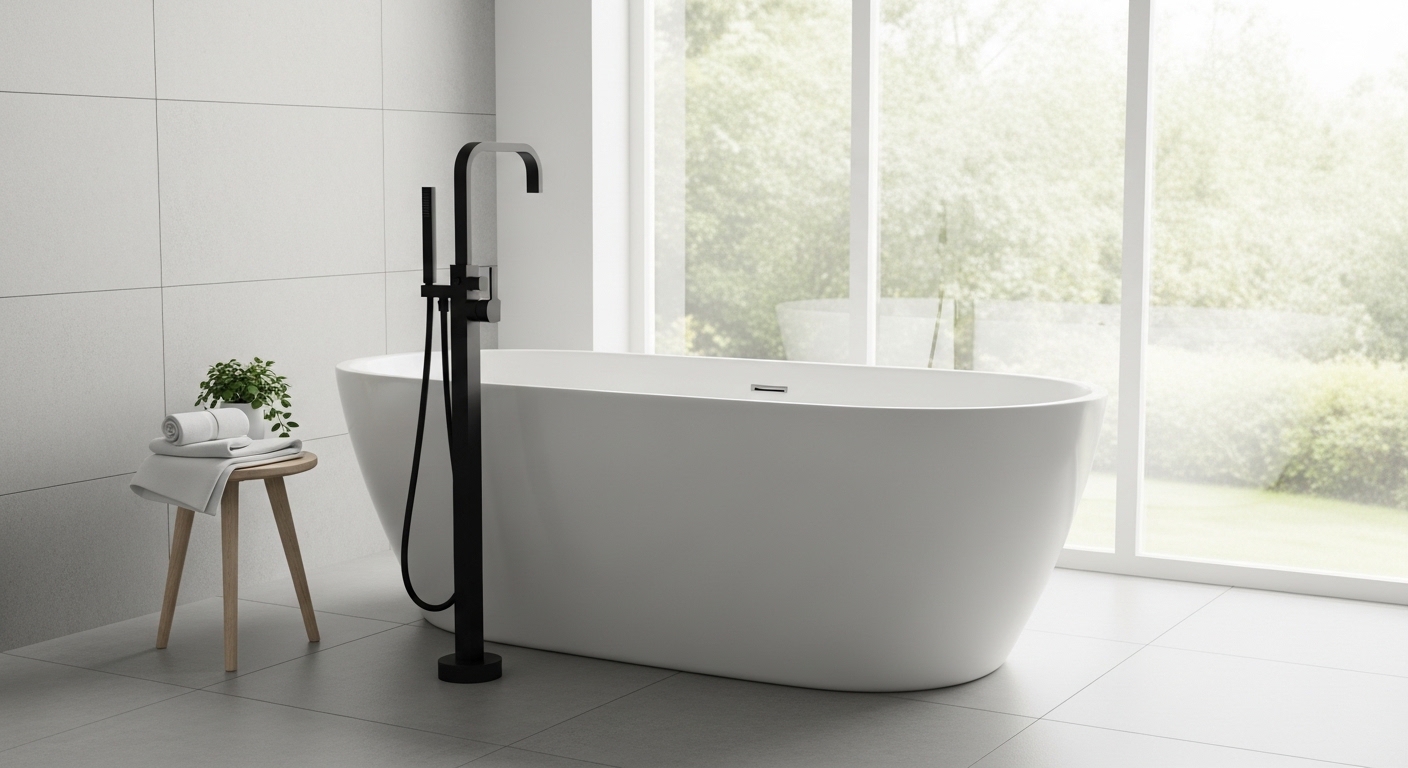
Shopping for a freestanding tub faucet kohler style setup usually means one thing: you bought (or are about to buy) a beautiful standalone soaking tub, and now you need a floor-mounted filler tall enough and strong enough to fill it without splashing everywhere. Kohler is one of the most recognized names in that space, and for good reason — but “recognized” and “right for your bathroom” aren’t always the same thing. This guide breaks down exactly what a Kohler freestanding filler costs, how it installs, where it shines, and when a comparable brand makes more sense, so you can buy once and not regret it.
What exactly is a freestanding tub faucet, and does Kohler make a good one?
A freestanding tub faucet is a floor-mounted faucet that rises up on its own from the bathroom floor to fill a standalone tub — not deck-mounted on the tub rim or wall-mounted behind it. Kohler makes several strong ones, and yes, they’re genuinely good: solid brass construction, ceramic-disc cartridges rated for high cycle counts, and a lifetime limited warranty on finish and function for residential use.
The reason you need a dedicated freestanding filler at all is simple. A modern soaking tub can hold 40–70 gallons. If your faucet only pushes 4 gallons per minute (GPM), that’s a slow, cold fill. Freestanding fillers — Kohler’s included — are built with larger internal waterways, often delivering closer to 6–8 GPM so the tub fills before the first inch goes cold. They also stand tall (most floor-mount fillers reach 40–44 inches) so the spout clears a deep tub wall.
Kohler’s freestanding lineup spans a few design languages: the transitional Purist and Components families, the traditional Artifacts series with its lever and cross-handle options, and simpler contemporary gooseneck models. Most include an integrated handheld sprayer on a hose, which matters more than people expect — it’s how you rinse the tub, rinse your hair, and bathe a dog or a toddler without turning the whole bathroom into a splash zone.
How much does a Kohler freestanding tub faucet actually cost in 2026?
Plan on $500 to $1,400 for the faucet itself, depending on the series and finish, and remember that’s not the whole bill. The floor-mount rough-in valve, the mounting bracket/drain assembly, and labor are separate. All-in, a professionally installed Kohler freestanding filler commonly lands between $900 and $2,200.
Here’s where the money goes, and why the sticker price alone is misleading:
- The faucet trim — the visible spout, handles, and sprayer. This is the $500–$1,400 part.
- The floor-mount valve / supply elbows — the rough-in hardware buried in the floor. Often $80–$250, and it must match the trim brand.
- Finish premium — matte black, brushed brass, and Vibrant polished finishes can add $100–$300 over standard chrome or brushed nickel.
- Labor — because supply lines run through the floor, installation is more involved than a wall faucet, typically $300–$700.
That last point is the one buyers miss. A freestanding filler is plumbed up through the subfloor, so the water lines have to be roughed in before your finished floor goes down. If you’re retrofitting an existing bathroom, that can mean opening the ceiling below or the floor above — a real cost worth confirming before you fall in love with a specific model.
Kohler vs. Arcora vs. other brands: which freestanding tub filler is the best value?
Kohler wins on brand trust and finish selection; brands like Arcora, Delta, and Moen win on price-to-spec value; boutique brands win on unique looks. The best value depends on whether you’re paying for the name or the water. Here’s a straight comparison of what you actually get.
| Brand / Type | Typical trim price | Body material | Flow (GPM) | Warranty | Best for |
|---|---|---|---|---|---|
| Kohler freestanding filler | $500–$1,400 | Solid brass | ~6–8 | Lifetime limited (residential) | Name recognition, widest finish range |
| Arcora freestanding filler | $180–$400 | Solid brass | ~6–7 | Limited (finish + function) | Same look and footprint for far less |
| Delta / Moen freestanding | $350–$900 | Brass / brass-zinc mix | ~6–7 | Lifetime limited | Big-box availability, easy parts |
| Boutique / imported designer | $800–$3,000+ | Varies | Varies | Often 1–5 yrs | Statement designs, custom finishes |
The honest takeaway: at the hardware level, a well-made freestanding filler is a brass tube, a ceramic-disc cartridge, and a diverter for the handheld. Kohler executes that reliably — but so do value brands. What you’re paying extra for with Kohler is the finish warranty, the polish quality of finishes like Vibrant Brushed Moderne Brass, and the resale-friendly name. If your renovation budget is tight and you’d rather spend the difference on the tub itself, an Arcora-style filler gives you the same 40-inch floor-mount presence for a third of the price.
What do I need to check before I buy a freestanding filler for my tub?
Before you buy any freestanding filler — Kohler or otherwise — confirm four things: the floor-to-spout height clears your tub wall, the rough-in valve is compatible with the trim, your water pressure supports the flow rate, and your floor can be plumbed for a floor mount. Skipping any of these is how people end up returning a $900 faucet.
- Spout height vs. tub height. Measure your tub’s rim height from the finished floor. Your filler’s spout must clear it comfortably — you want the water arcing into the tub, not dribbling down the outside.
- Rough-in compatibility. Freestanding trim and its floor valve are usually sold as a matched system. Don’t assume a Kohler trim will seat on a generic valve. If you’re unsure how deep the rough-in sits, our guide on correct tub shower valve rough-in dimensions walks through the standard measurements.
- Water pressure. High-flow fillers want 45–60 psi to actually deliver their rated GPM. If your home already struggles, read up first on why tap water pressure suddenly gets worse and how to fix it — a fancy filler won’t fix a supply problem.
- Floor access. Confirm you can route supply lines up through the subfloor at the exact spot beside the tub. In slab-on-grade homes this can be a dealbreaker or a wall-mount reroute.
One more measurement people forget: the distance from the wall to where the filler will stand. It needs to be close enough to your tub to fill it, but far enough that the handheld sprayer hose reaches comfortably. If you’re also fine-tuning an existing spout, our tub spout measurement guide covers the same measure-twice logic.
Is a Kohler freestanding tub faucet hard to install yourself?
It’s a moderate-to-advanced DIY job — harder than a sink faucet, easier than re-piping a bathroom. The trim installation is straightforward, but the rough-in (running and securing the floor supply lines) is where most people call a plumber, because a leak under the floor is expensive to find later.
The realistic split: if the rough-in is already done and roughed to the right spot, mounting the Kohler trim is a 1–2 hour job for a confident DIYer — you set the mounting bracket, connect the supply risers, tighten with the included hardware, and seal the base. If the rough-in isn’t done, you’re into subfloor work, and that’s the part worth hiring out.
A few install realities to plan for:
- Freestanding fillers must be anchored firmly. A tall filler with a heavy brass body creates leverage — a weak mount will wobble every time you swing the spout.
- Flush the supply lines before final connection. Debris from new pipe is the number-one cause of a cartridge that sputters or a diverter that sticks.
- Test at low pressure first, then full. Look for weeping at every joint before you close up any access panel.
If your project also involves the tub’s drain-side plumbing or you’re pairing this with a shower, it’s worth reading how the pros install a shower faucet in new construction — a lot of the same rough-in discipline applies.
Which finish holds up best — and does matte black really show water spots?
For durability and low maintenance, brushed finishes (brushed nickel, brushed brass) hide water spots and fingerprints best; polished chrome shows spots but wipes clean instantly; matte black looks stunning but does show hard-water mineral spots more visibly than any other finish. Kohler’s PVD-coated finishes resist corrosion and tarnish well across the board.
Finish choice on a freestanding filler matters more than on a hidden wall faucet, because the whole faucet is on display from every angle. Matte black is the trend-forward pick and pairs beautifully with a white tub — just know that if you have hard water, you’ll be wiping it down more often to keep that flat, even look. Brushed brass and brushed nickel are the forgiving middle ground. If you’re weighing finishes and want to understand what “real” quality metal feels like, our explainer on how to tell if a brass faucet is real brass is a useful gut-check before you spend — a heavier, genuinely brass body is what you’re paying for at this price point.
Whatever finish you pick, look for a PVD (physical vapor deposition) coating rather than a cheap electroplate. PVD is what lets Kohler and quality alternatives back a finish with a long warranty — it bonds at a molecular level and resists the flaking that plagues bargain fixtures within a couple of years.
How this article was researched (author & brand note)
This guide was written by the Arcora product team, drawing on hands-on testing of freestanding floor-mount fillers, published manufacturer specifications, and common installer feedback. Arcora designs and manufactures faucets and bathroom fixtures built to North American standards — our fittings are engineered around cUPC / NSF-61 compliance for drinking-water safety and tested through high-cycle ceramic-disc valve validation, and we back our finishes and function with a limited warranty. We don’t sell Kohler; we compete with it, so we’ve tried to keep this comparison honest about where Kohler earns its premium and where it doesn’t. Always confirm current pricing, warranty terms, and local plumbing code with the manufacturer and a licensed plumber before you buy.
FAQ
Can I use a Kohler freestanding tub faucet with a non-Kohler tub?
Yes. Freestanding fillers are floor-mounted and completely independent of the tub, so brand-mixing is normal — the faucet doesn’t touch or attach to the tub at all. Just confirm the spout height clears your specific tub’s rim and that the filler stands at a comfortable distance for filling and using the handheld sprayer.
What’s the difference between a freestanding filler and a deck-mount tub faucet?
A freestanding filler rises from the floor on its own supply riser; a deck-mount faucet is installed through holes drilled in the tub deck or rim. Choose freestanding when your tub has no deck (a true standalone soaker) or when you want the dramatic floor-standing look. Deck-mount only works if your tub is designed with a mounting ledge.
Do freestanding tub fillers leak more than wall faucets?
No, not if installed correctly — but a leak is harder to reach because the connections are below the floor. That’s why flushing the lines, using quality supply risers, and pressure-testing before closing any access panel matters so much. If you ever do get a drip, our guide on fixing a leaking bathtub faucet without calling a plumber covers the usual cartridge and O-ring culprits.
How tall should a freestanding tub faucet be?
Most freestanding fillers stand 40–44 inches tall so the spout clears a deep soaking tub. The key number isn’t the total height — it’s the gap between the spout and your tub’s rim. You want the spout to sit a few inches above the rim so water pours cleanly inside, not down the outside wall.
Is Kohler worth the extra money over a value brand like Arcora?
Kohler is worth it if finish warranty, the widest finish selection, and resale-brand recognition matter to you. If you mainly care about a solid-brass body, high flow, and the freestanding look, a value brand like Arcora delivers comparable hardware for a fraction of the price — freeing up budget for the tub, floor, or a matching shower system.