 ARCORA FAUCETS
Here is the complete, publish-ready HTML article:
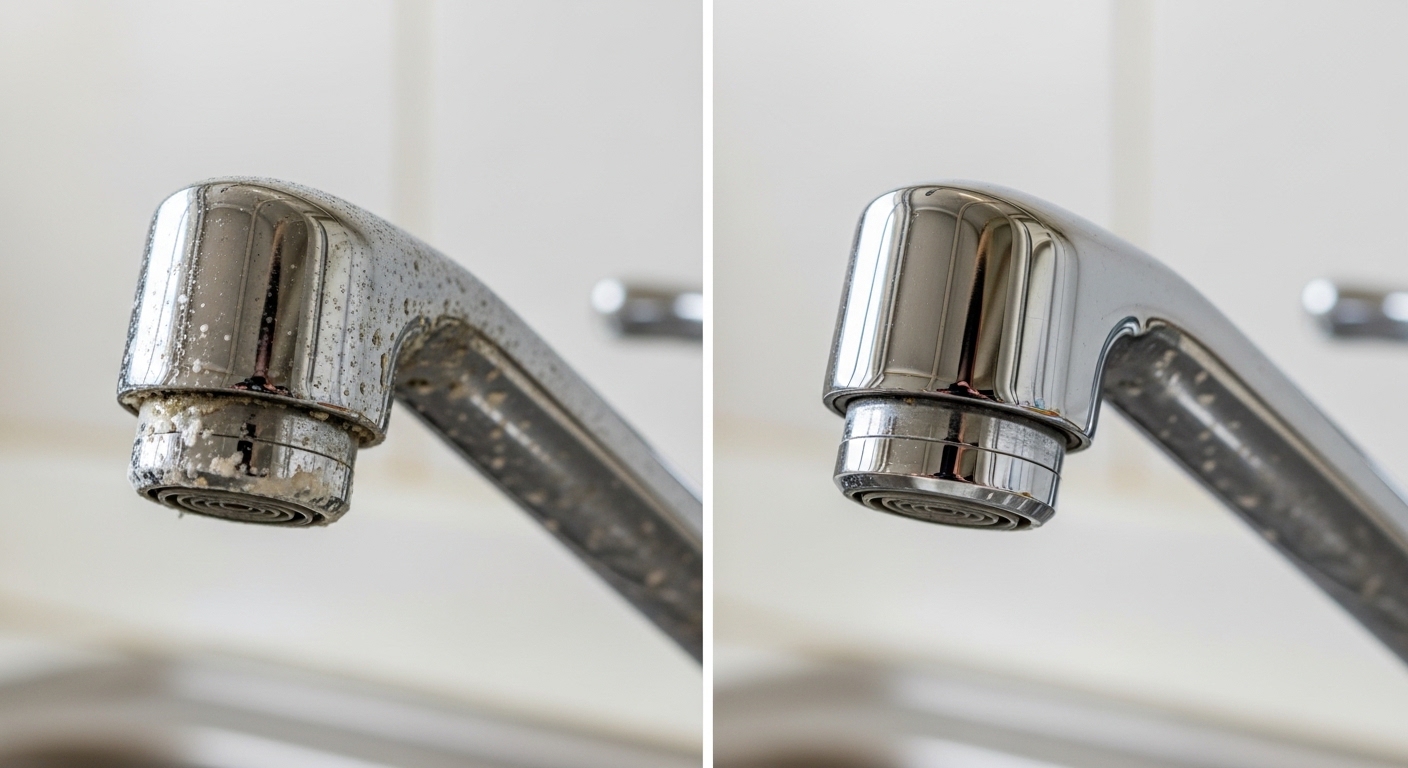
If you want to remove hard water stains on faucet surfaces the right way, the trick isn’t scrubbing harder — it’s letting a mild acid do the chemistry for you and picking a method that matches your finish. Those chalky white or rust-tinted crusts around your spout and aerator are limescale: dried mineral deposits (mostly calcium carbonate and magnesium) left behind every time hard water evaporates on the metal. Below is exactly how to dissolve them, how to keep them from coming back, and — just as important — which “cleaning hacks” will permanently damage certain faucet finishes.
Why does my faucet get those white crusty stains in the first place?
Those white crusty stains are limescale — the leftover minerals from hard water. When water that’s high in dissolved calcium and magnesium dries on your faucet, the water evaporates but the minerals stay behind and slowly build into a chalky, cement-like layer.
The harder your water, the faster it happens. Water hardness is measured in grains per gallon (GPG). Anything above about 7 GPG is considered “hard,” and much of the U.S. — especially the Southwest, Texas, and the Midwest — sits in the 10–20 GPG range. At those levels you can see fresh spotting within a day or two of wiping the faucet down. You’ll notice it most around the aerator (the screened tip of the spout), the base where the faucet meets the sink, and the handles, because that’s where water pools and dries. If the stains have a reddish or brown tint, your water also carries iron, which stains on top of the limescale.
One important point most cleaning articles skip: the stain sitting on the metal is the easy part. The same minerals also clog the tiny screen inside your aerator, which is what causes weak or sideways-spraying flow. Cleaning the outside without pulling the aerator is like mopping the floor and ignoring the leak. We’ll cover both.
What’s the fastest way to remove hard water stains on a faucet at home?
The fastest reliable method is a vinegar soak. White vinegar is about 5% acetic acid, which chemically dissolves calcium carbonate — the main ingredient in limescale — without you having to scrub the finish raw.
Here’s the step-by-step that works on chrome and stainless faucets:
- Soak a rag or paper towels in plain white distilled vinegar. Not cleaning vinegar (too strong), not apple cider vinegar (leaves residue) — just cheap white vinegar.
- Wrap the stained areas. Mold the vinegar-soaked towel around the spout, base, and handles so it stays in contact. This is the key step — a quick wipe barely touches a thick crust.
- For the spout tip, use a bag. Fill a small sandwich bag with vinegar, slip it over the end of the spout, and rubber-band it in place so the aerator sits submerged.
- Wait 15–30 minutes. Heavy buildup may need up to an hour. Warming the vinegar slightly (not boiling) speeds it up.
- Scrub gently. Use an old soft toothbrush or a non-scratch nylon pad. The softened deposits should wipe away. For grooves and the base ring, the toothbrush bristles get into seams.
- Rinse thoroughly and buff dry with a clean microfiber cloth. Drying is what stops new spots from forming immediately.
For stubborn spots, make a paste of baking soda and a little water, apply after the vinegar soak, and rub gently — it adds mild mechanical scrubbing without scratching. Do not mix baking soda and vinegar into a fizzing paste and expect more power; the fizz just neutralizes both. Use them in sequence, not together.
What household products actually work — and which are a waste of time?
Anything acidic dissolves limescale; anything abrasive risks your finish. The best options are the ones that are acidic and gentle. Here’s how the common ones compare:
| Product | How well it works on limescale | Safe on chrome/stainless? | Best for |
|---|---|---|---|
| White vinegar (5%) | Excellent — dissolves calcium carbonate | Yes | Everyday buildup, the go-to first choice |
| Fresh lemon juice | Good — citric acid, smells better | Yes | Light spots, quick freshen-up |
| Citric acid powder (dissolved in water) | Excellent — stronger, controllable | Yes | Heavy buildup, aerator soaks |
| Baking soda paste | Fair — mild abrasion, not a solvent | Yes (rub gently) | Follow-up scrub after a soak |
| Commercial descaler (CLR, Lime-A-Way) | Excellent — fast on severe scale | Chrome/stainless only, follow label | Neglected, rock-hard deposits |
| Abrasive powder / steel wool / Magic Eraser | Removes stain — and the finish | No | Nothing on a faucet — avoid |
The last row matters most. Melamine sponges (Magic Eraser), scouring powders, steel wool, and even some “soft scrub” creams are micro-abrasives. They’ll clear the stain and leave your faucet looking hazy or scratched because they’ve sanded off the polished clear coat. Once that protective layer is gone, the faucet spots faster and can start to corrode. Acid dissolves the mineral; abrasion destroys the metal. Always reach for the acid first.
Will vinegar or CLR ruin my brushed nickel, bronze, or brass faucet?
It can — and this is the mistake that turns a cleaning job into a replacement job. Vinegar and CLR are safe on solid chrome and stainless steel, but they can strip, dull, or discolor coated and living finishes like oil-rubbed bronze, matte black, brushed gold/champagne bronze, and unlacquered brass.
Here’s why: finishes like oil-rubbed bronze and matte black are essentially a colored coating over brass or zinc. Acid eats through that coating and exposes the raw metal underneath, leaving permanent light patches you can’t buff out. Brushed nickel is usually fine with a short vinegar contact, but leaving it soaking for an hour can dull the sheen. If you’re not sure whether your faucet is real solid brass or a coated look-alike, that distinction changes how you should clean it — our guide on whether a brass faucet is real brass and how to tell walks through the finger tests before you pour acid on it.
For these delicate finishes, use the gentle protocol instead:
- Warm water + a drop of dish soap on a soft microfiber cloth, wiped in the direction of the brushed grain.
- For mineral spots, dab diluted vinegar (1 part vinegar to 4 parts water) on just the spot, wait 60 seconds, then rinse and dry immediately — never soak.
- Finish with a light coat of car wax or a dedicated fixture polish to rebuild the water-repelling barrier.
- When in doubt, check the manufacturer’s care card — most spec a pH-neutral cleaner and specifically warn against acids and abrasives on PVD and living finishes.
If your finish is already worn or blotchy from past cleaning, descaling won’t bring it back. At that point you’re either replacing the faucet or refinishing it — and yes, that’s a real option; here’s how faucet paint works to fix a worn finish if the metal is sound but the look is shot.
How do I clean the clogged aerator so my water pressure comes back?
Unscrew the aerator from the spout tip, soak it in vinegar or citric acid for 20–30 minutes, and brush out the loosened scale — this restores flow far more than cleaning the outside ever will. A clogged aerator is the number-one cause of a faucet that suddenly runs weak, splits into two streams, or sprays sideways.
Do it like this:
- Unscrew the aerator by hand, turning counterclockwise (as you look up at it). If it’s stuck, wrap the tip in a cloth to protect the finish and use pliers gently. Some faucets have a hidden “cache” aerator that needs a small key tool included with the faucet.
- Note the order of the parts. Lay them out left to right as they come off — there’s usually a screen, a rubber washer, and a plastic insert that must go back the same way.
- Soak the pieces in a cup of warm vinegar or citric-acid solution for 20–30 minutes.
- Brush the screen with a toothbrush and poke any stubborn holes clear with a toothpick. Rinse.
- Reassemble and hand-tighten. Run the water — flow should be back to full and straight.
If cleaning doesn’t fully fix it, the mesh screen may be corroded or torn and needs replacing — it’s a cheap part. We cover exactly that in what faucet aerator mesh is and when to clean versus replace it. And if the weak flow turns out to be a whistling or rattling issue rather than pure buildup, this guide on why a faucet makes noise covers the other culprits.
How do I get hard water stains off the base and handles where they pool?
Target the seam where the faucet meets the sink with a vinegar-soaked cloth and a soft toothbrush, because that low spot is where water sits longest and scale builds thickest. Handles collect it in the base ring and around any decorative grooves.
Wrap the base in a vinegar-soaked paper towel, let it sit 20 minutes, then work the toothbrush around the seam. For the crevice right at the sink deck, a wooden toothpick or the edge of a plastic card lifts the softened crust without scratching. Rinse and dry the whole area — and dry the sink deck too, since standing water there feeds the next round of buildup.
How do I stop hard water stains from coming back so fast?
The single most effective habit is drying the faucet after heavy use — limescale can only form when hard water sits and evaporates on the metal. Keep a microfiber cloth by the sink and give the faucet a quick wipe after doing dishes or brushing your teeth, and you’ll cut buildup by most of what you’re fighting now.
Beyond drying, here’s what actually moves the needle, roughly in order of impact:
- Wipe and dry daily-ish. Ten seconds beats a 30-minute soak later.
- Apply a protective coat monthly. A thin layer of car wax, Rain-X, or a fixture polish on chrome/stainless makes water bead and roll off so minerals don’t cling. (Skip this on delicate finishes unless the maker approves it.)
- Fix drips fast. A slow-dripping faucet is a stain machine — it deposits minerals 24/7 in the same spot. If yours drips, our walkthroughs on fixing a leaky Moen faucet at home and stopping a leaking bathtub faucet get you there without a plumber.
- Treat the water source. If your whole house battles hard water — spotty glasses, crusty showerheads, stiff laundry — a water softener or a point-of-use filter tackles the cause instead of the symptom. It’s an investment, but it protects every fixture and appliance in the house.
- Do a light vinegar wipe weekly. A fast diluted-vinegar pass prevents thin film from ever hardening into scale, so you never face a cement-like crust.
Think of it as maintenance, not a one-time deep clean. Ten seconds of drying most days plus a two-minute weekly wipe keeps a faucet looking new for years — versus the annual battle with a caked-on crust that tempts you into abrasive shortcuts.
When is a stained faucet actually a sign it’s time to replace it?
If the metal underneath the stains is pitted, flaking, or corroded — or if you’ve already stripped the finish with abrasives — cleaning won’t save it, and replacement is the smarter move. Surface limescale always comes off; damaged plating and corroded metal do not.
Signs you’re past cleaning: rough or gritty patches that stay after descaling, a faucet that spots within hours no matter what you do (a sign the protective clear coat is gone), green or white corrosion pitting into the metal, or a spray of hard water that’s leaking from a cracked body. If you’re replacing, it’s a good moment to check your existing setup — the number of mounting holes, the spout reach, and the finish that hides spots best. Brushed nickel and brushed stainless disguise water spots far better than polished chrome, which is worth knowing if you’re in a hard-water area. Our rundown on the best brushed nickel bathroom faucet 4-inch setup is a useful starting point for a standard sink.
FAQ
Does vinegar damage chrome faucets?
No — plain white vinegar is safe on solid chrome and stainless steel, which is exactly why it’s the go-to descaler. Just rinse and dry afterward, and don’t leave it soaking for hours on end. The finishes that vinegar can damage are oil-rubbed bronze, matte black, brushed gold, and unlacquered brass, where acid strips the coating.
How long should I leave vinegar on a faucet to remove hard water stains?
15–30 minutes for typical buildup, up to an hour for a thick, neglected crust. On coated or delicate finishes, don’t soak at all — dab diluted vinegar on the spot for 60 seconds and rinse immediately. Warming the vinegar slightly speeds the reaction if you’re impatient.
Can I use CLR or Lime-A-Way on my faucet?
Yes on chrome and stainless steel, following the label’s contact-time limits — these commercial descalers are stronger and faster on severe scale. Keep them off brushed, bronze, black, brass, and other coated or living finishes, where they’ll discolor the surface. Rinse thoroughly, because leftover acid keeps working on the metal.
Why does my faucet still have low water pressure after I cleaned the stains?
Because the stains you see on the outside aren’t what’s choking the flow — the aerator screen inside the spout tip is clogged with mineral scale. Unscrew it, soak it in vinegar for 20–30 minutes, brush it clean, and reassemble. If flow is still weak, the mesh may be corroded and needs a cheap replacement.
Will a Magic Eraser remove hard water stains from a faucet?
It’ll remove the stain and dull or scratch your finish along with it — Magic Erasers are micro-abrasive and sand off the polished clear coat, which makes the faucet spot even faster afterward. Use an acidic soak (vinegar or citric acid) instead; it dissolves the mineral without touching the metal.
How do I prevent hard water stains on a new faucet?
Wipe it dry after heavy use and apply a thin protective coat (car wax or Rain-X on chrome/stainless) monthly so water beads off. Fix any drips promptly, and if your whole house has hard water, a softener or point-of-use filter stops stains at the source on every fixture.
About the author: This guide was written by the Arcora product team, who design, pressure-test, and finish-test faucets for a living. We put every faucet finish through salt-spray corrosion and abrasion testing, and we field real customer questions about hard-water care every week — so the advice here reflects what actually holds up on the fixtures we build.
About Arcora: Arcora (www.arcorafaucet.com) engineers kitchen and bathroom faucets built to survive real-world water. Our fixtures are made with lead-free brass and ceramic-disc cartridges, meet cUPC and NSF/ANSI standards for drinking-water safety, and are backed by a limited lifetime warranty on finish and function. Cleaning your faucet with the gentle methods above keeps that warranty finish intact — abrasives and harsh chemicals can void finish coverage, so when in doubt, start mild.