 ARCORA FAUCETS
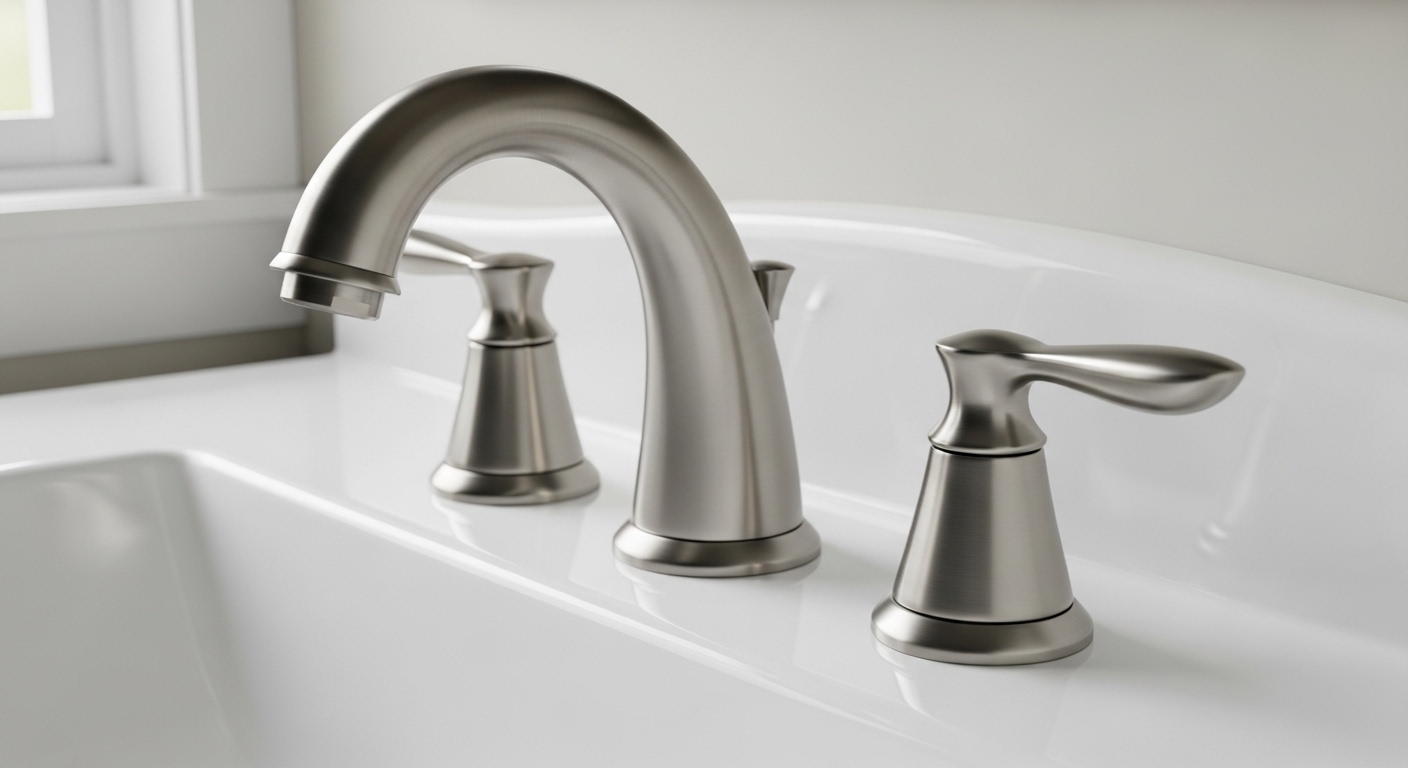
If you’re shopping for a brushed nickel bathroom faucet 4 inch model, you almost certainly have a standard three-hole sink with holes spaced 4 inches apart, and you want a finish that looks clean without constant wiping. That’s exactly what a 4-inch centerset in brushed nickel is built for. This guide breaks down what “4 inch” actually measures, why brushed nickel is the most forgiving finish for a family bathroom, how to confirm it fits before you buy, and what separates a faucet that lasts 15 years from one that drips in 18 months.
What Does “4 Inch” Actually Mean on a Bathroom Faucet?
The “4 inch” refers to the center-to-center distance between the two outer mounting holes — the hot handle hole and the cold handle hole — not the width of the whole faucet. On a 4-inch centerset, that spacing is 4 inches, and the handles plus spout are usually joined on one continuous base plate (also called an escutcheon). This is different from a widespread faucet, where the two handles and the spout are three separate pieces that can sit 8 to 16 inches apart.
So when a listing says “4 inch centerset,” it’s telling you two things: your sink has three holes, and the outer two are drilled 4 inches apart on center. Most bathroom sinks and vanity tops sold in the U.S. are pre-drilled exactly this way, which is why 4-inch centerset is the default bathroom faucet size.
There’s a common point of confusion worth clearing up: some 4-inch faucets are “single-hole ready with a deck plate,” meaning the spout and handles are actually built as one unit that covers all three holes. Others use three genuinely separate connection points. Both are called 4-inch centerset. If your sink has three holes, either style will work as long as the outer spacing matches.
| Faucet Type | Hole Spacing (center-to-center) | Number of Holes | Best For |
|---|---|---|---|
| 4-inch centerset | 4 inches | 3 holes (or covered by deck plate) | Standard bathroom vanities, small-to-medium sinks |
| Single-hole | N/A (one hole) | 1 hole | Compact vanities, modern minimalist looks |
| Widespread | 8–16 inches | 3 holes | Large vanities, upscale / custom builds |
| Mini-widespread | 4 inches | 3 holes | Standard sinks wanting the “separate handle” look |
How Do I Know a 4-Inch Faucet Will Fit My Sink Before I Buy?
Measure the center-to-center distance between your two outer holes — if it’s 4 inches, a 4-inch centerset fits. Grab a tape measure, find the middle of the left hole, and measure straight across to the middle of the right hole. If that reads 4 inches (and there’s a third hole in the middle), you have a standard three-hole centerset configuration.
A few things to check while you’re down there with the tape measure:
- Hole diameter: Most faucets need holes about 1‑1/4″ to 1‑3/8″ wide. Standard drilled sinks are fine, but confirm if you have a thick stone top.
- Deck thickness: Granite and quartz vanity tops are thicker than a ceramic sink deck. Make sure the faucet’s mounting shanks and included hardware are long enough to clamp through.
- Third hole: Some centersets don’t use the middle hole for the spout — they use it for the drain pop-up rod. Don’t panic if the spout mounts over it via the base plate.
- Clearance behind the sink: Make sure a backsplash or wall won’t block the handles from turning fully.
If your holes measure 8 inches apart instead of 4, you don’t have a centerset sink — you have a widespread layout, and a 4-inch faucet won’t reach. We cover that switch in depth in our guide on how to replace a centerset faucet with a widespread faucet. And if you’re unsure about hole sizing in general, our breakdown of what hole size is needed for a faucet walks through every measurement before you commit.
Why Is Brushed Nickel the Most Popular Finish for a Family Bathroom?
Brushed nickel hides water spots, fingerprints, and toothpaste splatter better than almost any other finish, which is exactly why it dominates family bathrooms. Its warm gray tone has a fine directional grain — a subtle brushed texture — that scatters light instead of reflecting it. Polished chrome, by contrast, is a mirror: every drop of hard-water residue and every kid’s fingerprint shows.
Here’s the practical difference in daily life. A chrome faucet in a hard-water home needs wiping almost every day to look clean. A brushed nickel faucet can go a week and still look presentable, because the matte texture visually blends the mineral spotting. For a bathroom used by kids or a busy household, that’s the whole ballgame.
Brushed nickel also plays well with almost any color scheme — white, gray, navy, wood-tone vanities, warm or cool tile. It reads as neutral and slightly warm, so it doesn’t clash the way a very cool chrome or a very warm brass can. If you like the low-maintenance, spot-hiding quality of the finish and want it in your kitchen too, the same logic applies to a brushed nickel pull-out tap.
Brushed Nickel vs. Other Popular Finishes
| Finish | Hides Water Spots? | Maintenance | Look |
|---|---|---|---|
| Brushed Nickel | Excellent | Low — wipe weekly | Warm gray, matte, versatile |
| Polished Chrome | Poor | High — wipe daily | Bright, cool, mirror-like |
| Matte Black | Good (spots) / shows dust & limescale | Medium | Bold, modern |
| Brushed Gold / Champagne Bronze | Good | Low–Medium | Warm, upscale |
| Oil-Rubbed Bronze | Excellent | Low | Dark, traditional |
Is Brushed Nickel Just Painted On, or Is It a Real Finish?
On a quality faucet, brushed nickel is a real electroplated or PVD (physical vapor deposition) finish bonded to a solid brass or stainless body — not paint. That distinction matters enormously for how long it lasts. A genuine plated finish is fused to the metal at a molecular level and won’t peel or chip under normal use. A cheap “coated” finish, on the other hand, can flake within a couple of years, especially around the handles where hands touch constantly.
The tell is the base metal underneath. A faucet built on a solid brass body with a proper nickel finish feels heavy, resists corrosion, and holds its color. A hollow zinc-alloy body with a sprayed finish feels light and tends to degrade faster. If you want to understand how to judge the metal under the finish before you buy, our article on whether a brass faucet is real brass explains exactly what to look for.
One quick reassurance: brushed nickel is one of the most durable everyday finishes on the market. Because its surface is already textured rather than mirror-polished, minor scuffs and wear blend in rather than standing out — a scratch on polished chrome screams, while the same scratch on brushed nickel practically disappears.
What Should I Look For in a 4-Inch Brushed Nickel Faucet Under $150?
Under $150, prioritize a solid brass body, a ceramic disc valve cartridge, and a lead-free waterway certified to NSF/ANSI 61 and 372 — those three things predict whether the faucet lasts. Finish color is easy to get right; internal quality is where cheap faucets cut corners. Here’s what actually matters, in order:
- Valve type: Insist on a ceramic disc cartridge. It’s the part that turns the water on and off thousands of times a year. Ceramic disc valves resist wear and hard-water grit far better than old rubber-washer compression valves, which are the number-one cause of drips.
- Body material: Solid brass beats zinc alloy for corrosion resistance and longevity. Heft is a decent proxy — a solid faucet feels substantial in the box.
- Lead-free certification: Look for NSF/ANSI 61 and 372 compliance, which limits lead in the wetted parts. This is a legal requirement for faucets sold in the U.S. and a baseline safety marker.
- Flow rate: A bathroom faucet is typically capped at 1.2 GPM (gallons per minute) to meet WaterSense standards. That’s plenty for handwashing and saves water.
- Drain assembly included: Many 4-inch centersets include a matching brushed nickel pop-up drain. Confirm it’s in the box so the drain matches the faucet.
- Warranty: A finish-and-function lifetime warranty signals the manufacturer trusts its own build. A 1-year warranty is a warning sign.
Can I Install a 4-Inch Centerset Faucet Myself?
Yes — a 4-inch centerset is one of the easiest faucets to install yourself, usually taking 30 to 60 minutes with basic tools and no plumber required. Because the whole unit mounts as one piece over three aligned holes, there’s far less fiddly alignment than a widespread faucet, where you position three separate parts. If you can turn a wrench and connect two supply lines, you can do this.
The basic sequence looks like this:
- Turn off the hot and cold shutoff valves under the sink and open the old faucet to release pressure.
- Disconnect the supply lines and remove the old faucet’s mounting nuts. (Removing a stubborn old faucet is the hardest part — our step-by-step on how to remove an old Moen bathroom faucet covers the corroded-nut situation most people hit.)
- Clean the deck, set the new faucet with its gasket or plumber’s putty, and tighten the mounting nuts from below.
- Connect the flexible supply lines — hot to hot, cold to cold — hand-tight plus a quarter turn.
- Install the pop-up drain if it’s included.
- Turn the water back on slowly and check every connection for drips.
The two tools that make life easier are a basin wrench (for the nuts you can’t reach with a normal wrench) and a bucket or towel for the water still sitting in the lines. Take your time on the supply-line connections — overtightening is a more common cause of leaks than under-tightening.
Author Note & Why You Can Trust This Guide
This guide was written by the Arcora product team, who design, spec, and pressure-test bathroom and kitchen faucets for a living. Arcora builds faucets on solid brass bodies with ceramic disc cartridges and lead-free waterways certified to NSF/ANSI 61 and 372, and every model is cycle-tested — valves are run through hundreds of thousands of open-close cycles — before it ships. Our brushed nickel finishes are applied for durability against daily wear, and our bathroom faucets are backed by a limited lifetime warranty on finish and function. We stay strictly in our lane: faucets, showers, and bathroom fixtures — so the advice here comes from people who handle these parts every day, not generalists.
FAQ
Is a 4-inch faucet the same as a centerset faucet?
Effectively, yes. “4 inch” describes the 4-inch center-to-center spacing between the outer mounting holes, and “centerset” describes the style where the handles and spout share one base. In bathroom faucets, a 4-inch faucet almost always means a 4-inch centerset. The main exception is a “mini-widespread,” which also uses 4-inch spacing but has three visually separate pieces.
Will a 4-inch centerset fit an 8-inch widespread sink?
No. If your outer holes are 8 inches apart, that’s a widespread layout, and a 4-inch centerset physically can’t span the distance. You’d either need a widespread faucet or a single-hole faucet with a deck plate long enough to cover all three holes. Always measure center-to-center between your outer holes first.
Does brushed nickel match stainless steel and other fixtures?
Brushed nickel and stainless steel are close cousins and generally pair well — both have a warm-gray, brushed matte look. They’re rarely a perfect identical match (nickel runs slightly warmer), but the difference is subtle and reads as intentional. Brushed nickel also coordinates well with white, gray, chrome, and even black accents in the same bathroom.
How do I clean a brushed nickel faucet without ruining the finish?
Wipe it with a soft damp cloth and mild dish soap, then dry it. Avoid abrasive pads, scouring powders, and acidic or ammonia-based cleaners, which can dull or damage the finish over time. For hard-water buildup, a cloth dampened with a little white vinegar, applied briefly and rinsed off, works — just don’t leave vinegar sitting on the finish for long periods.
How long should a good brushed nickel bathroom faucet last?
A quality brushed nickel bathroom faucet 4 inch model built on solid brass with a ceramic disc cartridge should last 15 to 20 years or more with normal care. The finish typically outlasts the internal valve, and even then a worn cartridge is a cheap, replaceable part rather than a reason to buy a whole new faucet. Cheaper zinc-body, spray-finished faucets are the ones that fail early.
Does a 4-inch centerset faucet come with a drain?
Many do, but not all — check the listing. A lot of quality 4-inch centersets include a matching brushed nickel pop-up drain assembly so the whole setup coordinates. If a drain isn’t included and yours is old or mismatched, buy a matching brushed nickel pop-up separately so the finish is consistent.