 ARCORA FAUCETS
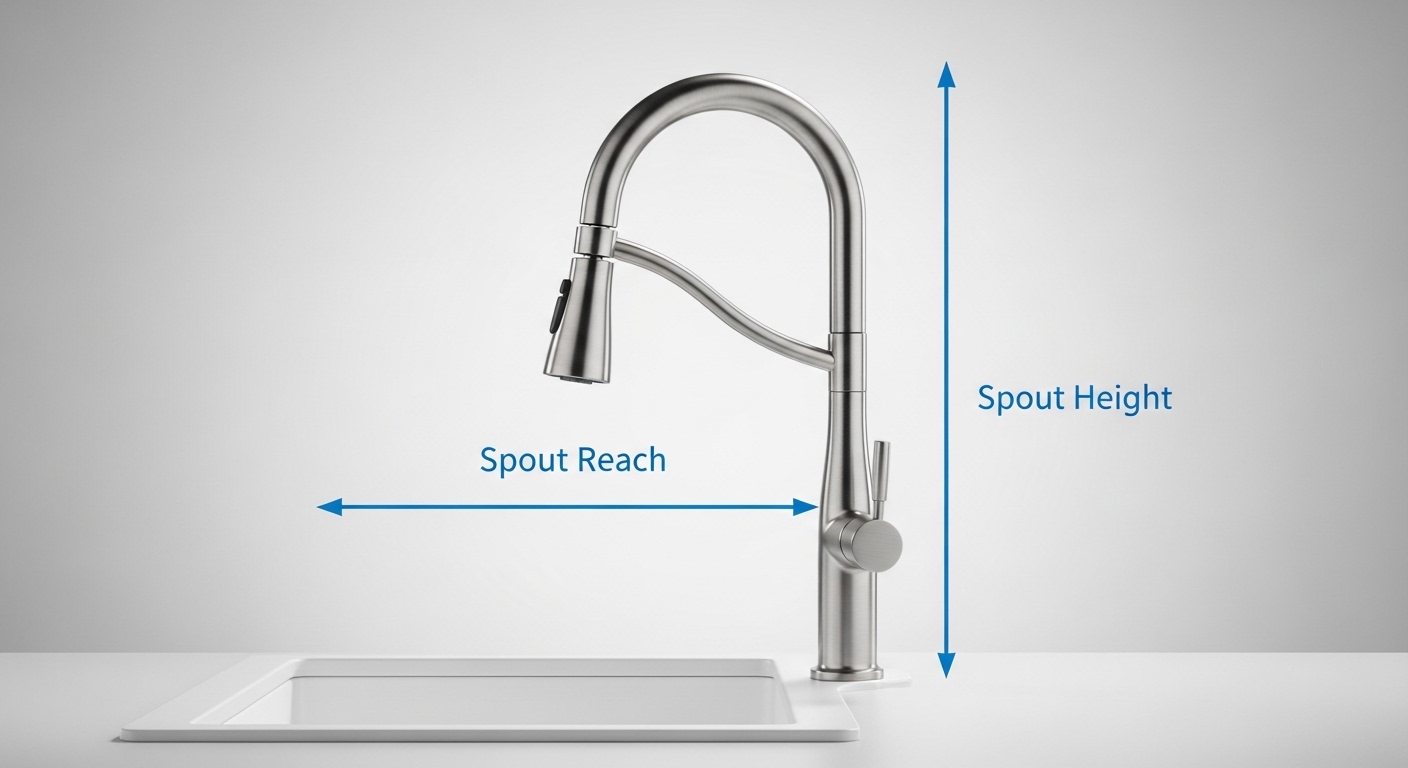
A long spout reach kitchen faucet is a faucet whose spout extends far enough forward that the water lands where you actually need it — the middle of the basin or the far bowl — instead of splashing down against the back wall of the sink or forcing you to shove dishes under a stubby stream. “Reach” is the horizontal distance from the center of the faucet base to the point where the water comes out. It is the single most overlooked spec when people shop for a kitchen faucet, and it is the one that quietly ruins the experience if you get it wrong. Below, we’ll answer the real questions shoppers ask — what counts as “long,” how much reach your specific sink needs, and how reach interacts with height, swivel, and spray style.
What counts as a “long” spout reach on a kitchen faucet?
Anything at or above roughly 8.5 inches of reach is considered long; 9–10 inches is the sweet spot for most modern sinks. Standard faucets typically land between 7 and 8.5 inches, which is fine for a small single-bowl sink but comes up short over a wide or double basin.
Here’s the context that makes the number meaningful. Kitchen sinks have gotten bigger — a 30 to 33 inch cabinet is now the norm, and the sink cutout inside it is often 27 to 30 inches wide. If your faucet is mounted at the back-center and only reaches 7 inches forward, the stream lands maybe a third of the way into the basin. You end up leaning over the counter to rinse a pot. A 9-inch reach puts the water at or past the center, which is where you naturally hold things.
Reach and height work together. A tall gooseneck with 16 inches of height but only 7 inches of reach still dumps water near the back wall — it just does it from higher up. What you want is a spout that arcs out and over, not straight up. When you read a spec sheet, look at both “spout reach” (sometimes called “spout length” or “reach”) and “spout height” as two separate numbers.
Is 8 inches of reach enough, or do I need 10?
Eight inches is enough for a single-bowl sink up to about 28 inches wide; go to 9–10 inches for a double-bowl sink or any basin 30 inches and wider. The reason is simple geometry: on a double sink, the faucet base usually sits behind the divider, so the stream has to travel forward and the spout has to swivel side-to-side to serve both bowls. A short reach can’t cover the far edges of either bowl.
If you’re right at the border — say a 30-inch single-bowl sink — a pull-down faucet solves the problem regardless of the fixed reach number, because you pull the spray head down and out to wherever you need it. That’s a key point most spec sheets don’t spell out: on a pull-down or pull-out, the listed reach is where the water lands when the head is docked. The functional reach is much greater once you pull the hose.
How do I measure the spout reach my sink actually needs?
Measure from the center of your mounting hole to the point directly above where you want water to land — usually the center of the drain or the center of each bowl — then add about half an inch of margin. That number is your minimum reach. Do this before you shop, because faucet listings hide reach in the fine print and it’s the spec that determines whether the faucet is usable.
- Find your mounting point. On most sinks the faucet hole sits 1.5 to 2.5 inches behind the back edge of the sink cutout. Mark it.
- Find your target. For a single bowl, that’s the center of the drain. For a double bowl, it’s the center of the bowl you use most, and then the far edge of the second bowl to check swivel coverage.
- Measure the horizontal distance between those two points with a tape measure held flat. That’s the reach you need.
- Add a half-inch buffer so the stream lands inside the basin, not on the drain edge where it splashes.
While you’re measuring, confirm your faucet hole size and number of holes — a long-reach single-hole faucet won’t drop into a 3-hole sink without a deck plate, and getting that wrong sends the whole faucet back.
Long spout reach faucet types compared: which one fits your sink?
The short answer: for deep or double sinks, a pull-down gives you the most usable reach because the spray head detaches; a fixed gooseneck looks cleaner but locks you into its stated reach. Here’s how the common styles stack up on reach and real-world use.
| Faucet type | Typical reach | Typical height | Best for | Watch out for |
|---|---|---|---|---|
| Fixed gooseneck (high-arc) | 8–9 in | 15–18 in | Single deep bowl, farmhouse sinks | Reach is fixed; can splash in shallow sinks |
| Pull-down | 8.5–9.5 in docked, ~20 in+ with hose | 15–18 in | Double bowls, deep basins, filling pots | Needs clearance behind sink for high spout |
| Pull-out | 8–9 in docked, ~24 in with hose | 7–9 in | Low windows behind sink, small kitchens | Lower arc means less clearance for tall pots |
| Commercial / spring-coil | 9–10 in | 18–28 in | Large single bowls, heavy rinsing | Tall; check ceiling of upper cabinets |
| Standard non-spray | 7–8 in | 8–12 in | Bar sinks, small prep sinks | Too short for wide main sinks |
If you’re leaning toward a detachable head — and for most busy kitchens you should — it’s worth reading up on the tradeoffs of a single-handle pull-out kitchen faucet setup versus a pull-down, because the arc height and hose length change how much effective reach you actually get.
Why does a long spout reach faucet splash so much — and how do I stop it?
Splashing happens when the water hits a hard, flat surface at a steep angle — usually the sink bottom in a shallow basin, or the drain in a deep one. A longer reach reduces back-wall splash but can increase drain splash if the stream lands right on the metal drain grate. Three fixes solve almost every case:
- Match reach to your drain position. Aim the stream to land a couple inches to the side of the drain, onto a dish or the basin floor, not directly on the grate.
- Use an aerator. A quality aerator softens the stream into a bubbly, low-splash flow. If yours is old, splashy, or crusted, clean or swap the faucet aerator mesh — it’s a five-minute fix that changes the whole stream.
- Consider flow rate. A gentler stream splashes less. Many buyers happily run a low-flow kitchen faucet at 1.5 GPM instead of 2.2 GPM and never notice the difference except less splash and a smaller water bill.
Does a longer spout mean I lose water pressure?
No — spout reach has essentially nothing to do with water pressure. Pressure at the tap is set by your home’s supply line, your shutoff valves, and the faucet’s aerator flow rate, not by how far the spout extends. A 10-inch-reach faucet and a 7-inch one with the same 1.8 GPM aerator deliver identical flow.
What can change with a long pull-down or pull-out is the feel of the spray when the head is extended, because the water travels through a flexible hose. A cheap, kinked, or undersized hose can throttle flow. On a quality faucet the hose is sized so you never notice. If you already have a long faucet and the pressure dropped over time, that’s almost always sediment in the aerator or valve, not the spout length — worth checking before you blame the faucet. If the drop is sudden and affects the whole tap, our guide on why tap water pressure suddenly gets worse walks through the usual culprits.
Will a tall long-reach faucet fit under my window or upper cabinet?
Check your clearance before the height, not after. Measure from the deck (the counter or sink rim where the faucet mounts) straight up to the lowest obstruction — a window sill, an upper cabinet, or a shelf. Subtract 2 to 3 inches so the handle has room to lift and the spout can swivel. That number is your maximum spout height.
This is where a lot of long-reach purchases go wrong. People fall for a dramatic 18-inch commercial spring faucet, then discover the handle hits the windowsill when they turn it on, or the spout can’t swivel to the second bowl because it’s boxed in. Two ways around a tight space:
- Pick a pull-out instead of a pull-down. Pull-outs have a low horizontal spout (7–9 inches tall) but a long hose, so you get reach without height. Great under a window.
- Choose a lower-arc gooseneck with a forward-leaning spout — it trades a little height for the same or better reach.
Is a long spout reach faucet good for filling tall pots and portable appliances?
Yes — this is where a long, tall faucet earns its keep. A high-arc spout with 9+ inches of reach lets you slide a stockpot or a Brita pitcher under the stream without tilting it, and a pull-down head lets you direct water into anything sitting in the basin. If you regularly fill a portable dishwasher or a countertop appliance, prioritize both height (16 inches or more) and reach (9 inches or more), plus a spray head that swivels a full 360 degrees so you can aim it at the coupler or hose without fighting the faucet.
One caveat: the taller and longer the spout, the more it can splash in a shallow bar or prep sink. Long-reach high-arc faucets are made for deep main sinks (8 inches deep or more). Pair them accordingly.
What finish and build should a long-reach faucet have to last?
For a spout that’s constantly swiveling and getting pulled, prioritize a solid brass or stainless body, a ceramic-disc cartridge, and a spot-resist or brushed finish that hides water marks. Reach doesn’t matter if the swivel base loosens or the finish flakes in two years. If you like the low-fingerprint look, a brushed finish on a brushed nickel pull-out tap is the most forgiving choice for a busy kitchen — it shades water spots and light scratches better than polished chrome.
Two build details matter specifically for long-reach faucets:
- The swivel joint. A long spout puts more leverage on the base, so a metal (not plastic) swivel collar and a quality O-ring keep it from wobbling or dripping at the base.
- The hose and dock. On pull-downs, a magnetic dock holds the heavy head snugly so it doesn’t sag over time. A weak dock is the number-one long-term complaint on long-reach pull-downs.
Long spout reach kitchen faucet buying checklist
Before you check out, run through this. It’s the same order a pro would use to spec a faucet, and it prevents the two most common returns — “too short” and “won’t fit.”
- Measure required reach (base to drain/bowl center + 0.5 in).
- Measure max height (deck to obstruction − 2–3 in).
- Confirm hole count and hole size match your sink (or plan on a deck plate).
- Decide fixed vs. pull-down vs. pull-out based on clearance and how you use the sink.
- Check the flow rate (GPM) and whether it meets your local water regulations.
- Confirm solid brass/stainless body, ceramic cartridge, and a warranty you can actually use.
FAQ
What is the average spout reach on a kitchen faucet?
Most standard kitchen faucets have a reach of 8 to 9 inches. Anything under 8 inches is short and best for small or bar sinks; 9 to 10 inches is considered long and suits wide single bowls and double-bowl sinks. Pull-down and pull-out models effectively extend far beyond their docked reach because the spray head detaches.
How long should a kitchen faucet spout be for a double sink?
Aim for at least 9 inches of reach for a double-bowl sink, combined with a spout that swivels a full 360 degrees. Because the faucet usually mounts behind the divider, the spout has to reach forward and rotate to serve both bowls. A pull-down head makes this effortless regardless of the fixed reach, since you can pull the water to either bowl.
Does a longer faucet spout reduce water pressure?
No. Water pressure is determined by your home’s supply and the faucet’s aerator flow rate, not by spout length. A longer spout delivers the same pressure as a shorter one with the same GPM rating. If pressure has dropped on an existing long faucet, the cause is almost always a clogged aerator or sediment in the valve, not the spout.
Can a long-reach faucet cause more splashing?
It can, but only if the stream lands directly on the drain grate or the flat bottom of a shallow sink. A longer reach usually reduces back-wall splash. Aim the stream a couple inches off the drain, use a good aerator, and pair long high-arc faucets with deep basins (8 inches or more) to keep splashing minimal.
What’s the difference between spout reach and spout height?
Spout reach is the horizontal distance the water travels forward from the faucet base; spout height is how tall the spout rises above the deck. You need both: a tall spout with short reach dumps water near the back wall, while a long-reach spout puts the stream where you work. For most sinks, look for roughly 9 inches of reach and 15 to 17 inches of height.
Do I need a pull-down or pull-out for a long-reach faucet?
Not strictly — a fixed gooseneck with 9 inches of reach works fine for a single deep bowl. But if you have a double sink, a low window behind the faucet, or you fill large pots, a pull-down (for height and clearance) or pull-out (for low-clearance spots) gives you far more usable reach because the spray head extends on a hose to wherever you point it.
Author note & brand credibility
Written by the arcorafaucet product team. We design and stress-test kitchen and bathroom faucets, and the reach and clearance guidance here comes from fitting faucets to real sink cutouts, not spec sheets alone. Arcora faucets are built with solid brass and stainless bodies and ceramic-disc cartridges, and our kitchen models are tested to cUPC / NSF-61 standards for lead-free drinking-water safety and cartridge cycle life. Reputable long-reach kitchen faucets typically carry a limited lifetime warranty on the finish and cartridge — always confirm the warranty terms before you buy, since that’s the clearest signal of how long the swivel joint and spray head are built to last.