 ARCORA FAUCETS
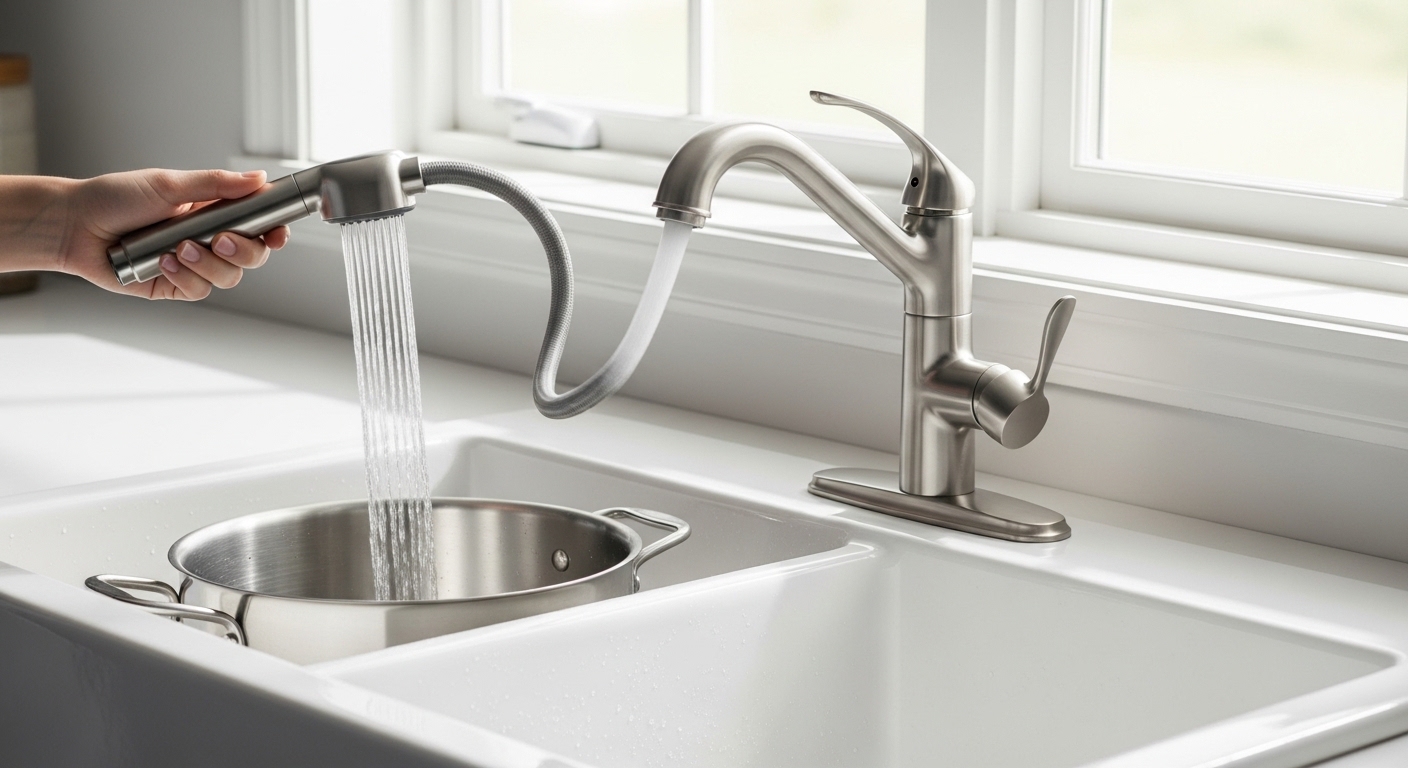
A pull out kitchen faucet single handle is the workhorse of the modern kitchen: one lever handles both temperature and volume, and the spray head pulls straight out toward you on a flexible hose so you can rinse dishes, fill pots on the counter, and clean the sink without contorting your wrist. If you’ve been staring at a wall of nearly identical-looking faucets wondering what actually separates a good one from a headache, this guide breaks it down in plain terms — what to look for, what the specs really mean, and how to match a faucet to your sink and your habits.
Below, we answer the questions people actually ask before buying: pull-out vs. pull-down, how many holes you need, what a “single handle” really gets you, which finish survives daily life, and how to install one without a plumber. Let’s get into it.
What exactly is a pull out kitchen faucet single handle — and how is it different from a pull-down?
A pull-out single-handle faucet has one lever for temperature and flow, plus a spray head (the “wand”) that detaches and pulls horizontally toward you on a hose, usually from a lower, more compact spout. A pull-down, by contrast, has a tall gooseneck spout, and the wand pulls straight down into the sink. The single-handle part just means you operate everything with one lever instead of separate hot and cold knobs.
That horizontal pull is the whole point. Pull-outs shine when you need to aim water beyond the sink — filling a pot on the counter, watering a plant, rinsing a baking sheet that won’t fit under a fixed spout. They also fit better under low upper cabinets or a window, because the spout sits lower than a dramatic gooseneck.
| Feature | Pull-Out Single Handle | Pull-Down Single Handle |
|---|---|---|
| Spray direction | Horizontal, toward you | Vertical, down into sink |
| Spout height | Lower (8–11 in typical) | Taller (14–18 in typical) |
| Best for | Low cabinets, windows, filling on counter | Deep single-bowl sinks, big pots in-basin |
| Wand ergonomics | Longer wand, easy to grab | Compact, docks overhead |
| Typical price | $80–$200 | $100–$250 |
Neither is “better” universally. If your sink sits under a window or a low cabinet, or you regularly fill things on the counter, a pull-out single handle is the smarter pick. If you have a deep single-bowl sink and want to fit tall stockpots underneath, a pull-down usually wins. If you’re weighing the two in a brushed finish specifically, our deep dive on whether a brushed nickel tap pull out is worth it for a busy kitchen covers the trade-offs finish-by-finish.
How many holes do I need in my sink for a single-handle pull-out faucet?
Most single-handle pull-out faucets need just one hole (1⅜ inch, or 34–35 mm) for the faucet body. If your sink or countertop already has three or four holes — from an old two-handle setup or a side sprayer — you cover the extras with a deck plate (also called an escutcheon), which almost every single-handle faucet includes or offers.
Here’s the quick way to know before you buy:
- 1 hole: Perfect — install the faucet directly. Cleanest look.
- 3 holes (4-inch centers): Use the included deck plate to cover the outer two.
- 3 holes (8-inch centers): Buy a 10-inch deck plate, or repurpose a hole for a soap dispenser.
- 4 holes: Deck plate over three, dedicate the fourth to a soap dispenser or air gap.
Before you order anything, measure the mounting hole diameter and the distance between hole centers. If you’re unsure exactly what to measure or how a too-small hole can sink a purchase, our guide on what hole size is needed for a faucet walks you through it with a tape measure in about two minutes.
What should I actually look for so it doesn’t leak or wear out in two years?
Prioritize four things: a ceramic-disc valve, a solid brass body, a nylon-braided pull-out hose, and a magnetic dock. Those four separate a faucet that lasts a decade from one that drips and sags within a couple of years. Everything else — finish, spout style — is preference.
Here’s why each one matters:
- Ceramic-disc valve: This is the cartridge that starts and stops the water. Ceramic discs resist wear and hard-water grit far better than old rubber-washer designs, which is the single biggest reason a faucet drips. Look for a valve rated to 500,000 cycles.
- Solid brass body: Brass resists corrosion and gives threads something durable to bite into. Cheaper zinc-alloy or plastic bodies can crack or corrode. If you want to know how to tell real brass from plated pot-metal, we cover the trick in is a brass faucet real brass and how can you tell.
- Nylon-braided hose: The pull-out hose flexes thousands of times. A braided stainless or nylon hose outlasts bare PVC and won’t kink.
- Magnetic dock: Older pull-outs used a counterweight to retract the wand; over time the wand droops and won’t seat. A strong magnet snaps the wand back into place cleanly every time.
One more spec worth checking: flow rate, listed in GPM (gallons per minute). A 1.8 GPM aerator is the sweet spot for a kitchen — strong enough to fill a pot fast, efficient enough to meet water-saving standards. If you’re curious where the line sits, see what is considered a low flow kitchen faucet before you decide you need maximum blast.
Which finish holds up best in a real kitchen — brushed nickel, matte black, or chrome?
Brushed nickel is the most forgiving finish for a busy kitchen: its soft satin texture hides water spots and fingerprints far better than shiny chrome, and it pairs with almost any counter or cabinet color. Matte black looks fantastic but shows hard-water mineral spots and dried soap more readily; chrome is durable and cheap but is a fingerprint magnet.
| Finish | Hides fingerprints | Hides water spots | Best for |
|---|---|---|---|
| Brushed / Satin Nickel | Excellent | Excellent | Busy family kitchens |
| Matte Black | Good | Fair (shows minerals) | Modern, soft-water homes |
| Chrome | Poor | Fair | Budget, classic look |
| Brushed Gold / Champagne Bronze | Excellent | Good | Warm, statement kitchens |
Whatever finish you choose, look for a PVD (physical vapor deposition) coating rather than a cheap electroplated one. PVD finishes bond at a molecular level and resist scratching, tarnishing, and fading — they’re the reason a good faucet still looks new after years of scrubbing. If you live with hard water, brushed nickel or brushed gold will forgive you the most; matte black will demand a quick wipe-down to stay looking its best.
How do I install a single-handle pull-out faucet myself?
You can install most single-handle pull-out faucets yourself in 45 to 90 minutes with an adjustable wrench, a basin wrench, plumber’s tape, and a bucket. The single-handle, single-hole design is genuinely one of the easier DIY plumbing jobs because there’s only one supply body to secure and two supply lines to connect.
The basic sequence:
- Shut off the water at the two valves under the sink and open the old faucet to release pressure.
- Disconnect and remove the old faucet — loosen the supply lines and the mounting nuts underneath (a basin wrench is your friend here).
- Feed the new faucet down through the hole, add the deck plate if needed, and tighten the mounting nut from below.
- Thread the pull-out hose through the spout, connect the weight or confirm the magnetic dock, and attach the hose to the supply outlet.
- Connect supply lines — hot to left, cold to right — wrapping threads with plumber’s tape.
- Turn the water back on slowly, remove the aerator, and run water 15 seconds to flush debris before checking for leaks.
If your existing setup is a specific brand like Kohler, the removal steps differ slightly and it’s worth a look at our step-by-step on how to replace a kitchen faucet Kohler model yourself. And if the wand’s spray hose is what’s actually failing — not the whole faucet — you may just need a replacement sprayer, covered in what should you actually buy for a pull-out or side spray replacement.
Is a pull-out single handle worth it, or should I just get two handles?
For nearly everyone, a single handle is worth it — it’s faster, more intuitive, and easier to use with wet or full hands. You bump the lever with a wrist or forearm to get water going, and you dial temperature in one motion instead of balancing two separate valves. Two-handle (widespread) faucets mainly make sense when you want a specific traditional look or already have three holes and don’t want a deck plate.
The practical wins of a single-handle pull-out add up daily:
- One-hand operation when your other hand is holding a pan or a toddler.
- Faster temperature setting — no fiddling with two knobs.
- Fewer leak points — one valve cartridge instead of two.
- Reach and flexibility — the wand goes where a fixed spout can’t.
The one honest downside: because temperature and volume share a lever, ultra-precise temperature tweaks are slightly less granular than two dedicated handles. In real kitchen use, almost nobody notices. If precise control matters and you’re renovating anyway, it’s worth reading about the trade-offs of moving from a compact layout to a spread-out one in how to replace a centerset faucet with a widespread faucet.
What’s a fair price, and what do I get at each tier?
Expect to spend $90–$180 for a genuinely good single-handle pull-out faucet — solid brass, ceramic valve, PVD finish, magnetic dock. Below $60 you’re usually buying zinc bodies and plastic wands that fail early; above $250 you’re mostly paying for designer branding and smart/touchless features, not core durability.
| Price tier | What you typically get | Watch out for |
|---|---|---|
| Under $60 | Zinc/plastic body, basic finish | Early drips, drooping wand |
| $90–$180 | Brass body, ceramic valve, PVD, magnetic dock | Sweet spot — best value |
| $180–$250 | Premium finishes, better sprays, longer warranty | Diminishing returns |
| $250+ | Touchless, smart, designer branding | Paying for tech/name, not durability |
The best value sits squarely in that middle band. A faucet there should carry a limited lifetime warranty on finish and function — if a brand only offers one year, that tells you something about their confidence. Cross-shop with real user feedback too; our roundup of Forious kitchen faucet reviews shows how a mid-tier brand actually holds up over time, which is a useful sanity check against marketing copy.
How do I keep the spray strong and the wand from drooping?
Two things keep a pull-out performing like new: clean the aerator every few months and confirm the retraction system stays healthy. Hard-water minerals clog the tiny mesh screen in the wand, weakening and splitting the stream; a drooping wand usually means the counterweight slipped or the magnetic dock has debris on it.
A simple maintenance routine:
- Unscrew the aerator/spray face and soak it in white vinegar for an hour to dissolve mineral buildup, then rinse. If the mesh is torn, replace it — see what is faucet aerator mesh and should you clean it or replace it.
- Wipe the magnetic dock and the top of the wand so the magnet seats cleanly.
- Check the counterweight (on non-magnetic models) is still clamped to the hose about 6–8 inches below the faucet base.
- Flush the hose occasionally by pulling the wand fully out and running warm water to clear grit.
If your stream suddenly goes weak everywhere, not just at the wand, the culprit may be pressure rather than the faucet — our guide on why tap low water pressure suddenly gets worse helps you tell the difference before you start replacing parts.
FAQ
Can I put a single-handle pull-out faucet on a sink that had two handles?
Yes. Sinks that had two handles usually have three holes on 4-inch centers. Use the deck plate that comes with the single-handle faucet to cover the two outer holes, then mount the faucet in the center hole. It’s one of the most common swaps people make, and it doesn’t require drilling anything.
Are pull-out faucets more likely to leak than fixed-spout ones?
Not if they’re built well. The extra potential leak point is the hose connection under the sink, but a quality nylon-braided hose with a proper quick-connect fitting is very reliable. The valve cartridge — the same part a fixed faucet uses — is still the most common source of drips, and a ceramic-disc valve minimizes that risk on either style.
What flow rate should a single-handle pull-out kitchen faucet have?
1.8 GPM is ideal for most kitchens — strong enough to fill pots quickly while meeting modern efficiency standards. Some regions cap kitchen faucets at 1.8 GPM by code (California, for example). If your only complaint is speed filling a large stockpot, 2.2 GPM units exist, but 1.8 handles nearly everything without wasting water.
How long should a good pull-out faucet last?
A solid-brass, ceramic-valve faucet with a PVD finish should last 10 to 15 years with basic care, and the finish itself is typically covered by a limited lifetime warranty. Budget faucets with zinc bodies and plastic wands often start failing — drips, drooping wands, flaking finish — within 2 to 4 years, which is why the mid-tier is usually the better long-term buy.
Do I need a plumber to install one, or can I do it myself?
Most people can install a single-handle pull-out faucet themselves in under 90 minutes with basic tools. The single-hole design means only one mounting point and two supply lines to connect. The trickiest part is loosening the old mounting nuts in the tight space under the sink, which a basin wrench solves. Call a pro only if your shutoff valves are corroded or your supply lines need replacing.
Will a pull-out wand fit my portable dishwasher adapter?
Pull-out spray heads generally don’t accept a portable dishwasher coupler because the wand isn’t threaded like a standard aerator. If you rely on a portable dishwasher, you’ll want a faucet with a compatible threaded aerator — we cover exactly which setups avoid the coupler headache in our guide to the best kitchen faucet for a portable dishwasher.
The bottom line
A single-handle pull-out kitchen faucet is the right default for most homes: one intuitive lever, a wand that reaches where a fixed spout can’t, and easy one-hole installation. Buy in the $90–$180 range, insist on solid brass, a ceramic-disc valve, a nylon-braided hose, a magnetic dock, and a PVD finish, and you’ll have a faucet that quietly does its job for a decade or more. Match the finish to your water and your cleaning tolerance — brushed nickel for maximum forgiveness — and you’re set.
Author note: This guide was written by the Arcora product team, drawing on hands-on testing of pull-out and pull-down faucets across finishes and valve types. Arcora designs and manufactures kitchen and bathroom fixtures built to meet cUPC and NSF/ANSI standards, and backs its finishes and cartridges with a limited lifetime warranty. We test spray heads, valve cartridges, and hose durability to real-world cycle counts before a faucet ever ships — because the difference between a good faucet and a frustrating one is almost always in the parts you can’t see.