 ARCORA FAUCETS
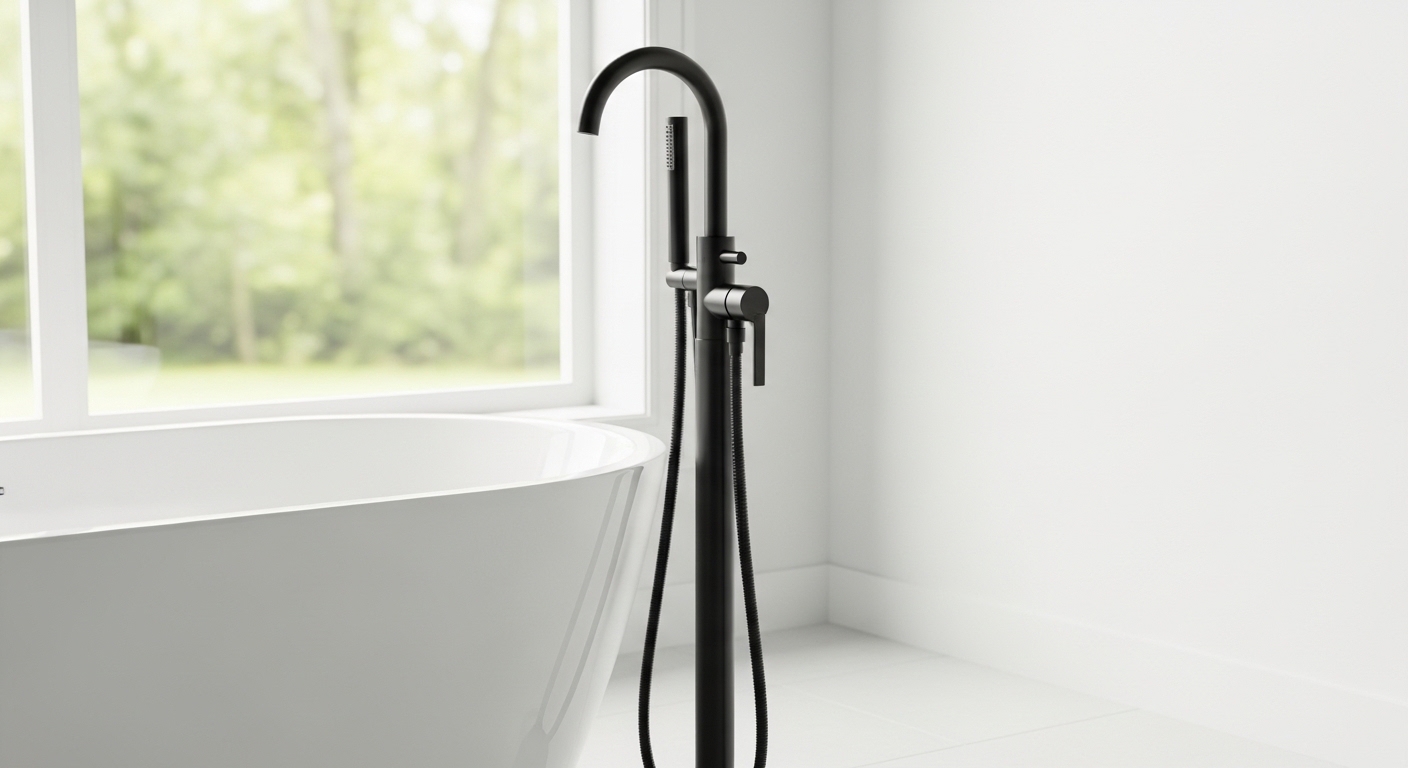
A freestanding tub faucet with shower is exactly what it sounds like: a tall, floor-mounted faucet that rises up next to a standalone bathtub and adds a handheld shower sprayer to the setup. Instead of the water only pouring from a fixed spout, you get a diverter that switches flow between the main tub filler and a flexible hand shower on a hose. That one addition is what turns a purely decorative soaking tub into something you can actually use every day — rinsing shampoo, bathing kids and dogs, and spraying down the tub after use. Below, I’ll walk you through how these work, who they’re actually for, what to check before you buy, and how to avoid the mistakes that lead to leaks and wobble.
What exactly is a freestanding tub faucet with shower, and how does it work?
It’s a single floor-standing faucet that combines a tub filler spout, hot/cold controls, and a handheld shower on a hose — all fed by one floor-mounted plumbing riser. You turn on the water, set the temperature, then flip a diverter (a small lever or pull-tab) to send water either out the main spout to fill the tub, or up through the hose to the handheld wand.
The whole thing stands on its own because it mounts through the floor, not the wall or the tub deck. Water lines run up through the subfloor and into the faucet’s supply riser (usually a wider decorative tube that hides the actual supply lines). Most models bolt down with a mounting bracket that’s secured to the floor joists or a reinforced block before the finished floor goes in. That floor anchor is the single most important part of the install — it’s what keeps a 40-plus-inch metal fixture from swaying every time someone grabs the handshower.
Functionally, there are three things happening in one body: the valve (which mixes hot and cold and controls flow), the spout (the arc that fills the tub), and the diverter + handshower (which reroutes water to the wand). If you want a deeper look at the valve side specifically — the part that actually lives below the floor — see our guide on what a freestanding tub faucet valve is and whether you need one.
Do I actually need the shower part, or is a plain tub filler enough?
Get the shower version if you’ll ever wash your hair in the tub, bathe kids or pets, or want an easy way to rinse the tub clean — otherwise a plain filler is fine. That’s the honest answer. A lot of people fall in love with the sculptural look of a freestanding tub, install a spout-only filler, and then realize six months later that they have no way to rinse conditioner out of their hair without dunking backward into the water.
Here’s how I’d think about it based on real use:
- You want it if: you have long hair, small kids, a dog that needs bathing, or you simply hate leaving soap residue in a soaking tub. The handheld makes all of those effortless.
- You want it if: the freestanding tub is your only bathing fixture in that bathroom and there’s no separate shower stall. The handshower gives you a quick-rinse option so the tub isn’t a soak-only luxury.
- You can skip it if: you have a separate walk-in shower nearby and the tub is purely for occasional relaxing soaks. In that case a clean spout-only filler looks more minimal and costs less.
One thing worth noting: adding the handshower rarely adds much to the price at the mid and upper tiers, but it does add a diverter — one more moving part that can wear or drip over time. That trade-off is almost always worth it for the everyday convenience.
What are the different types of freestanding tub faucet with shower?
There are three main styles, and the right one depends on your tub, your floor, and your budget: floor-mount single-riser, floor-mount with a metal supply-line “cannon” base, and deck-mount hybrids that sit on a tub deck rather than the floor. Most people picturing a standalone tub want a true floor-mount model.
| Type | How it mounts | Best for | Typical price (US) | Watch out for |
|---|---|---|---|---|
| Floor-mount single riser | One decorative tube through the floor, supply lines hidden inside | Modern standalone tubs, clean minimal look | $180–$600 | Needs precise floor rough-in; hard to move later |
| Floor-mount with exposed supply legs | Two visible metal supply legs plus mixing body | Traditional / vintage clawfoot-style tubs | $250–$800 | More visible plumbing to keep clean and aligned |
| Deck-mount with handshower | Bolts to a wide tub deck or platform | Drop-in or platform tubs, not true freestanding | $150–$500 | Requires a deck; not for center-of-room tubs |
If your tub is going to sit against or very near a wall, you might not need a freestanding unit at all — a wall-mounted setup can be cheaper and easier to rough in. We compare that scenario in detail in our guide to wall-mount faucets for bathtubs.
What finish holds up best in a real bathroom?
Brushed nickel and matte black are the most forgiving finishes for daily use because they hide water spots and fingerprints far better than polished chrome — while chrome stays the easiest to find replacement parts for and the cheapest to buy. Finish isn’t just looks; it changes how much you’ll be wiping the fixture down.
- Brushed / satin nickel: warm, hides limescale and fingerprints, pairs with almost anything. My default recommendation for hard-water homes.
- Matte black: dramatic and on-trend, hides spots well, but shows dried soap and mineral film if you have very hard water — you’ll want to wipe it after use.
- Polished chrome: classic, cheapest, easiest to source parts for, but shows every water spot.
- Brushed gold / champagne bronze: luxurious look, generally good spot resistance, but confirm it’s a PVD finish for durability, not a cheap coating.
Whatever finish you choose, hard water is the enemy of a good-looking tub faucet. If you’re already fighting mineral buildup elsewhere in the house, read how to remove hard water stains without wrecking the finish before you scrub anything abrasive across that new fixture.
How do I install a freestanding tub faucet with shower?
You install it by roughing in floor supply lines before the finished floor goes down, anchoring a mounting bracket to the subfloor or joists, then connecting the faucet body, spout, and handshower hose and pressure-testing for leaks. It is very doable as an advanced DIY job, but the plumbing rough-in has to happen at the right stage of construction — this is not a swap-it-out-in-an-afternoon project like a deck faucet.
Here’s the realistic sequence:
- Confirm rough-in location. The faucet must land where the manufacturer specifies relative to the tub’s overflow and rim — usually a few inches off the tub, on the drain end. Measure against your specific tub before cutting anything.
- Set the mounting bracket. Anchor it to solid framing, not just plywood. A tall fixture creates leverage; a weak anchor equals a wobbly faucet within a year.
- Run and flush the supply lines. Bring hot and cold up through the floor, flush debris out before final connection so it doesn’t clog the valve or aerator.
- Assemble the riser, valve body, spout, and handshower. Use the supplied gaskets and thread sealant where directed. Don’t over-torque decorative connections.
- Pressure-test. Turn water on slowly, check every joint, run the diverter through both modes, and watch for drips at the handshower connection and diverter.
Because the water-supply lines are permanent once the floor is finished, get the rough-in dimensions right the first time. If your project also involves the tub/shower valve wall side, our breakdown of which tub faucet valves you actually need is a good companion read for understanding valve compatibility.
Why is my tub faucet dripping from the handshower — and how do I stop it?
A freestanding tub filler that drips from the handshower after you shut it off almost always has a worn or dirty diverter, not a broken valve. The diverter is supposed to fully close the path to one outlet when it opens the other; when its seal wears or catches mineral debris, a little water keeps sneaking through to the wand.
Quick fixes, in order of likelihood:
- Mineral buildup in the diverter or handshower. Soak the wand in white vinegar and cycle the diverter a few times to clear grit.
- Worn diverter washer or O-ring. Most brands sell an inexpensive rebuild kit; swapping it takes minutes once you have the part.
- Hose kinked or not seated. A pinched hose can hold pressure and dribble; reseat the connection.
The same physics causes the classic complaint of water running out the tub spout while the shower’s on. If that’s the symptom you’re chasing, our dedicated guide on why a tub spout leaks when the shower is on and how to fix it fast walks through the diverter diagnosis step by step.
How much should I spend, and what do I get at each price?
Plan on $180–$300 for a solid mid-range freestanding tub faucet with shower that will last years, and $400+ if you want premium finishes, ceramic-disc valves, and a heavier solid-brass body. Below about $150, you’re usually looking at thin-walled construction, plastic internals, and finishes that can flake — fine for a rental, risky for a forever bathroom.
What the money actually buys:
- Under $150: lighter builds, often zinc or plated components, basic diverters. Watch for wobble and finish wear.
- $180–$300: the sweet spot — solid-brass or heavy-body construction, ceramic-disc valve cartridges, PVD finishes, smoother diverters, better handshowers.
- $400 and up: premium finishes, designer forms, heavier risers, longer warranties, and quieter, more precise valves.
One spec that quietly matters: valve type. Ceramic-disc cartridges resist wear and drips far better than rubber-washer valves, so they’re worth prioritizing at any budget. Flow rate matters too — many tub fillers deliver a high GPM to fill a big tub quickly, which is great for the spout but means the handshower can feel forceful; check that the model lets you throttle it comfortably.
Freestanding tub faucet with shower vs. wall-mount vs. deck-mount: which should I choose?
Choose a freestanding tub faucet with shower if your tub sits away from any wall and you want a self-contained, statement fixture; choose wall-mount if the tub is against a wall and you’d rather save on floor plumbing; choose deck-mount only if your tub has a wide rim or platform to bolt into. The tub’s position in the room decides this more than anything else.
A freestanding unit is the most flexible for a true center-of-room or off-wall soaking tub, and it keeps all controls at arm’s reach. The trade-off is the floor rough-in commitment and generally higher cost. If you’re weighing brand-name options in this category, our look at whether a Kohler freestanding tub faucet setup is worth it gives useful context on how build quality and pricing scale across brands.
Author note & why you can trust this guide
This guide was written by the arcorafaucet product content team, drawing on hands-on installation feedback, manufacturer spec sheets, and years of fielding customer questions about tub fillers, diverters, and handshower leaks. Arcora designs and sells faucets and bathroom fixtures direct to homeowners, and our tub fillers are built with solid-brass bodies and ceramic-disc cartridges, tested to standard flow and pressure benchmarks, and backed by a manufacturer warranty against finish and cartridge defects. We recommend confirming that any faucet you buy — ours or anyone’s — carries recognized certification (such as cUPC/NSF listing) for potable-water safety and lead-free compliance before it goes into your home.
FAQ
Can I add a shower to an existing freestanding tub filler?
Only if the filler was designed with a diverter and handshower port — you can’t easily add a handshower to a spout-only floor faucet. If yours has a capped diverter outlet, some brands sell a matching handshower add-on kit. Otherwise, you’d need to replace the whole fixture with a model that includes the shower.
Does a freestanding tub faucet with shower need special plumbing?
Yes — it needs floor rough-in plumbing (hot and cold supply lines brought up through the subfloor) and a solid mounting anchor into framing. This must be planned before the finished floor is installed, which is why it’s easiest to spec during a renovation rather than as a quick retrofit.
How far from the tub should a freestanding tub faucet be installed?
Follow the manufacturer’s spec, but it’s typically a few inches off the tub on the drain/overflow end so the spout arcs cleanly over the rim. Positioning it too far means water splashes the floor; too close and the spout may hit the tub. Always dry-fit against your exact tub before setting the plumbing.
Why does my freestanding tub faucet wobble?
A wobbling floor-mount faucet almost always means the mounting bracket wasn’t anchored to solid framing, or the anchor bolts have loosened. Because the fixture is tall, even a small looseness at the base becomes noticeable sway at the top. Re-securing the bracket to solid blocking usually fixes it.
Is the water pressure from the handshower strong enough for rinsing?
Yes — most tub fillers push a high flow rate to fill a big tub fast, so the diverted handshower typically has plenty of rinsing pressure. If anything, some feel too forceful; look for a model with a comfortable spray pattern and, ideally, a flow you can moderate at the valve.
What’s the difference between a freestanding tub faucet and a Roman tub faucet?
A freestanding tub faucet mounts to the floor and stands on its own beside a standalone tub, while a Roman tub faucet mounts onto the tub’s deck or a surrounding platform. They serve different tub styles — freestanding for off-wall soaking tubs, Roman for drop-in or platform tubs with a wide rim.