 ARCORA FAUCETS
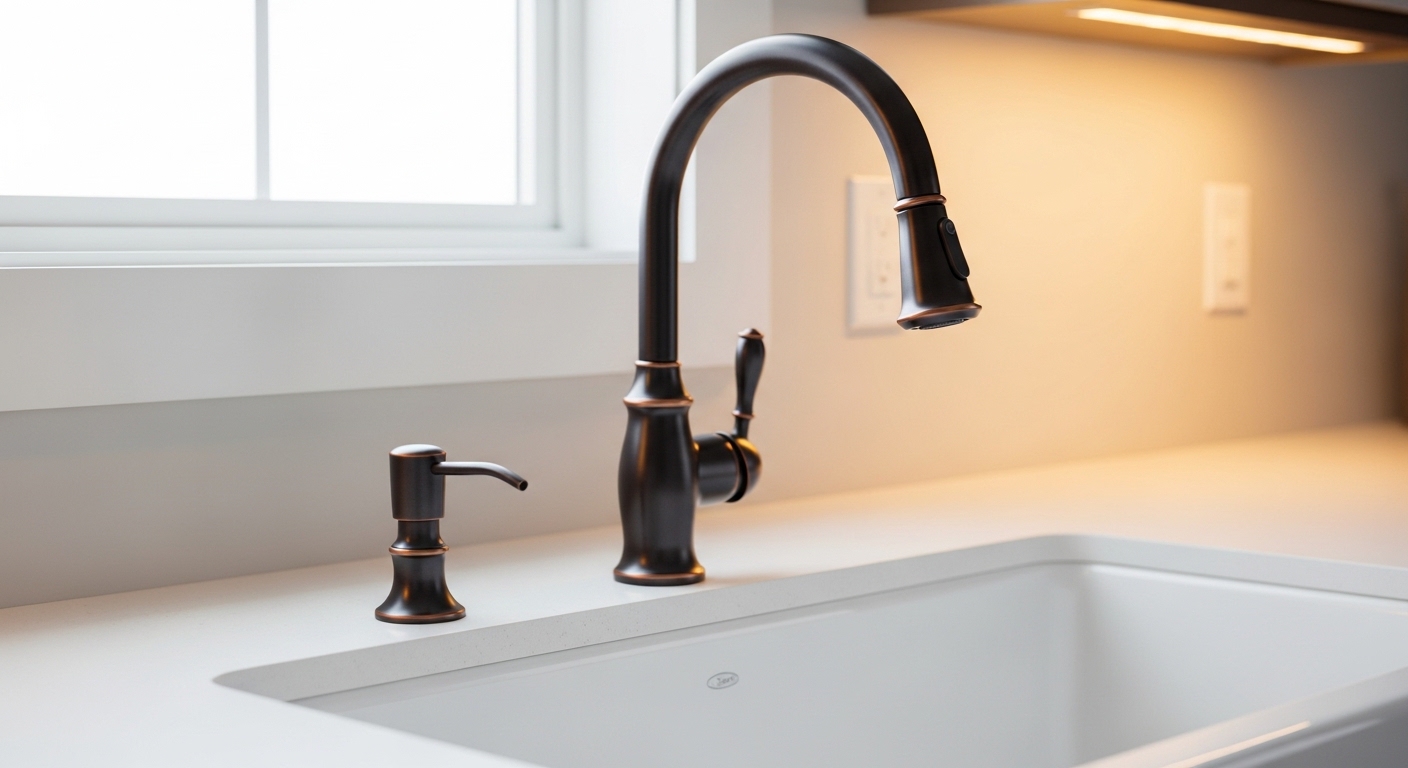
If you’re shopping for a kitchen faucet with soap dispenser oil rubbed bronze, you’re really asking two questions at once: “Will the finish actually look like warm, dark bronze in my kitchen?” and “Is the built-in soap pump worth it, or will it break in a year?” Both are fair concerns, and both have concrete answers. Oil rubbed bronze (often shortened to ORB) is a dark brown-black finish with hand-rubbed copper highlights on the raised edges — it hides water spots and fingerprints better than almost any other finish, which is exactly why it pairs so well with a busy kitchen sink. Add a matching soap dispenser and you free up counter space and lose the ugly plastic pump bottle. Below is everything that actually matters before you spend the money.
What exactly is a kitchen faucet with soap dispenser in oil rubbed bronze — and why buy the set together?
A kitchen faucet with a soap dispenser is a faucet sold (or paired) with a countertop-mounted pump that draws liquid soap from a refillable bottle mounted under the sink, so you’re not squeezing a plastic bottle by the tap. Buying the set in oil rubbed bronze matters because finish matching is the number-one thing people get wrong. “Oil rubbed bronze” is not a standardized color — one brand’s ORB leans almost black, another leans warm brown with heavy copper. If you buy the faucet from one maker and grab a random bronze dispenser off a marketplace, they’ll clash under kitchen light.
The practical fix: buy the faucet and dispenser from the same brand and the same product line, or buy a faucet that ships with its matching dispenser in the box. That guarantees the plating batch and the finish tone line up. A dispenser is a small part, but a mismatched one is the visual equivalent of wearing black shoes with a navy suit — technically fine, obviously off.
Is oil rubbed bronze a good finish for a kitchen faucet, or does it wear off?
Oil rubbed bronze is an excellent kitchen finish because it’s a “living finish” — it’s meant to age, and it hides hard-water spotting and fingerprints far better than chrome or polished nickel. The honest caveat: on cheaper faucets the dark color is a thin coating that can rub through to brass at the highest-contact points (the handle, the spray-head trigger) after a few years. On better faucets, the finish is a physical vapor deposition (PVD) coating that’s extremely scratch- and corrosion-resistant, or a genuine hand-applied bronze that patinas gracefully instead of flaking.
Here’s the plain-language rule: if the listing says PVD oil rubbed bronze, the color is locked in and will basically outlast the faucet. If it just says “oil rubbed bronze finish” with no coating callout and a very low price, treat it as a 3–5 year cosmetic that may show wear at the wand. Neither is wrong — you just want to know which one you’re buying. And if your ORB faucet ever does show spotting, our guide on how to remove hard water stains on a faucet without wrecking the finish walks through the safe, finish-friendly method (spoiler: no acidic descalers straight on ORB).
How much should a good oil rubbed bronze kitchen faucet with soap dispenser cost in 2026?
Expect to spend $130–$260 for a quality set, and be skeptical of anything under $80. That lower band almost always means a zinc-alloy body with a thin sprayed finish and a weak soap pump. Here’s roughly where your money goes by price tier:
| Price range | What you typically get | Best for |
|---|---|---|
| Under $80 | Zinc body, sprayed ORB coating, plastic pull-down wand, basic soap pump | Rentals, short-term, low-use sinks |
| $80–$130 | Partial brass body, better sprayed or entry PVD finish, decent spring spout | Budget-conscious homeowners |
| $130–$200 | Solid-brass body, PVD oil rubbed bronze, magnetic dock, ceramic disc valve, matching all-metal dispenser | Most daily-use family kitchens |
| $200–$260+ | Premium brass, dual-function spray, commercial-style spring or high-arc gooseneck, lifetime warranty | Renovations, statement kitchens, heavy use |
The sweet spot for the vast majority of kitchens is the $130–$200 band. That’s where you stop paying for a coating that rubs off and start getting a solid-brass body, a ceramic disc cartridge (the part that actually determines whether it drips in year three), and a soap dispenser made of metal instead of hollow plastic. If you’re weighing bronze against other dark, spot-hiding finishes, our comparison of the matte black modern faucet covers the other end of the dark-finish spectrum — matte black reads more contemporary, ORB reads warmer and more traditional.
Which faucet style works best with a soap dispenser — pull-down, pull-out, or standard spout?
For a soap-dispenser setup, a single-handle high-arc pull-down faucet is the best all-around choice, because it clears counter space and the dispenser sits comfortably beside it without crowding. Here’s how the three main styles stack up when you’re adding a dispenser to the picture:
- Pull-down (spray wand pulls straight down into the sink): Best for deep single-bowl and farmhouse sinks. High arc gives you room to fill pots. Pairs cleanly with a dispenser on the opposite side of the deck.
- Pull-out (wand pulls horizontally toward you): Great for low-clearance spots like a window over the sink. Slightly shorter reach — check it against a deep or double-bowl sink. Our breakdown of the best pull-out kitchen faucet single-handle setup goes deeper on this.
- Standard non-spray spout: Cheapest, but you lose rinsing flexibility. Only makes sense if you already have a separate side sprayer.
One layout tip people miss: a standard sink has a limited number of pre-drilled holes (usually 1, 3, or 4). A single-handle faucet plus a soap dispenser needs two holes minimum. If your faucet also has a separate side-spray or you want an air-gap for a dishwasher, count your holes before you buy. If you’re short a hole, most single-handle faucets include a deck plate (escutcheon) that covers extra holes — but you can’t create a hole you don’t have without drilling the sink or countertop.
Will the soap dispenser fit my sink and last, or is it a gimmick?
A soap dispenser fits almost any sink with a spare mounting hole (or a knock-out in a granite/quartz counter), and a good one lasts for years — the failure point is almost always the pump head, not the bottle. Two specs decide whether it’s worth it. First, reach/tube length: the pump’s supply tube must reach down to a bottle you can actually refill from above the counter, or you’ll be crawling under the sink to top it off. Look for “top-fill” or “refill from the top” dispensers — you just pour soap down the spout. Second, pump material: an all-metal pump head with a stainless spring outlasts a plastic one by years.
If a dispenser does clog (usually from thick soap or dried residue), it’s a five-minute fix: unscrew the pump, run warm water through it, and thin your soap with a little water. It’s genuinely one of the most repairable parts in a kitchen — a world apart from diagnosing a mystery drip, which we cover in what a leaking faucet actually means.
What specs actually matter before you check out?
Ignore marketing adjectives and check these five specs, in order — they’re what separate a faucet that lasts a decade from one that drips in two years:
- Body material: Solid brass beats zinc alloy for corrosion resistance and finish adhesion. “Lead-free brass” is what you want under a US drinking-water tap.
- Valve/cartridge: A ceramic disc cartridge is the standard for drip-free longevity. This is the single biggest predictor of whether you’ll be fixing a leak in a few years.
- Finish type: PVD oil rubbed bronze for durability; sprayed ORB for budget builds.
- Flow rate: US kitchen faucets are capped at 1.8 GPM federally, and 1.5 GPM in some states. Lower flow saves water but check it feels strong enough for filling pots — see what counts as a low-flow kitchen faucet.
- Certifications: Look for cUPC/UPC listing and NSF/ANSI 61 and 372 (lead-free) compliance. These aren’t optional fluff — they’re the standards that say the faucet is safe for potable water.
Is oil rubbed bronze hard to keep clean in a busy kitchen?
No — ORB is one of the easiest finishes to keep looking good, which is a big reason it’s popular at the kitchen sink. Because the finish is dark with copper highlights, water spots and fingerprints basically disappear against it, unlike chrome where every splash shows. Day-to-day care is just a soft damp cloth and a wipe-dry. The one hard rule: never use acidic or abrasive cleaners — no vinegar-soaked rags left sitting, no scouring powders, no bleach — because they can strip the highlights and dull the finish. Mild dish soap and water is all it needs. If mineral buildup ever appears around the aerator, unscrew and soak just the aerator (not the whole faucet) in a mild descaler; our guide to faucet aerator removal when it’s stuck shows how to get it off without scratching the bronze.
How do you install a kitchen faucet with a soap dispenser yourself?
Most homeowners can install one in about 45–90 minutes with basic tools — the soap dispenser adds only a few minutes to a standard faucet swap. Here’s the short version:
- Turn off the hot and cold shut-off valves under the sink and open the old faucet to release pressure.
- Disconnect the supply lines and remove the old faucet’s mounting nuts from below.
- Drop the new faucet through the deck hole; secure it from underneath with the mounting hardware.
- Connect the braided supply lines (hand-tight plus a quarter turn with a wrench — don’t over-torque).
- Insert the soap dispenser pump into its own hole, attach the supply tube, and screw the bottle onto the tube from below (or choose a top-fill model and skip the crawling).
- Turn the water back on, remove the aerator, and run water for 15 seconds to flush debris before testing for leaks.
Two rookie mistakes to avoid: over-tightening supply connections (it cracks fittings and doesn’t stop leaks), and forgetting to flush the line before reinstalling the aerator (construction debris will clog it immediately). If you hit a stuck old part on the way out, that’s a different job — worth doing carefully rather than forcing.
Author note, brand credibility, and warranty
This guide was written by the Arcora product team — we design and sell faucets and bathroom fixtures full-time, and we pressure-test our own oil rubbed bronze finishes for salt-spray corrosion resistance and cycle-test cartridges to hundreds of thousands of open/close cycles before a model ships. Arcora faucets are built with solid-brass bodies, ceramic disc cartridges, and cUPC-listed, lead-free (NSF/ANSI 372) construction so they’re safe for drinking water straight from the tap. Our oil rubbed bronze kitchen faucets are backed by a limited lifetime warranty on the finish and function against manufacturing defects — the kind of coverage that only makes sense when you actually trust the parts. As always, register your product and keep your receipt so a warranty claim is a five-minute email, not a fight.
FAQ
Does the soap dispenser use special soap, or any dish soap?
Any liquid dish soap or hand soap works. If a thick, gel-style soap pumps slowly or clogs, just thin it with about 10–20% water. Avoid soaps with grit or heavy exfoliant particles, which can jam the pump over time.
Will an oil rubbed bronze faucet match my stainless steel sink and appliances?
Yes, and it’s a popular pairing. The warm dark bronze contrasts nicely against cool stainless without clashing. If you want a more monochrome look, ORB also pairs beautifully with white farmhouse sinks, black granite, and butcher-block counters.
Can I add a soap dispenser to a faucet I already own?
Usually yes — as long as your sink or countertop has a spare hole (or a knock-out plug in a stainless sink). Just buy a standalone dispenser in the same oil rubbed bronze tone as your faucet, ideally from the same brand so the finish matches. No plumbing connection is needed; the dispenser only draws from its own soap bottle.
What’s the difference between oil rubbed bronze and matte black?
Oil rubbed bronze is a warm, dark brown-black with copper highlights on raised edges, giving a traditional, aged look. Matte black is a flat, uniform charcoal with no highlights and reads modern. Both hide spots well; choose ORB for warm/traditional kitchens and matte black for contemporary ones.
How long does an oil rubbed bronze kitchen faucet last?
A solid-brass ORB faucet with a PVD finish and a ceramic disc cartridge routinely lasts 10–15 years or more with basic care. Budget zinc-body faucets with sprayed finishes tend to show finish wear at the handle and wand in 3–5 years. The finish type and cartridge quality matter far more than the color itself.
Do I need a plumber to install one?
Most people don’t — a standard faucet-and-dispenser install takes under 90 minutes with an adjustable wrench, a basin wrench, and plumber’s tape. Call a pro only if your shut-off valves are seized, your supply lines are corroded, or you need to drill a new hole in a granite or quartz countertop.