 ARCORA FAUCETS
Here is the complete, publish-ready HTML article:
“`
“`
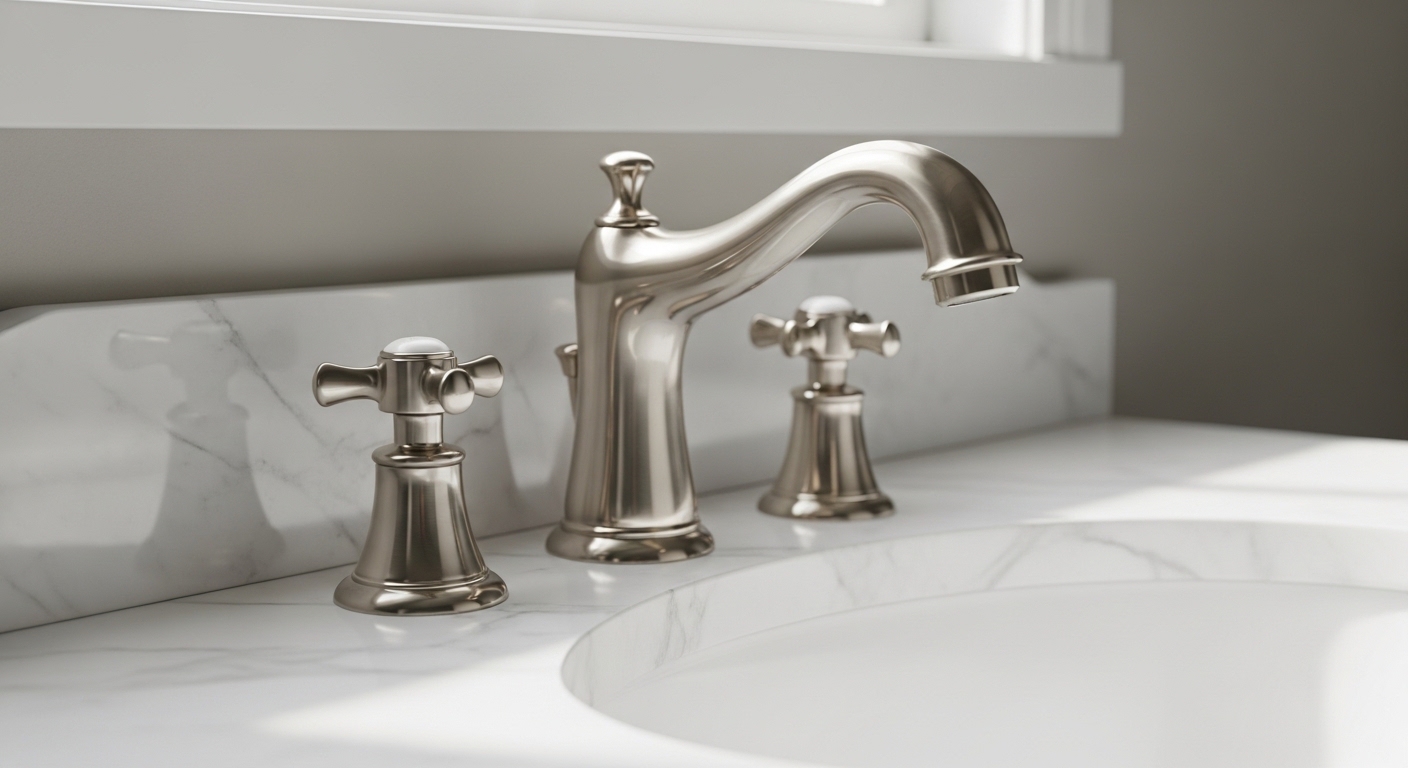
A quality polished nickel bathroom faucet under $150 is absolutely realistic in 2026 — you do not need to spend $300+ to get a genuinely good one. The trick is knowing which specs actually matter (solid brass body, ceramic-disc valve, real PVD or electroplated nickel finish) and which are just marketing. Polished nickel gives you that soft, warm, mirror-like glow — think of it as chrome’s more elegant cousin, a touch warmer and less blue — and at this price point the difference between a faucet you’ll love for 15 years and one you’ll replace in two comes down to a handful of details. Below, we’ll walk through exactly what to look for, what a fair price gets you, and how to match the faucet to your sink so you order the right one the first time.
What exactly is polished nickel, and how is it different from chrome or brushed nickel?
Polished nickel is a bright, mirror-shine finish with a warm, slightly golden-silver tone — chrome is cooler and bluer, brushed nickel is the same warm tone but matte instead of shiny. That’s the whole difference in one sentence, but it matters a lot in a real bathroom.
Chrome reflects like a mirror but has a cool, almost blue cast — it reads modern and a little clinical. Polished nickel reflects just as brightly but the tone is warmer, so it pairs beautifully with marble, cream, warm-white, brass hardware, and traditional or transitional bathrooms. Brushed nickel (sometimes called satin nickel) is that same warm color with a brushed, low-sheen surface that hides water spots and fingerprints. If you love a bright, glamorous, “wet” look and don’t mind wiping the faucet down now and then, polished nickel is the winner. If you have hard water or kids and want low maintenance, you might lean brushed instead — we cover the trade-off below.
One practical note: polished nickel does show water spots and fingerprints more than brushed finishes, simply because it’s shiny. It’s not a defect — every mirror-shine finish does this. A quick daily wipe with a soft cloth keeps it flawless, and if you already battle hard water, our guide on how to remove hard water stains on a faucet without wrecking the finish walks through the safe way to do it.
Can you really get a good polished nickel bathroom faucet under $150?
Yes — and comfortably. In 2026, a well-made polished nickel bathroom faucet with a solid-brass body, ceramic-disc cartridge, and a lifetime finish-and-function warranty typically lands between $90 and $140. Spending more than that on a standard bathroom faucet usually buys you a brand name or a designer profile, not better core engineering.
Here’s where your money actually goes at this price. The single biggest quality driver is the valve cartridge: a ceramic-disc cartridge is what lets a faucet turn on and off tens of thousands of times without dripping. Cheap faucets under about $40 often use rubber-washer or low-grade plastic valves that start dripping within a year. The second driver is the body material — solid brass resists corrosion and holds a plated finish far better than zinc alloy (pot metal). The third is the finish process itself: quality nickel is either electroplated or applied via PVD (physical vapor deposition), both of which bond far more durably than a sprayed-on coating.
So the sweet spot is clear: skip the $30 bargain faucets, which almost always cut corners on the valve and the body, and skip the $250+ tier unless you specifically want a designer’s name. The $90–$140 band is where you get real brass, a real ceramic cartridge, and a real lifetime warranty — everything that makes a faucet last.
What does the price difference between $50 and $150 actually buy?
Between a $50 faucet and a $130 faucet, the money buys durability, not looks — from the outside they can look nearly identical, but inside they’re different machines. Here’s the honest breakdown:
- Valve: $50 faucets often use a basic cartridge rated for far fewer cycles; $130 faucets use a ceramic-disc cartridge rated for 500,000+ open/close cycles.
- Body: Budget models frequently use zinc alloy that can corrode from the inside; better faucets use lead-free solid brass.
- Finish adhesion: Cheaper nickel can cloud, pit, or flake within a couple of years; PVD or quality electroplating stays mirror-bright for the life of the faucet.
- Warranty: Bargain faucets offer 1–5 years; quality ones offer a lifetime limited warranty on both finish and function.
- Included hardware: Better faucets include a matching metal pop-up drain and braided stainless supply lines instead of thin plastic parts.
How do I know which polished nickel faucet fits my bathroom sink?
Match the faucet to your sink’s hole configuration first — that single detail decides which faucets will even fit, before finish or price ever matters. Bathroom sinks come drilled for one of three layouts, and buying the wrong one means the faucet physically won’t mount.
Count the holes in your sink or countertop and measure the distance between the outer holes, center to center:
- Single-hole: One hole, one faucet body with the handle(s) built onto it. Cleanest, most modern look; easiest install.
- Centerset (4-inch): Three holes, but the two handles and the spout sit on one connected base, with outer holes 4 inches apart. Most common in American bathrooms with a standard vanity.
- Widespread (8-inch): Three separate pieces — spout in the middle, two handles up to 6–16 inches apart (commonly 8 inches). The most upscale, traditional look.
If you’re not sure how many holes you have or what size they are, our explainer on the hole size needed for a faucet shows exactly how to measure before you buy. And if you currently have a cramped 4-inch centerset but love the spread-out widespread look, it is a doable upgrade — here’s how to replace a centerset faucet with a widespread faucet and whether it’s worth it. For most standard vanities with a 4-inch spread, a 4-inch centerset setup is the plug-and-play choice — the same sizing logic applies whether you choose polished or brushed nickel.
Which faucet type is best for a small bathroom vanity?
For a small vanity, a single-hole or 4-inch centerset polished nickel faucet is the best choice — both take up minimal deck space and install in under an hour. Widespread faucets look gorgeous but need more room between the handles and can crowd a compact sink. If your vanity is under about 20 inches wide, go single-hole for the cleanest look, or centerset if your sink is already drilled for three holes.
What specs should I check before I buy a polished nickel bathroom faucet?
Before you add one to your cart, verify five things: hole configuration, body material, cartridge type, flow rate, and warranty. Get those right and the faucet will look and work great for well over a decade. Here’s a quick comparison of the finish and faucet-type options in the under-$150 range so you can see the trade-offs at a glance.
| Option | Look | Maintenance | Best for | Typical price under $150 |
|---|---|---|---|---|
| Polished nickel, single-hole | Warm mirror shine, minimalist | Wipe spots occasionally | Small/modern vanities | $90–$120 |
| Polished nickel, 4-inch centerset | Warm mirror shine, classic | Wipe spots occasionally | Standard American vanities | $95–$130 |
| Polished nickel, 8-inch widespread | Warm mirror shine, upscale/traditional | Wipe spots occasionally | Larger or luxury bathrooms | $120–$150 |
| Brushed nickel (same body) | Warm satin, low sheen | Hides spots and fingerprints | Hard water, high-traffic baths | $85–$140 |
| Polished chrome (same body) | Cool bright mirror | Wipe spots occasionally | Cool-toned modern baths | $80–$130 |
A few of those specs deserve a plain-language explanation:
- Body material — solid brass: Look for “lead-free solid brass.” It resists corrosion and holds the nickel finish far longer than zinc alloy.
- Cartridge — ceramic disc: This is the drip-proofing heart of the faucet. Ceramic discs seal metal-to-metal and shrug off hard-water grit that destroys rubber washers.
- Flow rate — WaterSense: A WaterSense-labeled bathroom faucet flows at 1.2 GPM or less (versus the federal max of 2.2 GPM), saving water without feeling weak. Many states now require it.
- Drain and supply lines: Confirm a matching polished nickel pop-up drain and braided stainless supply hoses are included so the whole assembly matches and installs cleanly.
- Warranty: A lifetime limited warranty on finish and function is the industry standard for quality — anything shorter is a red flag at this price.
Is polished nickel hard to keep clean, especially with hard water?
Polished nickel isn’t hard to keep clean, but because it’s a mirror finish it shows water spots and fingerprints more than a brushed finish — a quick daily wipe with a soft, dry microfiber cloth keeps it flawless. The finish itself is durable; the only real enemy is mineral buildup from hard water left to dry on the surface.
The key rule: never use abrasive scrubbers, ammonia, bleach, or acidic descalers directly on the finish. Those can dull or etch the nickel over time. To remove hard-water spots safely, use a 50/50 mix of white vinegar and water on a soft cloth (not a spray left to sit), wipe, then rinse and dry. For stubborn buildup around the aerator, unscrew the aerator and soak just that part. If your water is genuinely hard, brushed nickel is more forgiving day to day — but plenty of people happily live with polished nickel and a 10-second daily wipe because the look is worth it. Our step-by-step guide on removing hard water stains without wrecking the finish covers the exact do’s and don’ts.
Will a polished nickel faucet tarnish or turn yellow over time?
A quality electroplated or PVD polished nickel faucet will not tarnish or yellow — the finish is sealed and inert. What can happen with cheap faucets is that a thin, poorly bonded coating clouds, pits, or flakes, exposing the metal underneath. That’s a finish-quality problem, not a nickel problem, and it’s exactly why the body material and finish process matter more than the sticker. Buy solid brass with PVD or proper electroplating and a lifetime finish warranty, and you’ll never see yellowing.
How do I install a polished nickel bathroom faucet myself?
Most single-hole and centerset polished nickel faucets install in 45–90 minutes with basic tools — a basin wrench, an adjustable wrench, plumber’s tape, and a bucket. You do not need a plumber for a straightforward swap. Here’s the short version:
- Turn off both shut-off valves under the sink and open the old faucet to release pressure.
- Disconnect the supply lines and remove the old faucet’s mounting nuts (a basin wrench makes this far easier).
- Clean the deck, then set the new faucet through the hole(s) with its gasket or plumber’s putty as directed.
- Tighten the mounting nuts from below, wrap the threads with plumber’s tape, and connect the braided supply lines — hand-tight plus a quarter turn.
- Install the pop-up drain, turn the water back on slowly, and check every connection for leaks.
Take your time on the drain assembly — that’s where most first-time leaks happen. If you’re swapping a tub or a different fixture, the general leak-checking approach is the same, and our walkthrough on how to change a bathroom faucet yourself without a plumber reinforces the same careful, connection-by-connection method.
Polished nickel vs. brushed nickel: which should you actually pick?
Choose polished nickel if you want a bright, glamorous, mirror shine and don’t mind an occasional wipe; choose brushed nickel if you have hard water, kids, or a high-traffic bathroom and want a finish that hides spots and fingerprints. Both are the same warm silver tone and both are equally durable when made from solid brass — the choice is purely about sheen and maintenance, not quality.
Design-wise, polished nickel leans traditional, transitional, and luxury; it sings next to marble, glass, and warm-toned tile. Brushed nickel is the safe, low-maintenance all-rounder that fits almost any style. If your heart is set on the shine, get the polished — you can always keep a microfiber cloth in the vanity drawer. If you want to set it and forget it, brushed is the pragmatic pick, and it comes in the same 4-inch centerset configurations for standard vanities.
A quick note on quality, testing, and who’s behind this guide
About the brand: Arcora designs and manufactures faucets and bathroom fixtures with a focus on solid-brass bodies, ceramic-disc cartridges, and durable PVD and electroplated finishes. Arcora faucets are built to meet cUPC and NSF/ANSI standards for lead-free drinking-water safety and are pressure-tested before they ship. In 2026, Arcora bathroom products were recognized in the BIG SEE Product Design Awards, reflecting the brand’s design and build quality.
Author note: This guide was written by Arcora’s fixtures content team, drawing on hands-on testing of centerset, single-hole, and widespread faucets across finishes, plus feedback from installers and customers on real-world durability and hard-water performance. Our standing recommendation for any bathroom faucet under $150 is simple: insist on solid brass, a ceramic-disc cartridge, WaterSense flow, and a lifetime limited warranty — those four specs separate a faucet you’ll love for 15 years from one you’ll replace in two.
FAQ
Is a polished nickel bathroom faucet under $150 worth it, or should I spend more?
It’s worth it — $90–$140 buys a solid-brass faucet with a ceramic-disc cartridge and a lifetime warranty, which is everything that matters for longevity. Spending more mostly buys a brand name or designer styling, not better core engineering. The main thing to avoid is going too cheap (under ~$40), where zinc bodies and low-grade valves start dripping quickly.
Does polished nickel show water spots and fingerprints?
Yes, more than brushed nickel does, because it’s a mirror finish — but a quick daily wipe with a dry microfiber cloth keeps it flawless. If you have very hard water or a busy household and don’t want to wipe it, brushed nickel is the more forgiving choice in the same warm tone.
What’s the difference between polished nickel and chrome?
Both are bright mirror finishes, but polished nickel is warmer with a slightly golden-silver tone, while chrome is cooler and bluer. Polished nickel pairs better with marble, brass, and traditional or transitional bathrooms; chrome suits cool, modern, minimalist spaces. They cost about the same and are equally durable when built on solid brass.
How do I know if my sink fits a single-hole, centerset, or widespread faucet?
Count the holes and measure between the outer two, center to center. One hole means single-hole; three holes 4 inches apart means centerset; three holes about 8 inches apart means widespread. Buying the layout that matches your sink is the single most important step to make sure the faucet physically fits.
Will a cheap polished nickel faucet tarnish or turn yellow?
A quality electroplated or PVD finish on solid brass won’t tarnish or yellow. The clouding and flaking people worry about comes from thin coatings on zinc-alloy bodies in bargain faucets. Choose solid brass with a lifetime finish warranty and the finish will stay mirror-bright indefinitely.
Can I install a polished nickel bathroom faucet myself?
Yes. Most single-hole and centerset models install in 45–90 minutes with a basin wrench, an adjustable wrench, and plumber’s tape — no plumber required. Take extra care sealing the pop-up drain, since that’s where most first-time leaks appear, and check every connection as you turn the water back on.
“`