 ARCORA FAUCETS
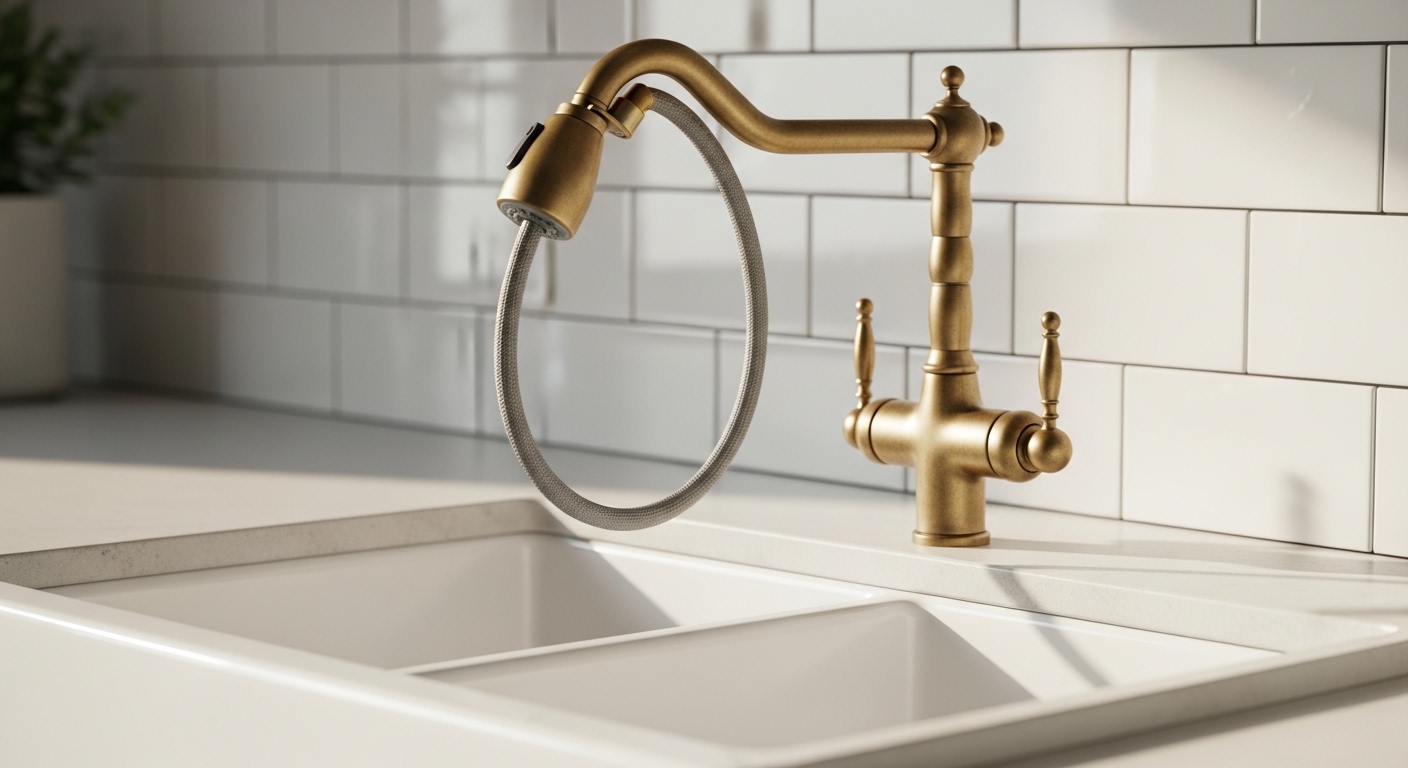
A pull out kitchen tap in aged brass gives you the reach-and-retract convenience of a pull-out sprayer wrapped in a warm, antique-gold finish that suits farmhouse, transitional, and modern-vintage kitchens. Unlike bright chrome, aged brass (sometimes labeled antique brass, brushed brass, or “aged” living brass) has a muted, slightly weathered tone that disguises water spots, toothpaste-white limescale flecks, and greasy fingerprints — which is exactly why busy home cooks keep gravitating to it. But not every tap wearing the “aged brass” label is built the same, and the finish story matters more here than with any other color. Let’s break down what you’re actually buying, what to check before you spend, and who should skip it.
What exactly is a pull out kitchen tap in aged brass — and how is it different from a pull-down?
A pull out kitchen tap has a spray head that pulls straight out toward you on a hose, usually on a lower, more horizontal spout, while a pull-down has a taller gooseneck spout and a wand that pulls down into the sink. “Aged brass” refers to the finish — a warm, slightly darkened gold meant to look like brass that’s mellowed over years, rather than shiny polished brass.
The practical difference between pull-out and pull-down matters day to day. Pull-out taps sit lower and pull the wand toward your body, which makes them great for filling tall pots on the counter beside the sink and for kitchens with a window or shelf directly behind the tap that blocks a tall spout. Pull-down taps give you a more dramatic high-arc silhouette and drop the wand into the basin, which many people find more ergonomic for rinsing dishes but needs more headroom.
- Choose pull-out if you have a low window sill or upper cabinet close behind the sink, or you frequently fill vessels on the countertop.
- Choose pull-down if you have open headroom, a deep single-bowl sink, and want maximum arc height for washing large cookware.
If you’re still deciding between spray styles and single- vs. dual-handle layouts, our guide to the best pull out kitchen faucet single handle setup walks through ergonomics for a busy household in more detail.
Does aged brass tarnish or change color over time?
It depends entirely on the finish type. A sealed PVD (physical vapor deposition) aged brass finish is color-stable and will not tarnish, spot, or change tone for the life of the tap. A “living finish” or unlacquered/raw brass will keep aging — darkening and developing patina where hands and water touch it — which some buyers love and others hate.
This is the single most important thing to understand before you buy, because “aged brass” is a look that can be achieved two very different ways:
| Finish type | What it does over time | Maintenance | Best for |
|---|---|---|---|
| PVD aged brass (sealed) | Stays exactly the same color for 10+ years; extremely scratch- and corrosion-resistant | Wipe with a damp cloth; no special care | Most people who want the look without surprises |
| Living / unlacquered brass | Continues to darken and patina unevenly where touched and splashed | Leave it (embrace patina) or polish periodically to keep it bright | Character-seekers, restoration and heritage kitchens |
| Lacquered antique brass | Color-stable while the clear coat holds; can chip or wear at high-touch spots over years | Avoid abrasives that break the lacquer | Budget picks; lighter-use kitchens |
For a low-stress kitchen tap, most homeowners should choose PVD aged brass. It gives you the warm, weathered tone locked in place, so the tap looks identical on year one and year ten. Only choose a living finish if you specifically want the evolving, one-of-a-kind patina and you’re comfortable that it will never look “new” again.
Is aged brass easier to keep clean than chrome or matte black?
Yes — aged brass is one of the most forgiving kitchen finishes for daily cleaning. Its warm, muted, non-mirror surface hides water spots and fingerprints that show up glaringly on polished chrome, and it doesn’t show dried limescale as starkly as matte black does.
Here’s why that matters at a sink you use 20 times a day. Polished chrome acts like a mirror, so every droplet that dries leaves a visible white spot. Matte black looks fantastic when clean, but hard-water minerals dry to a chalky white that contrasts sharply against the dark surface — you see every splash. Aged brass sits in the sweet spot: its gold undertone and low-luster finish blend with light mineral haze and skin oils, so it reads as “clean” longer between wipe-downs.
That said, no finish is immune to hard water. If you’re on well water or in a hard-water region, you’ll still get eventual buildup around the aerator and spray face. When that happens, resist steel wool and harsh acidic descalers on the finish itself — they can dull PVD and strip lacquer. Our step-by-step guide on how to remove hard water stains on a faucet without wrecking the finish covers the safe method (warm white vinegar on a cloth for the aerator, gentle wiping only for brass finishes). If you’re weighing finishes broadly, comparing aged brass against a matte black modern faucet is a useful exercise — they’re the two most popular alternatives to chrome right now, and they clean very differently.
What should I look for so my aged brass pull-out tap actually lasts?
Buy a tap with a solid brass body, a ceramic disc cartridge, a braided stainless steel pull-out hose, and a genuine PVD or well-applied finish. Those four things separate a 10-year tap from one that leaks or peels in two.
Finish color gets all the attention, but the internals decide whether you’re happy in year three. Here’s the checklist that matters:
- Solid brass body — the actual metal underneath. Zinc-alloy (sometimes called “zamak”) bodies are cheaper and more prone to corrosion at threaded connections. Brass resists corrosion and holds a finish better.
- Ceramic disc cartridge — this is the valve that controls flow and temperature. Ceramic discs are the industry standard for smooth, drip-free operation over hundreds of thousands of cycles. Look for a cartridge you can actually replace.
- Braided stainless pull-out hose — the hose takes the most abuse (it retracts thousands of times). A nylon-braided or stainless-braided hose with a quality quick-connect and a smooth-retract weight lasts far longer than bare PVC tubing.
- Docking magnet or spring dock — a magnetic dock snaps the spray head back into place cleanly. Weak docks let the wand sag over time, which looks sloppy and stresses the hose.
- Spray/stream toggle — check that switching modes is a button you can hit one-handed with a greasy thumb, and that it returns to aerated stream by default (not stuck on spray).
One more spec that quietly affects daily use: spout reach and flow. A pull-out spout with generous reach covers both bowls of a double sink; a stubby one forces you to drag dishes under it. If you’ve got a deep or double-bowl basin, read our breakdown of the long spout reach kitchen faucet so you match the spout to your sink. And if water efficiency matters to you, note the flow rate — most modern kitchen taps ship at 1.8 GPM, but you can go lower; here’s what counts as a low flow kitchen faucet and whether it’s right for you.
How much should a good aged brass pull-out tap cost in 2026?
Plan on $180–$450 for a quality aged brass pull-out kitchen tap with a solid brass body, ceramic cartridge, and PVD finish. Under about $120 you’re usually getting a zinc body with a lacquered or coated finish that can wear at the spray head; above $500 you’re mostly paying for designer branding.
Here’s a realistic breakdown of what each tier gets you:
| Price range | What you typically get | Watch out for |
|---|---|---|
| Under $120 | Zinc-alloy body, coated/lacquered “antique brass” look, basic hose | Finish wear at high-touch spots; harder-to-source cartridge |
| $180–$300 | Solid brass body, ceramic cartridge, PVD aged brass, magnetic dock — the value sweet spot | Confirm the finish is PVD, not just “brass-plated” |
| $300–$450 | Heavier brass, premium PVD, longer or transitional design options, strong warranty | Some cost is styling/brand, not durability |
| $500+ | Designer/heritage names, unlacquered living-brass options | Diminishing returns on function; you pay for the label |
Aged brass tends to run a bit pricier than the same tap in chrome because the warm finishes cost more to produce consistently — the same premium you’ll see on a polished nickel kitchen faucet with pull out spray or a warm-toned copper vanity tap. If you love the warm-metal trend, it’s worth budgeting the extra $40–$80 for a genuine PVD finish rather than a cheap coating that can rub through.
Can I install an aged brass pull-out tap myself?
Yes — most single-hole and 3-hole pull-out taps are a genuine DIY job in about 45–90 minutes with basic tools, as long as you can reach the shutoff valves under the sink. You’ll need a basin wrench, an adjustable wrench, plumber’s tape, and a bucket for drips.
The general sequence: turn off the hot and cold supply valves, open the tap to release pressure, disconnect the old supply lines, unfasten the mounting nut under the deck, lift out the old tap, drop in the new one through the mounting hole, secure the mounting hardware, connect the braided supply lines and the pull-out hose weight, then turn the water back on and check every joint for leaks. Aged brass units install exactly like any other finish — the color has no bearing on the plumbing.
Two aged-brass-specific tips: protect the finish while you work by wrapping the jaws of your wrench with a cloth or painter’s tape, and don’t over-tighten the decorative parts — snug is enough. If your sink has a different hole configuration than your new tap (say you’re going from a 3-hole to a single-hole design), you may need a deck plate/escutcheon, and most quality aged brass taps include a matching one in the box. If a tap change turns into a bigger swap, our walkthrough on how to change a faucet yourself without a plumber covers the same core skills that transfer to the kitchen.
Who should NOT buy an aged brass pull-out tap?
Skip aged brass if your kitchen hardware, appliances, and cabinet pulls are all cool-toned stainless or chrome and you don’t want to mix metals — the warm gold can clash and look accidental rather than intentional. Also skip a living/unlacquered finish if you’re a perfectionist who will be bothered by uneven, evolving patina.
Aged brass is a design commitment. It reads warm and vintage-leaning, so it shines in kitchens with wood tones, cream or sage cabinets, natural stone, and matte-black or brass accents elsewhere. In an all-stainless, ultra-modern kitchen it can look out of place unless you deliberately repeat the brass in a light fixture or drawer pull to make it read as an intentional accent. If you fall into the “clash” camp and still want a warm metal, polished or brushed nickel bridges cool and warm more easily and is a safer, more neutral choice.
FAQ
Is aged brass the same as brushed gold or champagne bronze?
Not exactly. They’re all warm-metal finishes, but aged brass is deliberately muted and slightly weathered to look antique, brushed gold is brighter and cleaner, and champagne bronze (a common brand-specific name) is a soft, pinkish-warm neutral. If you’re matching to existing hardware, order a sample or compare finishes in person, because photos and lighting distort warm tones badly.
Will an aged brass tap match my stainless steel sink?
It can, and the contrast often looks intentional and high-end — warm brass against cool stainless is a popular pairing. The trick is to repeat the brass somewhere else in the room (cabinet pulls, a pendant light, or a soap dispenser) so it reads as a chosen accent rather than a mismatch.
How do I clean an aged brass pull-out tap without ruining the finish?
Wipe it with a soft, damp cloth and a drop of mild dish soap, then dry it. Avoid steel wool, abrasive pads, and acidic descalers directly on the brass finish, because they can dull PVD coatings and strip lacquer. For stubborn limescale around the aerator only, soak that removable part in warm white vinegar rather than scrubbing the visible finish.
Do aged brass pull-out taps come with a warranty?
Quality ones do — typically a limited lifetime warranty on the finish and function, or at minimum 5–10 years. Always confirm the warranty specifically covers the finish, since warm finishes are where cheaper products fail first. Reputable brands test finishes against corrosion and abrasion standards (such as ASME A112.18.1 / CSA B125.1 for North American kitchen faucets) and back the cartridge separately.
Can I replace just the pull-out spray head or hose if it wears out?
Usually yes on quality taps — the spray wand and braided hose are serviceable parts that connect with a quick-connect fitting, and you can order a matching aged brass replacement head from the manufacturer. This is another reason to buy from an established brand: proprietary or unbranded taps often have no replacement parts, so a worn hose means replacing the whole unit.
The bottom line
A pull out kitchen tap in aged brass is a smart buy when you want warmth and low-maintenance good looks: it hides spots and prints better than chrome or matte black, it suits farmhouse and transitional kitchens beautifully, and a solid-brass, PVD, ceramic-cartridge unit at $180–$450 will serve you for a decade. The one decision you can’t skip is the finish type — go PVD for set-and-forget consistency, or living brass only if you truly want an evolving patina. Match your internals to your sink, repeat the brass somewhere in the room, and you’ll have a tap that looks intentional and works every day.
Author note: This guide was written by the Arcora Faucet product team, drawing on hands-on testing of pull-out kitchen taps across finishes, cartridges, and hose systems. Arcora designs and sells faucets and bathroom fixtures direct to homeowners at www.arcorafaucet.com, and our kitchen taps are built with solid-brass bodies, ceramic disc cartridges, and finishes tested against ASME/CSA durability standards and backed by warranty. Always verify your specific model’s specifications and warranty terms before purchase.