 ARCORA FAUCETS
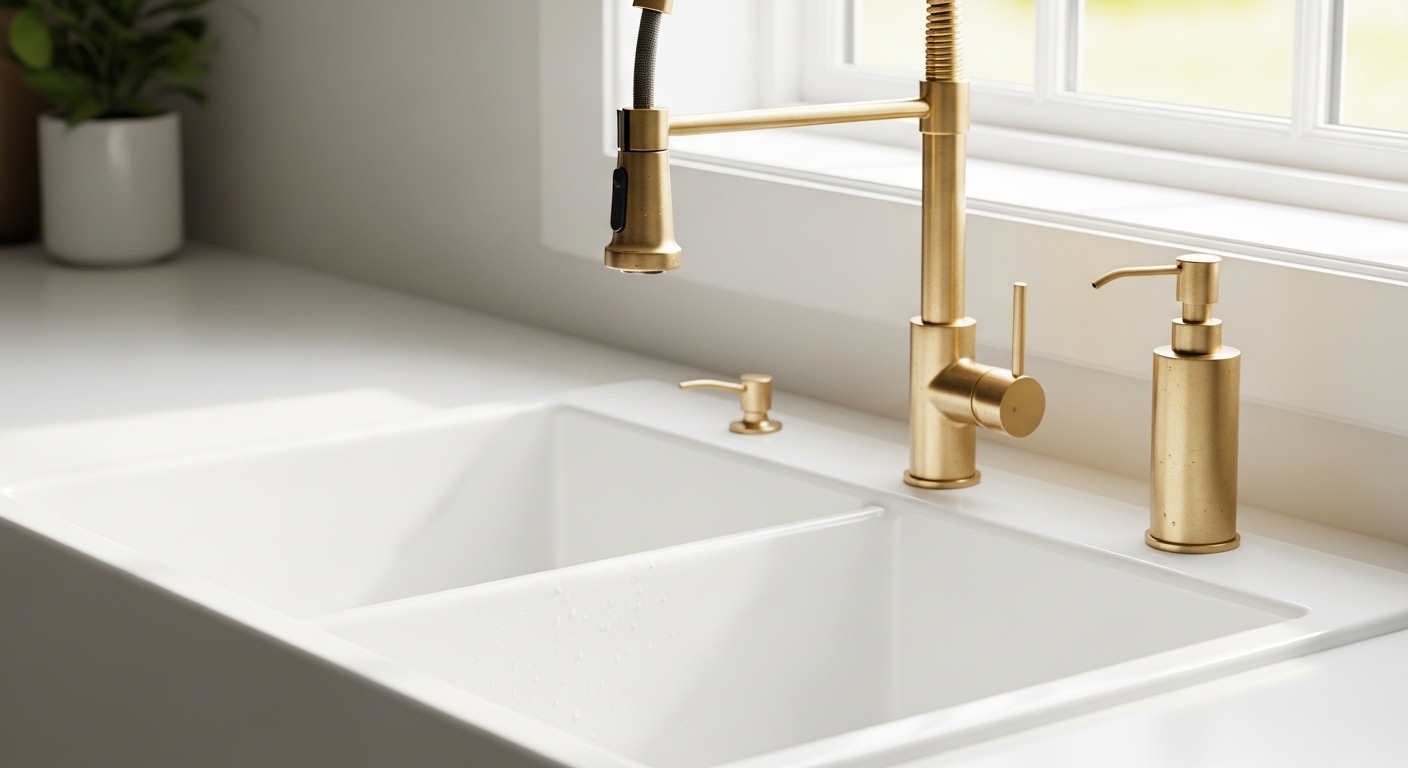
A brushed gold faucet with soap dispenser is a single-handle (usually pull-down) kitchen faucet in a warm, matte gold PVD finish that comes bundled with a matching pump-style dispenser you mount in one of your sink’s extra holes. Instead of a plastic dish-soap bottle cluttering the counter, you get a coordinated pump that draws from a reservoir under the sink. It’s the most-requested “matching set” upgrade we see, and for good reason: brushed gold is forgiving on fingerprints, the dispenser declutters the deck, and the two pieces read as one intentional design instead of a mismatched afterthought.
But “worth it” depends on your sink hole count, your water hardness, and whether the dispenser is genuinely refillable from the top. Below I’ll walk you through exactly what to check, what these cost, how brushed gold holds up in a real kitchen, and the mistakes that send people back to the store. Let’s get into it.
What exactly do you get in a “faucet with soap dispenser” set?
You get two coordinated pieces: the main kitchen faucet and a separate deck-mounted pump dispenser in the same brushed gold finish. They are not plumbed together — the dispenser is its own little unit. Understanding that split saves a lot of confusion.
Here’s what each part actually is:
- The faucet: Typically a single-handle pull-down or pull-out spout with a braided hose, a magnetic or weighted docking system, and one or two spray modes (aerated stream + spray). Brushed gold versions almost always use a PVD (physical vapor deposition) coating for durability, not paint or a thin plate.
- The soap dispenser: A pump head that threads into a sink hole, connected to a refillable bottle (the reservoir) that hangs below the deck. You pour soap into the bottle — ideally from the top, above the counter — and the pump pulls it up. Good ones hold 12–16 oz.
The dispenser is the piece people underestimate. A cheap one makes you crawl under the sink and unscrew a slippery bottle to refill it. A good one lets you top it off from above with a funnel, which is the single feature that decides whether you’ll actually use it a year from now.
How many holes does my sink need for a brushed gold faucet with soap dispenser?
You need at least two available holes: one for the faucet and one for the dispenser. Most modern pull-down faucets are single-hole, so if your sink or countertop has the common 3- or 4-hole drilling, you’ll have room for the dispenser and often a spot to spare for a sprayer, filtered-water tap, or air gap.
Count your holes before you buy. This is the number-one reason a set gets returned. Here’s how it usually shakes out:
| Sink hole setup | Faucet fits? | Dispenser fits? | What to do |
|---|---|---|---|
| 1 hole | Yes (single-hole faucet) | No spare hole | Buy a dispenser that mounts through the countertop, or drill a new hole (granite/quartz needs a pro) |
| 2 holes | Yes | Yes | Faucet in one, dispenser in the other — perfect |
| 3 holes | Yes (use deck plate/escutcheon to cover extras) | Yes | Faucet + dispenser + one spare for a filter tap or sprayer |
| 4 holes | Yes | Yes | Faucet, dispenser, side sprayer, and air gap all fit |
If you have a single-hole undermount sink and no countertop drilling, don’t panic — you can still add the dispenser, but it has to go through the stone or laminate, which means drilling. On laminate that’s a DIY job; on granite or quartz, hire someone with a diamond bit unless you enjoy expensive mistakes.
Does brushed gold actually hide water spots and fingerprints better?
Yes — a matte or brushed gold finish hides fingerprints, hard-water spotting, and toothpaste-style smudges far better than polished (shiny) gold or chrome. The micro-textured surface scatters light instead of reflecting it, so mineral residue and skin oils don’t stand out the way they do on a mirror finish. In a busy kitchen, that’s a real, daily quality-of-life difference.
That said, “hides spots” is not “immune to spots.” If you have hard water, you’ll still get faint mineral buildup around the aerator and the base over time — it’s just far less obvious. The fix is easy and gentle: wipe with a soft cloth, and for stubborn spots use a 50/50 white vinegar and water solution, then rinse and dry. Never use abrasive pads, scouring powder, or anything acidic-and-harsh on a PVD finish. If you’ve already got crusty buildup, our guide on how to remove hard water stains on a faucet without wrecking the finish walks through the safe method step by step.
One more thing about the finish itself: insist on PVD brushed gold, not electroplated or painted gold. PVD bonds the color at a molecular level and is rated to resist tarnishing, corrosion, and scratching for the life of the faucet. Painted “gold” chips at the spray head and around the handle within a year. If a product listing doesn’t say PVD, assume it isn’t.
How much should a good brushed gold faucet with soap dispenser cost in 2026?
Plan on $150–$350 for a quality set. Below about $120 you’re usually getting a painted or thinly plated finish and a hard-to-refill dispenser; above $400 you’re paying for a designer name more than better function. The sweet spot for a durable PVD finish, a solid brass or high-grade stainless body, and a top-fill dispenser sits right in that $150–$350 band.
Here’s roughly what your money buys:
| Price tier | Finish quality | Body & valve | Dispenser | Best for |
|---|---|---|---|---|
| Under $120 | Often painted/electroplated — can chip | Zinc or thin stainless | Bottom-refill, small reservoir | Rentals, short-term fixes |
| $150–$250 | PVD brushed gold, tarnish-resistant | Brass or 304 stainless, ceramic disc valve | Top-fill, 12–16 oz | Most homeowners — best value |
| $250–$350 | Premium PVD, consistent tone | Solid brass, smooth pull-down glide | Top-fill, large reservoir, metal pump | Renovations, forever kitchens |
| $400+ | Designer PVD | Solid brass | Top-fill | Brand-driven / luxury builds |
Watch for hidden factors that matter more than the sticker price: a ceramic disc valve (drip-free for years), a braided stainless supply/pull-down hose, and a lifetime or limited-lifetime warranty on both the finish and the valve. Those three tell you far more about longevity than the price alone.
Pull-down or pull-out — which brushed gold faucet is better for my sink?
Pick pull-down for deep single-bowl sinks and pull-out for shallow sinks or tight spaces under a window. A pull-down has a tall gooseneck spout and the sprayer pulls straight down into the basin — great for filling pots and rinsing large pans. A pull-out has a lower profile and the sprayer pulls toward you horizontally, which clears low windowsills and suits smaller kitchens.
For most kitchens, the tall pull-down brushed gold look is what people are after — it’s the silhouette that makes the finish pop. But if you have a shallow bowl, that same tall spout causes splash-back, so match spout height to bowl depth. If you’re weighing single-handle convenience specifically, our breakdown of the best pull-out kitchen faucet single-handle setup for a busy home covers the ergonomics in more detail. And for deep or double-bowl sinks where reach matters most, see our guide to choosing a long spout reach kitchen faucet so the stream actually lands in both basins.
What spray features actually matter?
- Dual spray modes: A steady aerated stream for filling and washing, plus a wide spray for rinsing. That’s all most people need.
- Magnetic docking: Keeps the spray head snapped firmly into the spout so it doesn’t droop over time. Weighted-only docking sags after a couple of years.
- Flow rate: Most U.S. kitchen faucets are capped at 1.8 GPM. If you want to save water, you can go lower — here’s what counts as a low flow kitchen faucet and whether it’s right for you.
Will the brushed gold match my other kitchen hardware?
Brushed gold pairs cleanly with white, cream, deep green, navy, and black cabinetry, and it coordinates beautifully with brushed gold or matte black cabinet pulls. The one thing to avoid is mixing warm brushed gold with cool-toned chrome or polished nickel in the same sight line — the undertones clash. If your existing hardware is warm (gold, brass, bronze), you’re set; if it’s cool (chrome, nickel), plan to swap the pieces nearest the sink.
Two practical matching tips from real installs:
- Match the dispenser to the faucet, not “close enough.” Buying a set guarantees the exact same tone. Buying a random gold dispenser separately almost always gives you a slightly different gold that looks like a mistake up close.
- Decide warm vs. cool for the whole zone. If you love the finish but aren’t sure about going all-warm, a modern neutral like a matte black modern faucet is the usual alternative people cross-shop — worth a look before you commit.
If you specifically want the “matching faucet + soap dispenser” combo but in a different finish, the layout and buying logic are identical — for example, our guide to a kitchen faucet with soap dispenser in oil-rubbed bronze covers the same decisions for a darker, warmer palette, and the polished nickel kitchen faucet with pull-out spray covers the cool-toned route.
How do you install the soap dispenser part yourself?
Installing the dispenser is a 15-minute job with no plumbing connections — you’re just mounting a pump in a hole and filling a bottle. Here’s the quick version.
- Drop the pump through the hole. Feed the pump shaft down through your spare sink or countertop hole from above.
- Secure it from below. Thread the mounting nut up onto the shaft under the deck and hand-tighten until snug — don’t overtighten and crack the finish.
- Attach the reservoir bottle. Screw the refill bottle onto the shaft underneath. This is your soap tank.
- Fill it. With a top-fill model, pour soap directly down the pump head using a small funnel. With a bottom-fill model, you’ll unscrew the bottle, fill it, and re-attach.
- Prime the pump. Press the head 10–15 times until soap comes out. Done.
If you’re replacing an old faucet at the same time, the faucet itself takes longer than the dispenser — budget 45–90 minutes and shut off the hot and cold supply valves first. If you hit a stuck old aerator or a corroded part during removal, we’ve got focused fixes for the annoying bits, like faucet aerator removal when it’s stuck.
What are the real downsides nobody mentions?
The honest cons are these: brushed gold shows less spotting but still needs occasional wiping; a bargain dispenser can clog with thick soap; and if you have zero spare sink holes, adding the dispenser means drilling. None of these are dealbreakers, but you should know them going in.
- Thick soap clogs cheap pumps. Heavy, gel-type hand soaps can gum up a low-quality pump. Use a standard-viscosity dish or hand soap, or dilute thick soap slightly with water.
- Finish consistency varies by brand. “Brushed gold,” “champagne gold,” and “brushed brass” can all look slightly different. Buy the faucet and dispenser together so the tone matches exactly.
- Drilling stone is not DIY-friendly. If your only option is drilling granite or quartz for the dispenser, hire a pro — a cracked countertop costs far more than the faucet.
Weighed against the daily convenience of a decluttered counter and a finish that stays looking clean, most homeowners find these are minor. Just go in with realistic expectations rather than assuming gold is maintenance-free.
FAQ
Will a brushed gold faucet finish tarnish or turn green over time?
A genuine PVD brushed gold finish will not tarnish, oxidize, or turn green — PVD is a bonded, corrosion-resistant coating rated to last the life of the faucet. Only cheap painted or electroplated “gold” degrades. Always confirm the listing says PVD before buying, and stick to gentle cleaning (soft cloth, mild soap, or diluted vinegar for spots).
Can I refill the soap dispenser from the top without going under the sink?
Only if you buy a top-fill dispenser. Top-fill models let you pour soap directly down the pump head from above the counter using a funnel — no crawling under the sink. Bottom-fill models require you to unscrew the reservoir bottle from below each time. This single feature is worth prioritizing; check the product description or spec sheet before you buy.
What kind of soap can I put in a built-in dispenser?
Use standard liquid dish soap or hand soap of normal viscosity. Very thick or gel-type soaps can clog the pump over time; if that’s all you have, dilute it slightly with water. Avoid abrasive or grit-containing hand cleaners, which wear out the pump seals faster.
Do I have to drill a new hole for the soap dispenser?
Not if your sink or countertop already has a spare hole — most 3- and 4-hole setups leave room for the dispenser. You only need to drill if you have a single-hole installation with no extra opening. Drilling laminate is DIY-friendly; drilling granite or quartz should be done by a professional with a diamond bit to avoid cracking the surface.
Is a matching set better than buying the faucet and dispenser separately?
For finish matching, yes — a coordinated set guarantees the faucet and dispenser share the exact same brushed gold tone. Buying separately risks a subtle mismatch since “brushed gold” varies between manufacturers. Buy separately only if you already own a faucet you love and just need to add a dispenser, in which case try to match the same brand.
How do I clean a brushed gold faucet without damaging it?
Wipe it with a soft, damp cloth and mild dish soap, then dry it to prevent water spots. For hard-water buildup, use a 50/50 white vinegar and water solution, let it sit briefly, then rinse and dry. Never use abrasive pads, scouring powders, bleach, or acidic bathroom cleaners on a PVD gold finish — they can dull the coating.
About the author: This guide was written by the Arcora Faucet product team, who spec, pressure-test, and install kitchen and bath fixtures year-round. We evaluate finishes for tarnish and scratch resistance, cycle-test ceramic disc valves, and install these faucets in real kitchens before recommending them — so the advice here reflects hands-on use, not just spec sheets.
Why trust Arcora: Arcora (www.arcorafaucet.com) designs faucets and bath fixtures built to meet U.S. plumbing standards (cUPC/ANSI-compliant, lead-free brass where required) with PVD finishes tested for durability and ceramic disc cartridges rated for hundreds of thousands of on/off cycles. Our brushed gold kitchen faucets are backed by a limited lifetime warranty covering both the finish and the valve, so a chipped coating or a drip years down the line is covered.